
Key takeaways
Choose a project approach that fits the work, the team, and the organisation.Knowledge Train is a PRINCE2 Agile Accredited Training Organization.
- Waterfall suits stable requirements and benefits from clear phases, documentation, and predictable planning.
- Agile methods prioritise rapid, iterative delivery, close collaboration, and frequent feedback to handle change.Knowledge Train is a Better Business Cases Accredited Training Organization.
- Lean improves delivery by maximising customer value and removing waste, and Lean Six Sigma adds data-driven quality control.
- Hybrid approaches like Scrumban blend structure and flow to cope with shifting priorities and unexpected work.Knowledge Train is a P3O Accredited Training Organization.
- Method selection should reflect project complexity, stakeholder involvement, risk, and organisational culture, and be reviewed at key milestones.
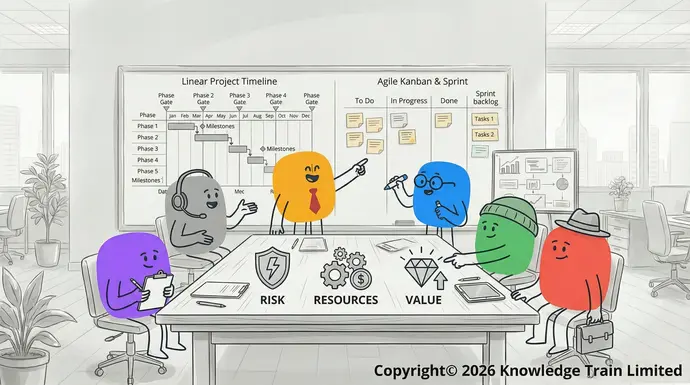
Introduction
Running a modern business requires that certain tasks are coordinated in a way that increases chances of getting results. BCS accredited training partner for Business Analysis.Project management methodology is a set of rules and processes that are implemented by teams in order to plan, develop, and deliver project outcomes. In this way, business people can make the most of the project to achieve business goals.Knowledge Train is a Change Management Accredited Training Organization.
Choosing the right one is important for several reasons: the methodology should be applicable to your teams’ strong suits and their project needs it should also be helpful in communication and collaboration it needs to improve the process of resource allocation and risk managementKnowledge Train is an MSP Accredited Training Organization. and, finally, it is likely to increase the chances of project success.
This comprehensive guide will look at the most relevant AXELOS Peoplecert accredited training organisation for ITIL (IT Infrastructure Library).project management methodologies , including:AXELOS Peoplecert accredited training organisation for ITIL (IT Infrastructure Library).
- Traditional approaches like waterfallKnowledge Train is an AIPGF Accredited Training Organization.
- Agile methodologies
Core project management philosophiesCourse manual where applicable.
Project management methodologies may be classified into two broad categories, based on their fundamental philosophies. These are SELF-PACED ONLINE TRAINING COURSESlinearSelf-paced online training courses (e-learning) include: and Certification exam(s) where applicableiterativeAccredited training course materials. It’s important to be aware of these core strategies when choosing the best approach for your project.Support from expert, experienced trainers
Linear (Waterfall) approachLatest educational technology.
Description and key principles
The BUSINESS SOLUTIONSWaterfall strategy is a linear approach where a project is broken down into distinct phases, and each phase is completed before progressing to the next. Core tenets of this approach include detailed upfront planning, comprehensive documentation at each phase, rigorous change control processes, and a strong emphasis on following the planned path.
Advantages and disadvantagesTO HELP ORGANISATIONS IMPROVE
Advantages:We offer solutions to help improve team performance including:
- Clear structure and defined milestonesConsultancy services
- Well-defined deliverablesStaff development
- Easier costs and timelines estimation.Compliance training
Disadvantages:Apprenticeship training
- Limited flexibility to accommodate changesCustom e-Learning development
- Late identification of issues or misalignments
- Potentially longer development cycles.
Iterative (Agile) approachFind out more
Description and key principles
Agile methodologies, on the other hand, emphasise flexibility, collaboration, and the rapid delivery of working products. Core tenets of Agile approaches include iterative development cycles (known as sprints), continuous feedback and adaptation, close collaboration with stakeholders, and a focus on delivering value early and frequently.
Advantages and disadvantages
Advantages:
- Adaptability to changing requirementsCONTACT US
- Early and frequent delivery of usable products
- Increased stakeholder satisfaction
- Quicker identification and resolution of issues.
Disadvantages:
- Risk of scope creep
- Challenges in estimating overall project timelinesName
- Requires highly skilled and self-motivated team members.
It’s worth noting that choosing between linear and iterative strategies depends on several factors, such as project complexity, stakeholder involvement, and the team’s capabilities. Additionally, some projectsEmail may benefit from a hybrid approach that combines elements of both strategies to leverage their respective strengths.
Traditional project management methodologiesSome of the charities we have helped over the years:
In this article, we will dive deep into several traditional project management methodologies. These have been in use for years, and if you are new to the field or are simply curious to learn more, read on!
Waterfall
Process and stages
Waterfall methodology follows a linear and sequential approach consisting of the following stages:AWARDS
- Requirements gatheringWe don’t go seeking awards, but here are two of the awards we have received for our training.
- Design
- Implementation
- Testing Request a quote
- Deployment
- Maintenance.
Each stage must be completed before proceeding to the next, with an emphasis on documentation and clear milestones.
Best use cases
Construction projects, manufacturing processes, large-scale infrastructure projects and projects with well-defined and stable requirements are particularly suitable for Waterfall.+44 (0)207 148 5985
Pros and cons
Pros:[email protected]
- Clear structure and timeline
- Easy to understand and manage
- Detailed documentation at each stage.
Cons:
- Limited flexibility for changes
- Late identification of issues
- Potentially lengthy development cycles.
Critical Path Method (CPM)United Kingdom
Key concepts and implementation
CPM is a scheduling technique for project activities. It involves identifying all necessary tasks, task dependencies, calculating the longest path of planned activities, and determining the minimum project duration.
Suitable projects and industries
CPM is commonly used in construction projects, product development, research initiatives, and event planning.
PRINCE2 (PRojects IN Controlled Environments)
Framework overviewSearch
PRINCE2 is a process-based method that emphasises organisation and control. Its key features include division into manageable stages, defined roles and responsibilities, product-based planning approach and a strong focus on business justification.
When to use PRINCE2
PRINCE2 is well-suited for large-scale government projects, IT implementations, business transformations and projects with a need for strict governance.United Kingdom
Project Management Body of Knowledge (PMBOK)Austria
Core principles and processesBelgium
- Denmark
- Monitoring and ControllingEstonia
- Closing.Finland
It also encompasses ten knowledge areas, including scope, time, cost, and Francequality managementGermany.Greece
Applications in various industriesIreland
PMBOK principles can be applied in information technology, healthcare, finance and banking, engineering and construction, and education industries, among others.Italy
These traditional methodologies provide reliable frameworks for managing projects. They work best in situations where requirements are well-defined, and stability is preferred over flexibility. However, they can face challenges in rapidly changing environments or when continuous stakeholder feedback is essential.Latvia
Ultimately, the choice of methodology depends on the specific needs of your LithuaniaprojectLuxemburg, the capabilities of your team, and the organisational culture you operate within. In some cases, a combination of different approaches may be the most effective solution.Malta
Agile project management methodologiesNetherlands
| Product Owner | Sprint Planning{ "@context": "http://schema.org", "@type": "BreadcrumbList", "itemListElement": [ { "@type": "ListItem", "position": 1, "name": "Home", "item": "https://www.knowledgetrain.co.uk" }, { "@type": "ListItem", "position": 2, "name": "Project Management", "item": "https://www.knowledgetrain.co.uk/project-management" }, { "@type": "ListItem", "position": 3, "name": "Risk management", "item": "https://www.knowledgetrain.co.uk/project-management/risk-management" } ] } | Product Backlog |
| Scrum Master | Daily Scrum | Sprint BacklogRisk management on projects |
| Development Team | Sprint ReviewKnowledge Train | Review Increment19 Feb 2026 |
| Sprint Retrospective |
Sprint planning and execution
Scrum operates in time-boxed iterations known as Sprints , typically ranging from 1 to 4 weeks. During each Sprint, the team commits to delivering a set of features.
Benefits and challenges
Benefits:
- Improved product quality
- Increased stakeholder satisfaction
- Better team collaboration.
Challenges:
- Requires cultural shift
- Potential for scope creep
- Difficulty in estimating long-term projects.
Kanban
Visualising workflow with Kanban boards
Kanban uses visual boards to represent work items as they move through different stages of completion.
Principles of Kanban
Key principles include:
- Visualise the workflow
Lean project managementA
Origins and principles of leanproject risk
Lean refers to an uncertain event or condition that, if it occurs, has the potential to either positively or negatively affect the outcome of a project. Risks can impact project objectives such as scope, schedule, cost, or quality. Examples of project risks include changes in customer requirements, budget constraints, delays in schedules, technical issues, resource shortages, and more. is a philosophy that originated in the manufacturing industry, particularly in the production system of Toyota. The primary principle of Lean is to maximise customer value while minimising waste. Lean thinking has been adapted to other industries, including Types of project risksproject managementProject risks can be classified into various categories, including:.Internal risks
Key : These risks originate from within the project or the organisation itself. They can be related to factors such as team dynamics, resource availability, or management decisions.principles of LeanExternal risks include:: These risks arise from factors outside the project’s control, such as economic conditions, regulatory changes, natural disasters, or market trends.
- Identify valueTechnical risks
- Map the value stream: Technical risks are associated with the technology or methodologies used in the project. They may involve issues like software glitches, hardware failures, integration challenges, or inadequate technical expertise.
- Create flowFinancial risks
- Establish pull: Financial risks impact the project’s budget, funding, or financial resources. They can include factors like unexpected cost overruns, currency fluctuations, or inadequate financial planning.
- Seek perfection.Operational risks
Eliminating waste in project management: Operational risks affect the day-to-day functioning of the project. They can encompass issues like human errors, process inefficiencies, supply chain disruptions, or equipment failures.
Lean project management is all about identifying and eliminating waste in processes. There are 8 types of waste that Lean project management focuses on:Strategic risks
- Defects: Strategic risks influence the project’s alignment with the organisation’s overall business goals. They may involve risks related to changing market demands, competitive pressures, or organisational changes.
- OverproductionImpact of risks on project success
- WaitingRisks can have a variety of impacts on a project’s success:
- Non-utilised talentPositive effects
- Transportation: These could include opportunities for innovation or efficiency improvements
- InventoryNegative effects
- Motion: These could lead to delays, cost overruns, or quality issues.
- Extra-processing.Effective
By reducing these wastes, teams can improve efficiency and provide more value to stakeholders.risk management
Lean Six Sigma is important for minimising negative impacts and maximising the potential for opportunities and overall project success.
Combining Lean and Six Sigma methodologiesBy identifying and assessing risks,
Lean Six Sigmaproject managers combines can develop contingency plans and take proactive steps to mitigate potential problems. This helps increase the chances of achieving project goals and delivering value to stakeholders.Lean principlesEnhance your skills with our expert-led courses with Six Sigma’s data-driven approach to quality improvement. The goal is to reduce waste and variation in processes.
DMAIC process
Lean Six Sigma projects use a process called DMAIC, which stands for Define, Measure, Analyse, Improve, and Control:
- Define:Instructor-led Identify the problem and project goalsIntroduction to Project Management course
- Measure: Collect data on the current process£499 +vat
- Analyse: Identify root causes of problemsSee all dates
- Improve: Implement and verify solutions
- Control: Maintain the improved process.Instructor-led
This structured approach allows teams to systematically improve processes and reduce variability.Project Management Essentials
Lean project management provides a powerful framework for optimising project delivery£999 +vat. By focusing on creating value and eliminating waste, teams can achieve better results with fewer resources. When combined with Six Sigma principlesSee all dates, Common project management risksLeanScope creep offers a comprehensive toolkit for continuous improvement in Common causesproject management practicesScope creep. is the uncontrolled expansion of a project’s scope without corresponding adjustments to time, budget, and resources. Common causes of scope creep include ambiguous initial requirements, lack of change control processes, Stakeholder pressure for additional features, and insufficient stakeholder engagement.
Hybrid and adaptive methodologiesImpact
As the field of project management continues to evolve, hybrid and adaptive methodologies have emerged to meet the demands of complex and dynamic project environments. These approaches combine elements from various project management frameworks to create flexible and tailored solutions.Scope creep can have several impacts on a project:
Scrumban (Scrum + Kanban)It can increase the project’s duration, require more resources and increase costs
Combining Scrum and Kanban principlesIt can lead to delays and missed deadlines
ScrumbanIt can cause the project to lose focus and drift away from its original objectives is a hybrid methodology that merges Scrum’s structured sprints with Kanban’s visual workflow management. This approach retains Scrum’s iterative nature while incorporating Kanban’s principles of continuous flow and visualisation.It can lead to team burnout and demotivation.
Benefits of the hybrid approachTo prevent scope creep, it is crucial to have a clear understanding of the project’s objectives and requirements, and to establish change control processes to manage and approve any changes to the project scope.
The Scrumban methodology offers several advantages:Budget overruns
- Improved workflow visualisationCommon causes
- Increased flexibility in task managementBudget overruns
- Enhanced team collaboration occur when the actual cost of a project exceeds the initially allocated budget. Common causes of budget overruns include inaccurate cost estimation, scope changes, unforeseen expenses, and poor resource management.
- Better handling of unexpected changes.Impact
Dynamic Systems Development MethodPrevent budget problems by performing a detailed cost analysis and ensuring financial reporting is transparent throughout the project.
(DSDM)Structured Agile approachSchedule delays
DSDMCommon causes is a comprehensive Agile project delivery framework that emphasises the early and continuous delivery of business value. It provides a structured approach to Agile project management.Schedule delays
MoSCoW prioritisation technique can occur due to a variety of reasons:
DSDMUnrealistic time estimates utilises the Resource unavailabilityMoSCoWDependency conflic method
- can stem from ambiguous project objectives, insufficient stakeholder input, lack of detailed documentation and changing business needs. or PRINCE2Effects on project outcomes.Lack of clarity can lead to misaligned expectations, rework and wasted resources, delayed decision-making and compromised project quality.
- Team size and expertiseInvest time in gathering and documenting clear requirements and maintain ongoing stakeholder engagement to ensure alignment.: Smaller, highly skilled teams may thrive using Operational changesATypes of operational risksgile methodsOperational changes. can include:
- Industry standards and requirementsOrganisational restructuring: Some industries have established preferences or regulations for specific methodologies.Process modifications
- Stakeholder involvementTechnology upgrades: Iterative methods like Scrum can work well when stakeholder involvement is high.
- Regulatory changes.Risk tolerance and adaptability: Adaptive methodologies are more appropriate when the project requirements are uncertain or evolving.Impact on project execution
Importance of organisational culture fitOperational changes can affect
The methodology you choose should align with your organisation’s culture, values, and working style. Mismatch can result in resistance and decreased effectiveness.projects
Remember, there is no one-size-fits-all methodology. Consider your project’s unique requirements and be flexible enough to adapt your approach as the project evolves. by disrupting established workflows, requiring additional training or resources, altering project priorities and necessitating scope or timeline adjustments.
Conclusion to document all identified risks.
Recap of key methodologiesRisk assessment and prioritisation
We’ve covered various After identifying risks, assess their potential impact and likelihood of occurrence. Tools you can use include:project management methodologiesRisk matrix, including traditional : Plot risks on a chart based on their probability and impactwaterfallQuantitative analysis, : Assign numerical values to risksPRINCE2Qualitative analysis, and : Categorise risks based on severity.APrioritise risks based on their potential impact.gile methodologiesRisk response planning like For each prioritised risk, develop a response strategy. Common responses include:ScrumAvoidance and Kanban. We also touched on hybrid approaches like Scrumban that combine elements of different methodologies.: Eliminate the threat by changing
Importance of continuous learning and adaptationproject plans
Project management is an ever-evolving field. To be successful, Mitigationproject managers: Reduce the probability or impact of the risk must stay updated on new methodologies, tools, and industry best practices. The ability to adapt your approach based on the specific needs of your projects and teams is crucial.Transfer
It’s important to emphasise that no methodology is perfect for every situation. The key to success lies in understanding different methodologies and choosing the most appropriate one for each unique project.: Shift the risk to a third party (e.g. insurance)
FAQsAcceptance
What is the difference between Agile and Waterfall methodologies?: Acknowledge the risk and prepare contingency plans.
Agile methodologies are iterative and flexible, while Waterfall is linear and sequential.Document your response strategies in a risk management plan.
How do I know which project management methodology is best for my team?Risk monitoring and control
Consider factors like project complexity, team size, industry standards, and organisational culture.Continuously monitor risks throughout the project lifecycle. This includes:
Can I combine different project management methodologies?Regular risk reviews and updates
Yes, hybrid methodologies like Scrumban incorporate elements from multiple methodologies.Tracking risk triggers and early warning signs
What are the key benefits of using an Agile methodology?Implementing planned responses when necessary
Agile methodologies offer benefits such as flexibility, faster delivery, and improved stakeholder satisfaction.Evaluating the effectiveness of risk responses.
How does Lean project management differ from traditional approaches?Adjust your risk management approach as needed based on new information and changing project conditions.
Lean focuses on eliminating waste and maximising value, while traditional methods emphasise detailed planning and control.By following this structured process, you can effectively manage risks and increase your project’s chances of success.
What role does software play in implementing project management methodologies?Enhance your skills with our expert-led courses
Software tools facilitate methodology implementation by enabling communication, task tracking, and resource management.
How often should I reassess my chosen project management methodology?
It’s a good practice to regularly evaluate the effectiveness of your methodology, especially during project milestones or when encountering new challenges.
Remember, the best project management methodology is the one that suits your project’s specific needs and your team. Don’t be afraid to adapt and refine your approach as necessary.Instructor-led
InfographicIntroduction to Project Management course
