What is PRINCE2?

PRINCE2 PMI (
PRINCE2 meaningProject Management Institute refers to a process based project management method that defines how to organise, manage and control a project from start to finish. It focuses on governance and accountability, requiring clear roles (such as the project board and project manager), continued )business justificationCertifications:, and management by stages with a stage plan. PMO Certification, PMP, CAPM
In practice, PRINCE2 helps teams answer: why are we doing this (business case), who makes decisions (project board), what are we delivering (scope and products), how will we control risks (risk management), and how do we handle change (change control).Examples:
Origin and governance Corporate IT PMOs, government programme offices.
PRINCE2 originated in the UK as a standard for managing projects, evolving from earlier PRINCE guidance and becoming widely adopted beyond information systems into general project management. The method is associated with the Portfolio, Programme, and Project best practice portfolio, and PRINCE2 examinations and certifications are delivered by PeopleCert.Related terms:
For governance and official updates, refer to the organisations that manage the framework and qualification delivery: Project Portfolio, Project Manager, Stakeholders, Best Practices, PMO Tools.
- PeopleCertLearn more on Wikipedia (exam institute delivering PRINCE2 certifications)Visit PMI.org
- Reference overviewPMO definition for history, terminology and structureA Project Management Office (PMO) is an organisational structure that defines and maintains project management standards, supports project teams, and ensures alignment with business objectives. PMOs play a crucial role in enabling successful project, programme and
Who should use PRINCE2?portfolio management
PRINCE2 is designed for organisations that want a repeatable approach to project control and governance. It can be tailored to suit different sizes and levels of complexity, but it is especially common where transparency, auditability and decision rights matter. by offering governance, methodology, resource management and oversight.
Job roles that commonly use PRINCE2The concept of a PMO has evolved as organisations recognise the need for a dedicated group to enhance consistency, optimise resources, and improve
- Project manager:project delivery runs day to day management, reporting and stage control. outcomes. PMOs may operate at the project, programme, or portfolio level and are commonly found in sectors such as
- Project board:IT provides direction and decision making across business, user and supplier interests., government, construction, and finance.
- PMO (Project Management Office):PMO functions and roles supports standards, assurance, reporting and portfolio level governance.PMOs perform a wide range of functions, adapting their roles according to organisational needs. The main functions and roles typically include:
- Team manager:Governance: accepts work packages and delivers specialist outputs. Establishing frameworks, processes and controls for effective decision-making and
- Project assurance:risk management independently checks business, user and supplier aspects. across the project lifecycle.
- Change authority:Standardisation: decides on certain changes within delegated limits (supports change control). Implementing and maintaining
Situations where PRINCE2 is a strong fitproject management methodologies
- Public sector projects and regulated environments requiring strong governance and traceability., best practices, and standards.
- Large or high risk initiatives needing formal risk management and stage boundaries.Support:
- Multi supplier delivery where roles, tolerances and reporting must be explicit. Providing guidance, templates, tools, training and mentoring for Project Managers and teams.
- Business change projects where continued business justification must be proven via the Methodology Enforcement:business case Ensuring consistent application of .project management approaches
How PRINCE2 works for delivery excellence.
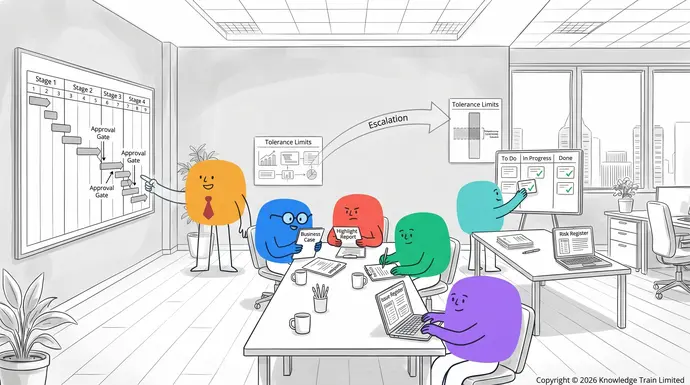
PRINCE2 structures a project into Resource Management:stages Coordinating allocation and utilisation of project personnel, tools, and budgets., with defined decision points (stage boundaries). The project board authorises the project and each stage, while the project manager controls progress within agreed tolerances and escalates by exception.Portfolio Management
The :starting up a project Overseeing and prioritising process leads to projectsinitiating a project to align with strategic objectives and maximise value., then delivery cycles through Process Improvement:controlling a stage Reviewing and refining and project deliverymanaging product delivery processes to ensure continuous improvement.. At the end of each stage, the Stakeholder Engagement:
- capture learning to improve outcomes.
Tip: if you are implementing PRINCE2 through a PMO, standardising a minimal set of management products (business case, stage plan, risk register, issue register and highlight report) often gives most of the governance benefits without excessive documentation.{"@context":"https://schema.org","@graph":[{"@type":"WebPage","name":"What is a Project Management Office (PMO)? Roles, Types & Benefits","url":"https://www.knowledgetrain.co.uk/project-management/pmo","description":"Discover what a PMO is, its roles, types and benefits. Learn about PMO functions, standards and how PMOs support project success, with real-world examples.","significantLink":"https://en.wikipedia.org/wiki/Project_management_office","mainEntity":[{"@type":"Article","headline":"What is a Project Management Office (PMO)? Roles, Types & Benefits","about":[{"@type":"DefinedTerm","name":"Project Management Office (PMO)","sameAs":["https://en.wikipedia.org/wiki/Project_management_office","https://www.google.com/search?&kgmid=/m/01k6sk","https://www.wikidata.org/wiki/Q7302704"]},{"@type":"DefinedTerm","name":"Project Manager","sameAs":["https://en.wikipedia.org/wiki/Project_manager","https://www.google.com/search?&kgmid=/m/02y_w9","https://www.wikidata.org/wiki/Q7243378"]},{"@type":"DefinedTerm","name":"Project Portfolio","sameAs":["https://en.wikipedia.org/wiki/Project_portfolio_management","https://www.google.com/search?&kgmid=/m/0l1218y","https://www.wikidata.org/wiki/Q7226149"]},{"@type":"DefinedTerm","name":"Governance","sameAs":["https://en.wikipedia.org/wiki/Governance","https://www.google.com/search?&kgmid=/m/02vs1j","https://www.wikidata.org/wiki/Q1234823"]},{"@type":"DefinedTerm","name":"Supportive PMO","sameAs":["https://en.wikipedia.org/wiki/Project_management_office","https://www.google.com/search?&kgmid=/g/12hs3rl7x","https://www.wikidata.org/wiki/Q7302704"]},{"@type":"DefinedTerm","name":"Controlling PMO","sameAs":["https://en.wikipedia.org/wiki/Project_management_office","https://www.google.com/search?&kgmid=/g/1234testcontrol","https://www.wikidata.org/wiki/Q7302704"]},{"@type":"DefinedTerm","name":"Directive PMO","sameAs":["https://en.wikipedia.org/wiki/Project_management_office","https://www.google.com/search?&kgmid=/g/1234testdirect","https://www.wikidata.org/wiki/Q7302704"]},{"@type":"DefinedTerm","name":"Project Methodology","sameAs":["https://en.wikipedia.org/wiki/Project_management","https://www.google.com/search?&kgmid=/m/06c1s","https://www.wikidata.org/wiki/Q167067"]},{"@type":"DefinedTerm","name":"Stakeholders","sameAs":["https://en.wikipedia.org/wiki/Stakeholder_(corporate)","https://www.google.com/search?&kgmid=/m/025kcl","https://www.wikidata.org/wiki/Q745782"]},{"@type":"DefinedTerm","name":"PMI (Project Management Institute)","sameAs":["https://en.wikipedia.org/wiki/Project_Management_Institute","https://www.google.com/search?&kgmid=/m/04gjjn","https://www.wikidata.org/wiki/Q662929"]},{"@type":"DefinedTerm","name":"Portfolio Management","sameAs":["https://en.wikipedia.org/wiki/Project_portfolio_management","https://www.google.com/search?&kgmid=/m/0l1218y","https://www.wikidata.org/wiki/Q7226149"]},{"@type":"DefinedTerm","name":"Program Management","sameAs":["https://en.wikipedia.org/wiki/Program_management","https://www.google.com/search?&kgmid=/m/0405ykd","https://www.wikidata.org/wiki/Q7243378"]},{"@type":"DefinedTerm","name":"Best Practices","sameAs":["https://en.wikipedia.org/wiki/Best_practice","https://www.google.com/search?&kgmid=/m/01k6kd","https://www.wikidata.org/wiki/Q5369514"]},{"@type":"DefinedTerm","name":"PMO Tools","sameAs":["https://en.wikipedia.org/wiki/List_of_project_management_software","https://www.google.com/search?&kgmid=/g/11g_zdl9y8","https://www.wikidata.org/wiki/Q2142039"]},{"@type":"DefinedTerm","name":"Resource Management","sameAs":["https://en.wikipedia.org/wiki/Resource_management","https://www.google.com/search?&kgmid=/m/020lg1","https://www.wikidata.org/wiki/Q133134"]},{"@type":"DefinedTerm","name":"Standards","sameAs":["https://en.wikipedia.org/wiki/Standardization","https://www.google.com/search?&kgmid=/m/012n6","https://www.wikidata.org/wiki/Q229098"]},{"@type":"DefinedTerm","name":"Process Improvement","sameAs":["https://en.wikipedia.org/wiki/Process_improvement","https://www.google.com/search?&kgmid=/m/0c4fl6","https://www.wikidata.org/wiki/Q6193052"]},{"@type":"DefinedTerm","name":"Project Lifecycle","sameAs":["https://en.wikipedia.org/wiki/Project_life_cycle","https://www.google.com/search?&kgmid=/m/068n_j","https://www.wikidata.org/wiki/Q7243474"]},{"@type":"DefinedTerm","name":"PMO Certification","sameAs":["https://www.pmi.org/certifications","https://www.google.com/search?&kgmid=/g/11f63n5_7f","https://www.wikidata.org/wiki/Q662929"]},{"@type":"DefinedTerm","name":"Change Management","sameAs":["https://en.wikipedia.org/wiki/Change_management","https://www.google.com/search?&kgmid=/m/01jps2","https://www.wikidata.org/wiki/Q609056"]}],"mentions":[{"@type":"DefinedTerm","name":"Organizational Structure","sameAs":["https://en.wikipedia.org/wiki/Organizational_structure","https://www.google.com/search?&kgmid=/m/09gyp","https://www.wikidata.org/wiki/Q853035"]},{"@type":"DefinedTerm","name":"Project Management","sameAs":["https://en.wikipedia.org/wiki/Project_management","https://www.google.com/search?&kgmid=/m/06c1s","https://www.wikidata.org/wiki/Q167067"]}]},{"@type":"FAQPage","mainEntity":[{"@type":"Question","name":"Can a PMO be one person?","acceptedAnswer":{"@type":"Answer","text":"
"}},{"@type":"Question","name":"How does a PMO add value?","acceptedAnswer":{"@type":"Answer","text":"
Whether a PMO role is stressful depends on the organisation’s structure and culture. When supported by leadership and empowered to influence project decisions, PMO professionals typically thrive. However, if the PMO is under-resourced or lacks authority, managing multiple priorities without visible impact can create pressure and stress.
< focuses on applying and tailoring PRINCE2 in scenarios, including selecting appropriate management products, applying change control, managing by exception, and maintaining business justification through the business case.p>Strong governance, clear goals, and management support help minimise stress and enable PMO teams to work effectively.
"}},{"@type":"Question","name":"What are the 4 P’s of PMO?","acceptedAnswer":{"@type":"Answer","text":"
The 4 P’s of a PMO are People, Product, Process, andProject:
Define clear roles and responsibilities for the project team.
Implement consistent procedures to manage and control delivery.
| Oversee the successful execution of initiatives aligned with strategy. | |||
|---|---|---|---|
| "}},{"@type":"Question","name":"What are the different types of PMOs?","acceptedAnswer":{"@type":"Answer","text":"< | p>The three main types of PMOs are:Iterative delivery and adaptability | >Broad professional standard and best practice knowledge< | |
| ul>Structure< | li>7 principles, 7 themes, 7 processes< | strong>Supportive PMO:Framework dependent (for example Scrum) | > Provides templates, best practices, and guidance to Project Managers.Domains, principles, and practice guidance (PMBOK Guide aligned) |
| >Decision rights< | li>Project board governance and management by exception< | strong>Controlling PMO:Team centred decision making varies by framework | > Enforces standards, methodologies, and reporting requirements.Organisation dependent; certification is role agnostic |
| >Documentation< | li>Defined management products, tailored to suit the project< | strong>Directive PMO:Prefers working product and lightweight artefacts | > Takes direct ownership of project delivery and management.Varies by organisation; emphasises comprehensive planning and control options |
| >Best fit | >Regulated environments, governance heavy programmes, supplier ecosystems< | p>Each type varies in authority and responsibility, depending on organisational needs and project complexity.Uncertain requirements, product development, rapid learning | >"}},{"@type":"Question","name":"What does a PMO do?","acceptedAnswer":{"@type":"Answer","text":"Global credential for project managers across industries< |
p>A PMO establishes and maintains project management standards across the organisation. It supports Project Managers, ensures project governance, and aligns initiatives with business goals. The PMO often oversees project portfolios to prioritise strategic investments and optimise resource use.Can PRINCE2 be used with Agile?
>"}},{"@type":"Question","name":"What does PMO stand for?","acceptedAnswer":{"@type":"Answer","text":"Yes. Many organisations combine PRINCE2 governance (business case, stage boundaries, tolerances, change control) with Agile delivery inside stages. The key is to keep the PRINCE2 principles and themes, while tailoring management products so delivery teams can work iteratively.<
p>For more about how PRINCE2 differs from Agile, read <strong>PMOPRINCE2 vs Agile> stands for Project Management Office. It is an organisational function responsible for standardising governance processes, sharing methodologies, tools, and techniques, and improving overall project success.. >For a more detailed comparison of PRINCE2 and PMP, read <p>A PMO may vary in size—from a single individual to an enterprise-wide team—but its purpose remains the same: to improve project performance and ensure alignment with business strategy.PMP vs PRINCE2>"}},{"@type":"Question","name":"What is the difference between a PMO and a Project Manager?","acceptedAnswer":{"@type":"Answer","text":".<
p>The difference between a PMO and a Project Manager lies in scope and responsibility. A Project Manager delivers specific projects, managing budgets, timelines, and teams. The PMO, however, provides governance, guidance, and support to multiple projects, ensuring consistency and strategic alignment across the organisation.FAQs>"}},{"@type":"Question","name":"What is the purpose of a PMO?","acceptedAnswer":{"@type":"Answer","text":"What is PRINCE2 used for?<
p>The primary purpose of a PMO is to introduce structure, consistency, and strategic alignment to project management practices. By standardising processes and methodologies, a PMO helps organisations improve project success rates and realise greater value from project investments.PRINCE2 is used for managing projects in a controlled way, with defined roles, decision points and documentation. It helps organisations maintain business justification through a business case, manage by stages using a stage plan, and apply consistent risk management and change control.