PRINCE2 project context

Key takeaways
PRINCE2 works best when its governance and controls are adapted to the realities around the project.
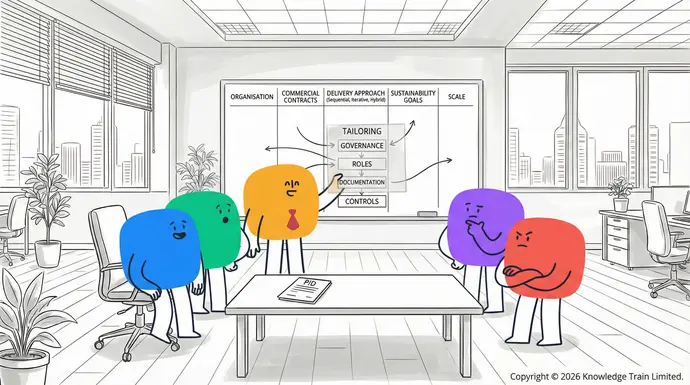
- Project context covers organisational, commercial, delivery, sustainability, and scale considerations, and each one affects how PRINCE2 should be applied.
- Contracts and multi-supplier arrangements must be reflected in roles, controls, and decision rights.
- PRINCE2 supports sequential, iterative-incremental, and hybrid delivery, as long as managing the project is kept separate from delivering products.
- Tailoring should be defined by the project manager in the PID, reviewed by stakeholders, and authorised by the project board.
- Effective tailoring keeps accountability clear, aligns with policies and regulations, and aims for just enough governance for acceptable risk.
Understanding the project context
The project context, alongside the principles, people, practices, and processes, is the fifth element within PRINCE2.
We can think of the project context in five main ways:
- Organizational context .
- Commercial context .
- Delivery method Request a quote.
- Sustainability context .[email protected]
- Scale . +44 (0)207 148 5985
The rest of this article will explore each of these five elements and describe the implications for tailoring the CoursesPRINCE2 methodPROJECT MANAGEMENT.PRINCE2
Organizational context®
PRINCE2 doesn’t assume any particular organizational context. On any project there will be business leaders who will provide the project’s justification and commit the necessary resources to the project. There will be users who define the expected outcomes (known as products in PRINCE2), and there will be suppliers who contribute resources and their expertise to design and build these products.Foundation
PRINCE2Learn the fundamentals of the PRINCE2 method. doesn’t dictate specific organizational ties between these users, suppliers, and business leaders. They might all belong to the same organization or from different ones, potentially linked by commercial contracts.Practitioner
In the Includes Foundation & Practitioner combined option.PRINCE2 frameworkAssociation for Project Management (APM), the business leaders are from the entity initiating the project (the commissioning organization, or businessProject Fundamentals Qualification (PFQ) ). Their decisions align with the organization’s strategy, goals, and policies.Start your APM project management career.
It’s also possible that the Project Management Qualification (PMQ) projectAdvance your APM project management expertise. is part of a Project Risk Single Certificate Level 1 programmeEnhance your project risk management skills. or AgilePMportfolio® within the organization, or it may be a standalone project. In all these cases, PRINCE2 can be applied successfully. – Agile Project Management
Commercial contextFoundation
The business might establish a commercial relationship with a supplier to provide products that meet the users’ requirements, as highlighted in the project’s Learn the key principles of Agile Project Management.business casePractitioner . The entity delivering the project (the supplier) aims to address a specific need recognized by the business (the customer).Includes Foundation & Practitioner combined option.
The business might divide the project into various elements, with different elements being delivered by different suppliers. Meanwhile, some elements might be internally managed, for instance, by departments like PRINCE2IT® or facilities. Agile
From a supplier’s perspective, the deliverables might be under a legally binding agreement stemming from a procurement process. To meet these deliverables, the supplier could engage subcontractors, each of whom would deliver sub-deliverables.Foundation
In a commercial context, commercial relationships might exist amongst suppliers. Instead of a straightforward two-party customer-supplier relationship, Learn the fundamentals of the PRINCE2 Agile method.projectsPractitioner could encompass several organizations bound by multiple contracts. A single customer might have a commercial relationship with a single main contractor, or there could be multiple customers and suppliers, each having distinct motives for their involvement in the project.Includes Foundation & Practitioner combined option.
All such contracts between the organizations describe how the customer(s) and supplier(s) will jointly execute the project. The obligations and rights outlined in a contract should be reflected in how the project is managed which in turn requires the AI Project Governance Framework (AIPGF)PRINCE2 methodologyFoundation to be tailored accordingly.Learn the fundamentals of the governance framework.
Delivery methodPractitioner
The delivery method of describes how a project’s work is carried out. A project might use a single deliver method, or multiple, depending upon its needs. The three most common methods include the following.Includes Foundation & Practitioner combined option.
Sequential approachBetter Business Cases
Here, every bit of work needed to design and build the product follows a set order. The product emerges either during the project or at its closure. A construction project exemplifies this, where design follows requirements gathering before actual construction begins.™
Iterative-incremental approachFoundation
Typically (but not always) this approach is used for product development. This method involves repeated cycles of requirements gathering, designing, development or coding, and testing throughout the project’s lifespan. It’s frequently dubbed the ‘agile’ method.Learn the fundamentals of Better Business cases.
Hybrid approach
loring approach for the project.
When doing this, the project manager often must modify the guidance and oversight of a project to accommodate internal and external influences impacting the project’s execution. Any departure from the company’s typical project management style should be recorded and agreed upon.PMI
Aspects to be tailored®
There are main areas of PRINCE2 that may be tailored.PMI-PBA
- PRINCE2 processesSelf-paced course to prepare you for the exam (exam not included). can be merged or modified.Business Analysis Learning Library (BALL)™
- PRINCE2 practicesCHANGE MANAGEMENT might be applied using techniques suitable for the project.APMG Change Management
- RolesFoundation can be consolidated or divided, if accountability is upheld, and conflicts of interest are avoided.Learn the fundamentals of enterprise change management.
- Management productsPractitioner can be combined or separated into multiple products or data sources.Includes Foundation & Practitioner combined option.
- Terminology can be adjusted to match organizational standards or policies, as long as it is applied consistently.PROGRAMME MANAGEMENT
Tailoring considerationsMSP
Environmental and project factors®
Both environmental and project factors can restrict and shape how a project can be tailored. Project processes should easily integrate the business organization’s policies, processes, methods, and standards. Tailoring should also consider factors external to the organization such as environmental standards, laws, or regulations.Foundation
The proficiency of project’s participants (for example, how experienced they are with Learn the fundamentals of programme management.project managementPractitioner ) can also restrict the degree of guidance required. Whether there is a commercial context must also be factored in when tailoring.Includes Foundation & Practitioner combined option.
The development of specialized products can also play a role because specialists usually perform the working practices (such as agile delivery) which is appropriate for the type of product they are delivering. The INFORMATION TECHNOLOGY (IT)project managerITIL must unify these practices to ensure the project’s outputs and outcomes are produced, and the benefits are realized.®
Whether the project is part of an ongoing programme or portfolio also matters. In such cases, processes, procedures, techniques, or approaches might be given to the project manager by the project, programme, or portfolio office (PMO) to adopt.Foundation
In all cases when tailoring effective governance requires maintaining clear chains of accountability from higher levels to the project level.Learn the fundamentals of ITIL service management.
TerminologyStrategist DPI
Consistent terminology also plays an important part because the uniform use of language and terminology aids communication and comprehension. The 3-day ITIL Strategist: Direct, Plan & Improve (DPI) course.project management methodSpecialist: DSV should, as much as possible, mirror the language within the organization.3-day ITIL Specialist: Drive Stakeholder Value (DSV) course.
Tailoring processes, themes, and role descriptionsSpecialist: CDS
Tailoring processes, roles, and product descriptions are intrinsically related. All the activities within the 3-day ITIL Specialist: Create, Deliver and Support (CDS) course.PRINCE2 processesIT Learning Library (ITLL)™ are performed by one or more of the project management team roles and generate one or more of the BUSINESS LEARNING LIBRARY (BLL)™PRINCE2 management productsAgile Learning Library (ALL)™.Business Analysis Learning Library (BALL)™
It is a good idea to start adjusting the PRINCE2 processes, updating them with any new terminology, and revising the process model and activities, to reflect the organization’s operational methods. Detailed role and role descriptions can then be tailored to align with the processes.Compliance Learning Library (CLL)™
The IT Learning Library (ITLL)™PRINCE2 practicesBusiness solutions are applied within the process activities. The organization must decide how each practice is used within its project management method. Having well-defined organizational processes for project management aspects such as risk, issues, quality, and communication ensures these aspects are consistently addressed. This also helps to alleviate the burden of each project manager having to define their own._blank
Managing the methodSelect your preferred training course below:
Although every PRINCE2 project must be tailored, many similar projects within the same organization might share many similar tailoring provisions. In this case, the organization can benefit from having a standard approach to tailoring across multiple projects.
If an organization embarks on the path of adopting a customized version of WORKSHOPSPRINCE2Select your preferred workshop below: across the organization, the method still requires management and maintenance. The method should therefore include guides, procedures, or processes to explain how it is managed, along with corresponding roles and role descriptions.
The roles should incorporate one for managing the overall method architecture, ensuring the process model and its elements function collectively. Another role would involve the management of each element of the method, which would enable the method architect to delegate different individuals to manage each component.AGILE QUALIFICATIONS
Tailoring rules and guidelinesSelect your preferred qualification.
Any method derived from PRINCE2 should incorporate its seven principlesAGILE PROJECT MANAGEMENT COURSES, including the ‘tailor to suit the project’ principle. This means the method should contain tailoring guidelines.Select your preferred training course below:
Organizations may consider categorize their projects by complexity and provide guidance on how each category should be tailored. The goal is to guide project practitioners in determining what constitutes ‘just enough’ project management to ensure project success.
For all projects, a project manager must guarantee there is an efficient and secure method of storing and distributing information. For more simple projects, a logbook and wall display might be enough, but for more complex projects, information systems must be developed and implemented.PRINCE2 AGILE COURSES
Embedding the tailored methodSelect your preferred training course below:
There are benefits to be obtained for the organization from looking at maturity models such as P3M3SCRUM COURSES and seeking to Select your preferred training course below:embed PRINCE2 within an organization. Embedding PRINCE2 would require a change management approach to enable all practitioners to apply the method in a consistent way across all projects.AGILE BUSINESS ANALYSIS COURSES