
Baseline management productsBUSINESS LEARNING LIBRARY (BLL)™
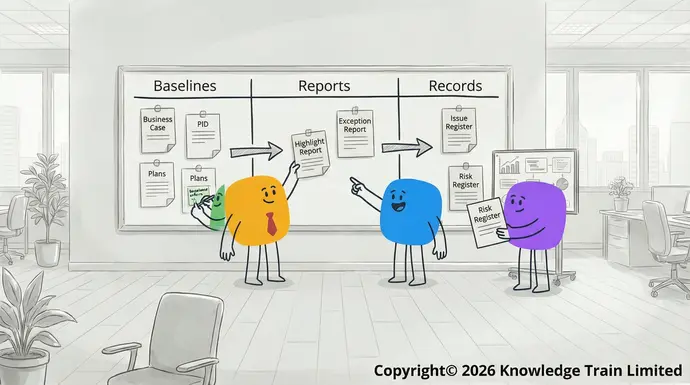
Baseline management products are those that define aspects of the project and once they have been approved, are subject to change control. Usually, baseline products have a version number assigned to them to identify the baseline.Agile Learning Library (ALL)™
Most baseline management products evolve during pre-project and during the initiation stage. The baseline management products of PRINCE2 are described below. Many of these form part of the project initiation documentation (PID) which is also indicated below.Business Analysis Learning Library (BALL)™
- Benefits management approachCompliance Learning Library (CLL)™
- Business caseIT Learning Library (ITLL)™
- Change management approachBusiness solutions
- Communication management approach_blank
- Commercial management approachFree tools
- Digital and data management approachAbout
- Issue management approach_blank
- Plan (project, stage, team, exception)
- Product description
- Project brief
- Project initiation documentationBlog
- Project product description
- Quality management aproachEXPLORE SUBJECTS
- Risk management approachSelect your preferred subject.
- Work package descriptionSelect your preferred qualification or workshop.
Benefits management approach (part of PID)
The purpose of the PRINCE2 COURSESbenefits management approachSelect your preferred training course below: is to identify the benefits management actions and reviews that will be performed to ensure the outcomes of the project will be achieved, and to confirm that the benefits are realized.
business caseAGILE PROJECT MANAGEMENT COURSES
AGILE PROJECT MANAGEMENT COURSES
Digital and data management approach (part of PID)Select your preferred training course below:
A digital and data management approachPRINCE2 AGILE COURSES describes how data will be managed across the project, and after the project closes.Select your preferred training course below:
Issue management approach (part of PID)
An SCRUM COURSESissue management approachSelect your preferred training course below: describes the processes for managing issues, and how changes to the project baseline will be controlled.
Plan (project plan, stage plans, team plans, exception plans)AGILE BUSINESS ANALYSIS COURSES
A Select your preferred training course below:plan provides an overview of the objectives, how they will be achieved, when they will be completed, and with what resources. A plan outlines the scope of the work, the products to be delivered, and the activities and resources responsible. BUSINESS ANALYSIS QUALIFICATIONSPRINCE2Select your preferred qualification. recommends three levels of plan – project plan, stage plan(s), and team plan(s).
Product descriptionBCS BUSINESS ANALYSIS COURSES
Product descriptionsSelect your preferred training course below: are created during planning. They are attached into plans and are written at the level of detail required by the plan. For example, for a team plan, a product description will be detailed, but for a project planAGILE BUSINESS ANALYSIS COURSES, it will not contain the same level of detail.
A Select your preferred training course below:product description is often written for each product contained with a product breakdown structure.CHANGE MANAGEMENT QUALIFICATIONS
Project briefSelect your preferred qualification.
The project briefAPMG CHANGE MANAGEMENT COURSES is a short summary of the project and is used by the project board to authorize the initiation stage of the project. It is assembled during the starting up a project process by the Select your preferred training course below:project manager . The PROGRAMME MANAGEMENT QUALIFICATIONSproject briefSelect your preferred qualification. is then used in the initiating a project process as the basis for creating the project initiation documentation.
If you are familiar with the PMBOKMSP COURSES®Select your preferred training course below: Guide, the Project Charter serves a similar purpose as the
ReportsSelect your preferred training course topic.
Reports form snapshots of progress containing information about the status of the project at a point in time. There are seven reports recommended by PRINCE2AI QUALIFICATIONS & WORKSHOPS, but depending upon how the method is tailored, fewer may be used on a project. The recommended reports are described below.Select your preferred qualification or workshop.
- Checkpoint report
- Select your preferred training course below:
- End stage report
- Exception reportBCS AI COURSES
- Highlight reportSelect your preferred training course below:
- Issue report
- Lessons reportAIPGF COURSES
Checkpoint reportSelect your preferred training course below:
A checkpoint reportAI WORKSHOPS is written by a team manager to report the progress of a work package to the project manager. It summarises the progress compared to what was agreed in the work package description. The format and frequency of checkpoint reports are agreed when the team manager accepts a work package from the project manager.Select your preferred workshop below:
The
An Knowledge Train is a Change Management Accredited Training Organization.issue report contains information to uniquely identify the issue, its type, the date raised, the person who raised it, the impact assessment on the project targets, the actions to resolve it, the person(s) responsible for these actions, and the closure date.Knowledge Train is an MSP Accredited Training Organization.
Lessons report
A AXELOS Peoplecert accredited training organisation for ITIL (IT Infrastructure Library).lessons report documents any lessons that might be of value later in the current project, or to future AXELOS Peoplecert accredited training organisation for ITIL (IT Infrastructure Library).projects . It is created by the project manager either at the end of a stage, and/or at the end of the project.Knowledge Train is an AIPGF Accredited Training Organization.
The purpose of a lessons reportKnowledge Train is an AIPGF Accredited Training Organization. is to initiate actions to enable the organization (or project) to avoid any negative lessons in the future and to embed any good lessons within the organization’s or project’s ways of working.
Records
Records are dynamic management products used to maintain regular status information about the project. Records do not need to be kept under version control because they are continuously updated to reflect project progress.
Collectively, these are referred to as the project log and contain the items listed below.Find out more