PRINCE2 vs Agile or PRINCE2 Agile?

- PRINCE2 can support iterative delivery and is not inherently a waterfall approach.
- PRINCE2 Agile explains how to tailor PRINCE2 for Agile work while keeping the same principles, practices, and processes.Contents
- Use fix or flex to protect time and cost, while flexing scope and quality criteria through prioritisation.
Introduction
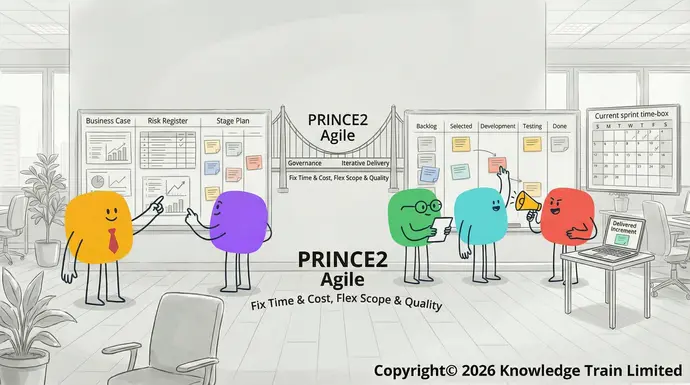
In 2015, AXELOS, the owners of PRINCE2 launched PRINCE2 Agile. £749 +vatPRINCE2 Agile is an attempt to get the best of both worlds – the structure and governance of PRINCE2 , combined with the flexibility of Self-pacedAgilePRINCE2 Agile Practitioner (with Foundation) self-paced online.
This article compares PRINCE2 and Agile methods and approaches and explains how PRINCE2 Agile can bridge the gap between the two.£1,399 +vat
PRINCE2 vs Agile
AgilePM Practitioner (with Foundation) self-paced online are also a standard feature of project management job specifications in the UK and have grown in popularity since PRINCE2£1,299 +vat was launched in 1996.About the speaker
Currently, over 100,000 Emanuela Giangregorio brings over 20 years of project management experience. As a trainer, coach, and author, she has trained thousands globally. Her ability to simplify complex topics makes her a sought-after thought leader in the field.PRINCE2 examsRelated courses are sat somewhere in the world every year.Our project management courses cater to different levels, offering foundational principles and advanced techniques. These courses help you enhance your project management skills and adapt to evolving industry demands. Whether you’re a beginner or a seasoned professional, there’s a course for you. Explore practical tools and methodologies to lead successful projects.
AgileCourse links
‘Agile’ is an umbrella term used to refer to numerous product delivery methods, frameworks and techniques used by development teams.Project Management Fundamentals
Agile approaches emerged from the software industry in the 1990’s, to try to overcome many of the problems which had beset traditional software projects. They were often delivered late, over budget, and with low quality.Advanced Project Management Techniques
There are different Agile Project ManagementAgile approachesPMP Certification, the most famous being Bespoke in-house trainingScrumTranscript, Here’s the full transcript of the webinar.Kanban00:00:00 Yassin Abbas:, Extreme Programming, and Hi Emanuela.Lean00:00:02 Emanuela Giangregorio:. All Agile approaches are based upon the Hello.12 Agile principles00:00:03 Yassin Abbas:.
One of the Hi Ingrid. So, you know what? That’s not an uncommon question, Ingrid. People often ask me which tool do you recommend? And soon I’m going to share you a slide with you that shows all the AI-powered tools. There are so many tools out there, I tend to use the tools that my clients use. And also, you can imagine somebody like myself as an external consultant, I couldn’t possibly be an expert in all of and also, couldn’t have licences for all of them. So, for some of them actually I’ve got three different e-mail addresses, just that I can keep on using the free versions. But Ingrid, since you asked me, I will tell you my top tools that I liked, and I enjoy working with these are the AI-powered tools. They have free versions that have limited AI-assistance, and then obviously you have the paid versions of these tools in no particular order. Asana is a tool I really like working with, Notion is great, Wrike, Smartsheet, and Taskade. I’m giving to give you 5 and you’ll see them on the slide that I’m going to share with you as well later on in this talk. But yeah, so those, why do I like them? They’ve got a great interface, reasonable price point, intuitive and easy to use. And certainly, my clients that are using those tools have actually adopted them and you know teams are using them very effectively as well. But you know that’s certainly the expense that I’ve had. There are other tools out there as well, which and I’m going to be talking about tool selection as well soon.Agile principles00:22:11 Yassin Abbas: is that people on teams must work together collaboratively with the customer. This is done by defining and prioritizing requirements, developing, testing, and providing feedback in a continuous and repetitive cycle of iterations. Often, the customer will be co-located with the development team.
Self-organisationDavid also has a question.
Self-organisation by teams is also one of the Agile principles. Agile teams determine their own tools and techniques to use (e.g. task backlogs, burn-down charts, Kanban boards), rather than these being mandated by a 00:22:16 Yassin Abbas:project manager So, everybody is talking about the problem and how AI can, you know, solve the problem. But what is the solution? What is the tool that you know would be best for me? Which also kind of collates with David’s question about best practises..00:22:37 Emanuela Giangregorio:
PRINCE2 and Agile comparison So best practice terms of how to get past this current situation?
Planning00:22:45 Yassin Abbas:
One key difference between PRINCE2 and Agile methods is that PRINCE2 is often described as a predictive (plan-based) approach, while AgileI think let’s answer David’s question about the solution? Which tools that you may recommend and how to use them? calls for short-term, incremental achievements independent of an over-arching plan (the adaptive approach).00:22:55 Emanuela Giangregorio:
This means that, while PRINCE2 enables the customer to remain focused on the project’s original business goals, Agile approaches are very responsive to changes in the project environment and customer requirements. Yeah. OK. So, I’m going to get past the tools and let’s continue then with the presentation because I’m going to go from here to how do we get closer to what Gartner is suggesting, right? I know people love the tools and it’s all about which software tool, but that’s part of the solution and we can talk more about that. Let’s go from here into the solution in terms of the current situation and then we can pick up any questions that perhaps we have missed out. So, can I leave you with the questions in the in the chat box there, Yassin? Yeah, thank you. I want to make sure that I don’t miss out anybody’s questions at all. And I just want to make sure also keep my eye on the time. So, we’d yeah, we’re doing good. So, we’ve got plenty of time for questions, that’s great. OK, so what are some of the solutions? How do we get to where Gartner says we’re going because I that’s a place to be if that’s where we’re going, get on board or not? Let’s decide. So, working backwards you need the AI-powered software tools to do the 80% if they are saying 80% of what we do is project is going to be done by AI, then it’s going to be tool driven and it could be multiple tools as well right? Bearing in mind if you don’t know about AI agents, I suggest you learn about AI agents quickly. You will discover that AI agents will come more and more into play, and they can do multiple automated tasks. So, this situation where 80% of our work is going to be going to be done through AI will largely be through authentic AI but in the end, we still need the tools right.
Agile approaches assume that the development process is (predictably) unpredictable. They encourage complete transparency, close collaboration and frequent delivery of usable sub-products that will eventually contribute to the final product delivered.00:24:26 Emanuela Giangregorio:
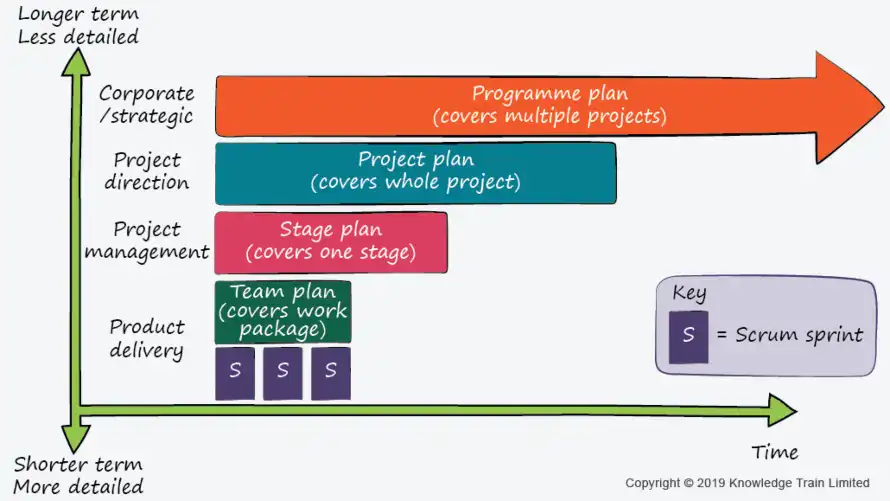
Levels of plan For the tools to work, they need data, so it’s all very well going out and getting a great tool. But if they don’t have data to work with then the tool is not going to be as efficient or effective as it could be and won’t deliver the value that we’re hoping for. And then for the above to be in place, we need capable humans to make it happen. So, a simple triangle that I like to use for ethical, efficient and effective human AI project collaboration, we need capable humans. We need the data which is, you know, complete, accurate and available to the tools and we need the AI-powered tools to support us. And so, what I want to do is just step into each of these 3 aspects. If you follow any of the stuff I say on LinkedIn or on my website, you’ll see me say this quite a few times. ‘
PRINCE2 has the concept of ‘Success hinges on our ability to masterfully blend our wonderful human expertise, experience, and wisdom with AI capabilities. The key isn’t to be driven by AI, but to drive success with AI as an assistantlevels of plan.’ Terminology is very important, there’s a lot out there about AI-driven project management and AI-driven organisations, but I think we need to be careful when we use terms like this. If certainly there’s no context around that because people, if they have the sense that things are AI-driven, then we run into the difficulty where we’re delegating into AI.’. This suggests that different plans are required by different levels of the project management team. There are 3 levels of plan in PRINCE2:00:25:55 Emanuela Giangregorio:
- Long-term – this is a high-level And let’s keep the discussion within project, the project manager’s actually not leading the activity. So really, I like to focus on the term AI-assisted rather than AI-driven. AI-assisted means therefore that project teams and related roles need to have the capabilities to be able to establish what the AI is giving us. Is it accurate? Is it reasonable and to be able to coach the AI tools to improve over time? So yeah, AI-assisted rather than AI-driven. The other thing is I’ve written a framework for AI-assisted Project Management, which is very much about helping project team-related roles. Even governance functions ensure that we can adopt this in our project processes alongside chosen methodologies like PRINCE2 or approaches like Agile and also the Project Management Institute, project processes. So capable humans, first we need some sort of AI-assisted projects strategy. Typically, what would this look like at sort of the top organisational level? We need to see some sort of AI adoption strategy across the organisation. What does it mean for people, process and technology and then part of that we should have an AI-assisted project strategy? It’s useful if it’s top-down. However, if you don’t have that top-down strategy, it doesn’t stop you from being an effective AI-assisted project manager.project plan00:27:27 Emanuela Giangregorio: which is required by the key decision-makers (the project board). The framework governing ethical, efficient and effective human-AI collaboration frameworks are useful. It doesn’t have to be the one that I wrote, but frameworks are useful because it does assist project teams use AI properly in their projects. It helps those that are taking a strategic leadership role provide assurance to the board and to other functions regarding responsible use of AI, as AI adoption continues and as the organisation data becomes available to these AI tools. And also, what we will need therefore is some emerging, you might have noticed the emergence of the Chief AI Officer (CAIO) or the Chief Data and AI Officer. This is a very important role at the C level of the organisation, and they have an important role to play in strategically guiding AI adoption in projects. Projects are the major vehicle for delivering the organisation strategic objectives if you think about it. The organisation has its strategy, its strategic priorities, the execution of those strategic priorities are often through projects. So, a lot of what we do to enable the organisation is through projects and therefore it makes sense that roles like the Chief AI Officer (CAIO) and related roles take a strong interest in providing some sort of strategic guidance around AI-assisted project management. And also, we need roles like the AI project coordinator on bigger projects so they can assist with the usage of AI tools. Data custodians and data coordinators to make the data available to us and then of course, training is important. So, all these roles that are going to help us drive successful projects with AI systems need to know how to strategically guide projects, those that are operationally working on projects. They need to know how to make the best use of the tools with the data that they have at their disposal.
- Medium-term – this is a stage plan required by the project manager for every stage of the project.00:29:32 Emanuela Giangregorio:
- Short-term – this is a team plan required by each team manager (leader) to cover the work done by their team. This is a detailed plan. Just looking at this dimension capable humans, you can start to see a lot of work to be done. What about data? So, we need overarching data strategies in the organisation and part of it would include a project data strategy. I mentioned the Chief AI Officer (CAIO) so if you have a look on LinkedIn or on Google you will find job functions for Chief Data and AI Officer and that’s where the data component would be included. In some organisations they split them out and in many organisations the role doesn’t exist yet. But essentially, we need some sort of overarching data strategy including a strategy for project data as well. Therefore, data owners and data custodians and then we need to operationally start collecting, cleaning and securely centralising project data which we can make available to tools. So, for organisations that have already had some sort of discipline around collecting project data we’re talking about lessons learned, blogs and risk logs and all these different things. There should be some sort of effort to collect that data because there’s a lot of wisdom in that data. Clean it up, make it available to AI tools, and then a day forward approach for organisations that don’t have their data, just follow a day forward approach. So, from now on, the projects that we run going forward, this is how we want to start collecting this data so that the AI and use them. And therefore, we can benefit from better predictive analytics and automation and prediction and so on. With their data available, then we need to provide secure access paths for the tools to access the project data.
Sprints and timeboxing00:31:21 Emanuela Giangregorio:
milar concepts to these in the form of ‘be on time and hit deadlines’ which is one of the Now I also know from working across my client base that sometimes organisations are often times organisations are in the habit of making tools available. And not providing training for those tools. So, if your organisation doesn’t provide the training, don’t just hack it and make you know, see if you can figure out, they are a host of useful tutorials on the vendor’s websites, on YouTube, et cetera, on how to make the best use of these tools. I would suggest whatever you’re using, even if you’re using Google Sheets or Excel or Asana or any of these fabulous tools, spend some time on the resources that are available to learn how to make the best use of the tool. One hour invested in learning the tool is going to save you heaps of time and turn you into more of a project management wizard where some of these AI-assisted tools. Let’s move over now to road or ride ahead. Where are we now? If from what I’ve seen, we generally have low AI adoption in projects and low capability to use AI properly. In project management, where do we go? Well, different roads to take. Some can stay, or some will choose to stay where we are and I don’t think the wait and see is a good game to play because the longer organisations leave this, the sooner their competitors will beat them to the market with more efficiently delivered projects. Take this down from the organisation to the individual, the longer individuals leave it to become proficient in AI usage in project management.five PRINCE2 Agile targets00:39:27 Emanuela Giangregorio:. Similarly, regular releases is one of the five The sooner other professionals are going to be competitors to you for the same job and I don’t want this to be scaremongering at all. But I really feel like this option of waits and see is not a good option for most business professionals. The other option is purposeless AI adoption in projects purposeless meaning, let’s just get a tool, put it in place and hopefully it works. We might be lucky, and it might work but it might not be sustainable. And really to truly drive project success with AI-assistance in a way that is explainable that where we can actually give assurance to governance functions that the usage of AI is responsible, the data is secure and protected. We then need to follow a path where we do this properly. So, what do we need to do? Strategic AI adoption’s gonna require us to intelligently select the tools, ensure we have strategies in place for data. That means the data needs to be quality data and most importantly, we need capable project managers and related roles. But as I said earlier, not only project managers, I really feel like roles people that take on the role of a project sponsor support functions like AI coordinators, data owners, et cetera. Chief AI officer (CAIO) would benefit from becoming skilled in this area to know how to properly strategically oversee AI-assisted project and for those that are operationally involved for them to make the best use of these tools.focus areas in PRINCE2 Agile00:41:17 Emanuela Giangregorio:. So, AI and project management is not hype, it’s here and it’s going to continue to be an important aspect to bring into our projects. Also, AI project management is currently underutilised, it’s certainly what I’ve seen and perhaps again I’ll be interested to know from your perspective what you feel there. But I also feel that now is the time if people haven’t done this yet. Now is the time for individuals and organisations to decide, do they wait until they have time or something else changes? Or do they lead? And in fact, now can still be the time to lead because most people haven’t yet adopted it. In other words, AI adoption is still low, anyone that kind of gets into this early will still be leading in the AI revolution. So, it’s a choice and I know it’s not a simple choice because there are constraints like budget constraints in organisations, time constraints, in terms of resources availability and capacity to kind of work on these things. And so, if we can’t do it sort of top-down full scale properly, we then can maybe bring this into our own world. So, if I’m in an organisation that perhaps is way behind in all of this, what can I do for myself? Well, as a person who’s practising in project management, I want to then make sure that I am very familiar with common AI tools, for example what they can do, understand some of the ethical challenges, know about some of the use cases? How AI tools can be used in projects? So, if I don’t have access to one of those cool tools, how can I use some of the freely available tools like Google Gemini and Microsoft Copilot or even the ChatGPT models to help us in projects. So, if we can understand how to use those and build AI literacy in project that’s going to get a long way from just dabbling and talking about it to actually using it and showcasing how we can use it in our projects going forward. So that’s it from me in terms of some of the talk that I want to have here. I think Yassin over to you, you want to do first do a survey and then after this we’re going to spend the rest of the time on some further Q&A but first over to you, Yassin.
Responding to change00:43:35 Yassin Abbas:
Cost of change Yeah. Thanks so much. I would like to share this feedback with you guys, if you don’t mind take a moment or two to complete it. Thank you so much.
One criticism of more predictive 00:46:19 Emanuela Giangregorio:project management approaches How are we doing Yassin? is that it is difficult and costly to manage changes. Changes are managed through formal change control processes, and decisions taken by a change authority.00:46:21 Yassin Abbas:
In Agile approaches, changes can be done quickly. This is because customer requirements (e.g. software features) are described by the customer in the form of tasks which are prioritised in a backlog.
Because planning is never done further in advance than the next iteration (1-4 weeks usually), tasks can be quickly re-assigned a different priority, new tasks added, or unnecessary tasks removed.Yeah, almost there.
Again, PRINCE2 Agile views change positively. One of the five targets in PRINCE2 Agile is the ‘00:46:36 Yassin Abbas:embrace change ’ target which sees change as something positive to be embraced, rather than something negative to be managed.We have some interesting questions.
PRINCE2 doesn’t have to be waterfall00:46:39 Emanuela Giangregorio:
There is a perception (wrong in my view) that PRINCE2 struggles to adapt to changing business requirements. Right. Oh right, tell me when we’re ready.
This view is based upon the assumption that PRINCE2 is a project ‘00:46:42 Yassin Abbas:waterfall We have some interesting questions.’ approach. A waterfall approach is where requirements are documented and approved before moving to a design phase, followed by a build phase and finally a testing phase.00:46:51 Yassin Abbas:
There is nothing in PRINCE2 which prescribes such a We’ve got events and feedback that we have, a human resources and organisation development specialist, and they are supporting this. So yeah, that’s a very good sign. Thank you.waterfall approach00:47:27 Emanuela Giangregorio:. In fact, the latest I’ll start at the bottom looking at some of the comments while you finish up on that poll, if you don’t mind Yassin and then you could just let me when you’re done, right? But I’m just looking here, my job title is associated safety and learning lead at NHS Resolution. I missed this question, I’ll come back to that I’m not sure what you missed the Ingrid. Katrina, I use Copilot for minutes, you know Copilot is a great tool, Katrina. So, you know, one of the biggest time oysters in or time, things that take a lot of time in projects. Any meetings in general is having to kind of record the actions in meetings and Copilot is great to transcribe the entire meeting and then also from there distil the key actions that come out of it. So, it’s kind of saving 80% of your time as you’ll know and of course you still need to have a look at it and kind of add anything that’s missing. So yeah, I think Copilot is fantastic.PRINCE2 manual 700:48:20 Emanuela Giangregorio:th And Sam, you are asking about AI tools, so yeah, a lot of the, this for Sam who is asking about, I know Katrina replied but Sam was asking about AI tools for meeting minutes and people’s experience with them. So, thanks for applying about Copilot, most of popular web meeting platforms now have some sort of AI tools embedded that will transcribe the meeting. So, if you guys are using Zoom and Webex for example, they have now tools that will transcribe those, but I would say out of those Copilot is more mature in terms of its ability to not only transcribe the meeting but actually extract the key actions from that. edition00:49:13 Yassin Abbas: assumes that on many projects, requirements emerge and evolve as the project continues. Yep. Thank you, thanks so much for sharing your feedback.
PRINCE2 manages such changes to project scope using its change control approach. However, lower-level changes, such as a feature requests can easily be managed at the team level using the prioritization techniques common in Agile approaches.00:49:18 Yassin Abbas:
Using both PRINCE2 and Agile We have a very interesting question, a question from about the AI integration. So, the question is basically is about. Is there an AI tool that can be integrated into existing software, specifically for the project management software?
The best of both worlds00:49:45 Emanuela Giangregorio:
Whereas PRINCE2 focuses on understanding what products are needed to support the business needs, Agile focuses on completing those products in an efficient manner, incrementally delivering more working software (products) as the work progresses.
Utilizing Agile approaches on PRINCE2 projects therefore can bring the best of both worlds – the structure and direction of PRINCE2, coupled with the flexibility and responsiveness of Agile.You mean say for example, if you have a project management software tool, can you integrate the tool into that existing software? Right so for example, if I’ve got Microsoft Project is in AI tool I can integrate with that.
PRINCE2 is not concerned with how teams organize or the methods they use. It does however define a simple interface between the customer organisation which is paying for the project and the supplier organisation which provides the teams which do the specialist work.00:50:02 Yassin Abbas:
Business focus and timely delivery Yeah, it seems like.
This therefore means that teams on a PRINCE2 project can use any development approach they choose – including any of the Agile approaches. Providing they comply with the interface defined by PRINCE2, teams can utilize the benefits of Agile (such as on-time delivery), whilst the customer maintains the benefits of PRINCE2’s focus on the 00:50:06 Emanuela Giangregorio:business justification So, most of the popular project management tools have a free version with very little AI integration. Some of them have a few bit of AI-assistance but most of them the free version is fairly basic and then as you go up the paid versions, there’s more and more AI integration. So, for example Asana, you know to the next level upgrade version, the AI system will be able to for example, let’s just say I want to build a website that’s my project. I can tell it that the project is about building a website, it will recommend a list of tasks and dependencies between those tasks, right? So, the point I want to make to answer your question is most of the popular project management tools, certainly the ones that are more mature in the market have actually got the AI systems built into those. Perhaps it would be interesting for you to put in the chat box the of the you’re using. And then I can answer your question better if we have time, Yassin just let me know..00:51:02 Yassin Abbas:
Quick PRINCE2 and Agile comparison Sure. Another question, what form can AI integration take in a project? So how do you see which tool to support which point in a project in projects? If you have any specific examples?
| PRINCE200:51:19 Emanuela Giangregorio: | Agile |
|---|---|
| Useful for the customer to justify a projectRight. OK. So, let’s look at the project life cycle. Let’s just talk about the initiate phase or that first phase of the project where we have an idea for the project. Now typically that phase is either just formalised or justified through maybe sometimes it’s just a simple discussion in a meeting, but in some cases, it needs to be formalised or justified through a project mandate or even a full-blown business case right now. Probably wouldn’t a software tool like some of those that drive the planning and monitoring of projects there, you could use a Gen AI type of tool, you could use ChatGPT, your organisations in-house Enterprise GPT. Some of you might have your own in-house GPT that would be a good tool to use for helping you write a comprehensive and compelling business case right. So, let’s move off the initiate phase, let’s go into the planning or define phase of the project. That’s where we need to put some more meat on the bones of the project, plan up the project by setting out the clear objectives, scope of work, the constraints, roles and responsibilities and then also build a project plan. So, some of the things around building your project charter or your project initiation document, again as useful to use a tool like Copilot, Gemini, ChatGPT or your organisations in-house GPT, Enterprise GPT to help you create those documents that can help you then establish the project chart or the project initiation document. When it comes into the planning, meaning the timeline so creating the project timelines and from there on that’s where some of these tools come onto their own. So, tools like those that are shared with you on the screen will be able to then help you set up your project and many of them, like Asana and others right Notion, Taskade. In fact, if you look at some of the demos for Taskade on YouTube, you’ll actually you can see really like a real good example of how these tools can actually automate a lot of things. So, Taskade for example has a lot of AI agents built in, so again you’ll tell the tool the project is about building a website or optimising this business process. And it will then generate a list of tasks and subtasks, it will recommend dependencies between those tasks. | Useful for the supplier to deliver working software00:53:36 Emanuela Giangregorio: |
| Focuses on higher management levels The example I’m sharing with you now is if we don’t even have previous project data, so it’s kind of just flying solo without any previous project data. Then you can obviously go into the tool and make some changes. If you give it a start date or map out the timelines or create some sort of Kanban board for you and recommend the dates and durations. And of course you can then fine-tune it based on the constraints. If these tools have access to pass project data, they will then be able to say OK, we know that these projects with those resources, they overestimated what they could do, things actually slipped as they will build in and more, more realistic time frames. So, these tools can assist with task generation that can assist with resource allocation that can assist with things like risk assessment, so using predictive analytics they can then do the risk assessment for you. And again, the most important thing is these tools are only as good as the users know how to use them, and they’re only as good as the data given to them, right? So, in other words, how you prompt them and how you describe what you need from them and also any data available, we still need the human in the loop. Therefore, my insistence on project managers who are competent to be able to look at what it’s given to say, actually. Yeah, that makes a lot of sense and let’s use that or let’s make some changes to what the tool has given to us. So, long of answer to a very short question, but I hope they give you some flavour for the types of things these tools can do, and also how they’re through the project lifecycle. And then, of course in the delivery phase, the monitoring and control phase of the project, you then have these tools that can, some of them will actually, you know, will summarise your dashboards for you in terms of project status and also give you heads up on potential new risks. Flag up issues that have maybe been outstanding for longer than two weeks, say et cetera, depending on the parameters. And then when you get to the close those of your project whether it’s an agile project or a non-agile project, you still have to do a final review of the project and all those kind of things come into play then. You know in what I call manual project management where we’ve kept everything on a spreadsheet. If we do a review at the end, we then need to go through all the logs, look at the, you know the issues log and the risk log and the scope change log and the baseline plan and from there we can discuss lessons learned. | Focuses on lower-level delivery teams00:55:50 Emanuela Giangregorio: |
| Answers questions such as “should we do the project?” and “are the benefits worth the costs and risk?” In addition to that, we’ll also discuss our stakeholder experiences and so on. But again, we can automate a lot of that as well. Now the maturity of these tools varies and that’s why I always said build a requirement specification. And be very clear on what you need from the tool and also then budget comes into play as well. The more elegant, advanced tools will be at a higher price point, the simpler, less elegant tools will obviously be at a more affordable price point as well. | Answers questions such as “what do we deliver next week?” “how will we know it (a product) is finished?”00:56:21 Yassin Abbas: |
| More predictive approach | More adaptive approachOK, we have a follow-up regarding the software integration for AI tool into a project management software and to be very specific there are things like DevOps and Jira being integrated into Microsoft Teams and whether there was a case like, for example, using Excel for project plan and ChatGPT assisting and assisting. Yeah, if that makes sense. |
PRINCE2 vs PRINCE2 AgilePRINCE2 Agile Practitioner (with Foundation) self-paced online
In 2015, in recognition that many people were struggling to find a way of applying PRINCE2 on Agile projects, AXELOS launched PRINCE2 Agile [2]£1,399 +vat.
PRINCE2 Agile is essentially the same as PRINCE2 . They both rely upon the exact same principles, practices, and processes. The only real difference is that the PRINCE2 Agile guidance explains in detail how to tailor these elements for Agile projects. In the Self-pacedPRINCE2 manualAgilePM Practitioner (with Foundation) self-paced online, whilst there are lots of examples of how to tailor PRINCE2 to different project context, it doesn’t go into the same amount of detail as the PRINCE2 Agile manual£1,299 +vat.Subscribe to our exclusive offers and promotions
Fix or flex?
In particular, PRINCE2 Agile explains what to ‘Subscribe nowfix or flex ’ for the 6 performance targets of PRINCE2 (time, cost, quality, scope, risks, benefits).
For PRINCE2 Agile, time and cost are fixed. These cannot change. However, to be able to deliver what the customer truly needs, scope and the products’ quality criteria can be flexed.{"@context":"https://schema.org","@type":"VideoObject","name":"AI in Project Management: Hype vs Reality in 2025' with Emanuela Giangregorio","description":"Many project managers hear about AI revolutionising the industry, but how much of it is hype, and what’s actually making an impact today? With AI technologies evolving so rapidly, it’s easy to become overwhelmed with all the “noise” and difficult to keep up. This webinar separates fact from conjecture. You will learn about some of AI's practical applications in project management today and how you can use AI tools for ethical, efficient, and effective human-AI project collaboration.","thumbnailUrl":"https://i.ytimg.com/vi/S8FKgxAq78k/maxresdefault.jpg","uploadDate":"2025-03-05T08:00:00+08:00","duration":"PT1H02M31S","contentUrl":"https://www.youtube.com/watch?v=S8FKgxAq78k","embedUrl":"https://www.youtube.com/embed/S8FKgxAq78k"}
What to flex must be agreed with the customer. Typically, to achieve this PRINCE2 Agile uses prioritization techniques such as MoSCoWSome related articles, coupled with sprint backlogs.
The other 2 performance targets (benefits and risk) may be either fixed or flexed depending upon the customer’s needs.
Conclusion
Simply choosing to use a particular method or approach will never guarantee a project is always successful. In fact, any method or approach used without thinking will make a mess of any project.
The PRINCE2 focus on the business justification and whether a project is justified when the business environment changes remain its biggest assets. It helps to ensure that projects are based upon sound business sense.
The ability to respond quickly to changes with on-time delivery of products which deliver value to the customer is the biggest contribution of Agile approaches.
So, is it a matter of choosing either PRINCE2 or Agile ? I don’t think so. If you are looking for a robust project management methodology to use on Agile projects, then PRINCE2 Agile fits the bill perfectly.
PRINCE2 Agile gives practitioners both the control and governance to guide the project, whilst at the same time it provides the agility and ability to deliver rapidly in a changing business environment.
If you want to learn more about PRINCE2 Agile, or want to become certified, consider taking a PRINCE2 Agile course .
Both Agile PMOPRINCE2 Agile Foundation and Simon BuehringPRINCE2 Agile Practitioner19 Feb 2026 qualifications are available to choose from.
ReferencesJoin Andrew Kell in a webinar exploring the integration of PRINCE2 and Agile methodologies. Ideal for professionals looking to adapt their project management approach.
Managing Successful Projects with PRINCE2 . 7 th edition. Nicosia, Cyprus. PeopleCert. 342.
[2] AXELOS (2018). Project management vs product managementPRINCE2 Agile (3 rdKnowledge Train impression)19 Feb 2026. Norwich: The Stationery Office. 338.