
keep up with industry trends and organisational needs.project management lifecycle which explains which role takes key decisions at crucial times during a project.
PRINCE2 recognizes that on By considering these factors carefully, organisations can create a solid projectsproject management framework there are all kinds of products (outputs) produced by teams of people with various specialist skills. These teams have myriad ways of working and PRINCE2 does not try to guide how they should work. for success and growth.
Instead, PRINCE2 simply defines the interface between the project and these teams in terms of reporting, accountability, and the work to be done.Overcoming common challenges
Engineers in the software industry in the 1990s created Agile approaches when they were trying to address problems with software projects being consistently late, over-budget or delivering low quality software.
Today many industries outside the software industry use Agile approaches.
Focus of AgileSelf-paced
Agile approaches do not concern themselves with the wider questions about whether a project is worth it, or whether the benefits can be realized afterwards. They do focus however on delivering value to the customer by delivering products incrementally, in the most efficient manner possible.AgilePM Practitioner (with Foundation) self-paced online
These products are likely to do what the user/customer needs because the customers have been involved in a constant cycle of defining and prioritizing requirements, developing, testing, and providing feedback.
Delivery of working products£1,299 +vat
Agile methods are delivery teams doing the work – whether part of a project or not. They focus on questions for the team such as ‘what needs to be delivered next week?’, and ‘is the working software what the customer needs?’Conclusion
CollaborationProject management
One of the offers numerous benefits to organisations, including improved decision-making, increased efficiency, and improved project success rates. These benefits translate into tangible impacts such as cost savings, productivity gains, and quality improvements. Less tangible benefits include enhanced morale and knowledge sharing, which contribute to a positive organisational culture.Agile principlesWhile implementing project management practices may be challenging, the benefits far outweigh the initial hurdles. By carefully selecting methodologies, tools, and training
Small businesses can improve efficiency, save money, and enhance customer satisfaction through project management. It helps to prioritise tasks, manage resources effectively, and deliver products or services on time. Project management also supports growth by providing a structured approach to new initiatives.
Agile approaches assume that the development process is (predictably) unpredictable. They encourage complete transparency, close collaboration and frequent delivery of usable sub-products that will eventually contribute to the final product delivered.What are the essential skills for effective project managers?
Levels of planKey skills include communication, leadership, problem-solving, and time management. Technical knowledge, risk management skills, and adaptability are also important. Successful project managers are skilled at managing stakeholders and possess strong analytical and organisational skills.
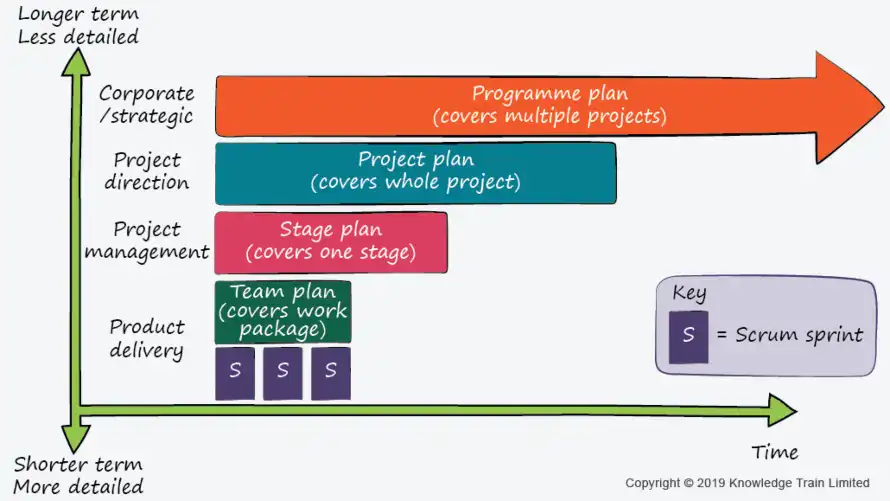
PRINCE2 has the concept of ‘How does project management contribute to risk mitigation?levels of planProject management includes risk assessment and mitigation. It identifies potential risks early on, develops contingency plans, and monitors risks throughout the project life cycle. This approach reduces the impact of unforeseen events on project outcomes.’. This suggests that different plans are required by different levels of the project management team. There are 3 levels of plan in PRINCE2:Can project management principles be applied to non-traditional industries?
- Long-term – this is a high-level project planYes, project management principles can be applied to various industries. Industries such as healthcare, education, and creative fields can adapt which is required by the key decision-makers (the project board).project management methodologies
- Medium-term – this is a stage plan required by the project manager for every stage of the project. to improve processes and outcomes.
- Short-term – this is a team plan required by each team manager (leader) to cover the work done by their team. This is a detailed plan.What are the key metrics for measuring project management success?
Sprints and timeboxingKey metrics include on-time delivery, adherence to budget, scope fulfilment, and stakeholder satisfaction. Quality metrics, team productivity, and return on investment are also valuable measures of project management success.
Agile approaches such as How often should project management processes be reviewed and updated?ScrumProcesses should be reviewed regularly, typically annually or bi-annually. Organisations should also review processes after significant , take this concept even further by suggesting a detailed plan for each ‘sprint’. A Scrum sprint is based upon the key Agile concept of a ‘time-box’ – a fixed period of time typically ranging from between 1-4 weeks.projects
Delivering working products or changes in the market. Continual improvement ensures that project management processes are aligned with business goals and industry standards.
At the end of every Scrum sprint a Scrum team delivers working software to the customer. Delivering working software at the end of each sprint guarantees that the software is never delivered late.Infographic
The customer receives ever increasing increments of working software until, at the end of the final sprint, they receive the fully built and tested system.Subscribe to our exclusive offers and promotions
Time-boxes and team plans
The Agile concept of time-boxes or iterations fits in neatly with PRINCE2’s concept of a team plan because there can be one or more time-boxes within a team plan.Subscribe now
PRINCE2 doesn’t prescribe how many time-boxes a team plan should contain because that’s a decision for the self-organizing Agile team members.
PRINCE2 Agile addresses similar concepts to these in the form of ‘be on time and hit deadlines’ which is one of the five PRINCE2 Agile targets. Similarly, regular releases is one of the five focus areas in PRINCE2 Agile.
Responding to change
Cost of change{"@context":"https://schema.org","@type":"ImageObject","contentUrl":"https://www.knowledgetrain.co.uk/training-courses/project-management-benefits-infographic-v1.0.webp ","description":"Project management benefits infographic","license":"https://www.knowledgetrain.co.uk/license","acquireLicensePage":"https://www.knowledgetrain.co.uk/license","creditText":"Knowledge Train","uploadDate":"2024-10-29T09:00:59.000Z","copyrightNotice":"© 2024 Knowledge Train Limited. All rights reserved.","creator":{"@type":"Organization","name":"Knowledge Train","url":"https://www.knowledgetrain.co.uk"}}
One criticism of more predictive project management approaches{"@context":"https://schema.org","@type":"ImageObject","contentUrl":"https://www.knowledgetrain.co.uk/training-courses/project-management-benefits.webp","description":"Project management benefits","license":"https://www.knowledgetrain.co.uk/license","acquireLicensePage":"https://www.knowledgetrain.co.uk/license","creditText":"Knowledge Train","uploadDate":"2024-10-29T09:00:59.000Z","copyrightNotice":"© 2024 Knowledge Train Limited. All rights reserved.","creator":{"@type":"Organization","name":"Knowledge Train","url":"https://www.knowledgetrain.co.uk"}} is that it is difficult and costly to manage changes. Changes are managed through formal change control processes, and decisions taken by a change authority.
In Agile approaches, changes can be done quickly. This is because customer requirements (e.g. software features) are described by the customer in the form of tasks which are prioritised in a backlog.Related articles
Because planning is never done further in advance than the next iteration (1-4 weeks usually), tasks can be quickly re-assigned a different priority, new tasks added, or unnecessary tasks removed.
Again, PRINCE2 Agile views change positively. One of the five targets in PRINCE2 Agile is the ‘ embrace change ’ target which sees change as something positive to be embraced, rather than something negative to be managed.
PRINCE2 doesn’t have to be waterfall
There is a perception (wrong in my view) that PRINCE2 struggles to adapt to changing business requirements.
This view is based upon the assumption that PRINCE2 is a project ‘ waterfall ’ approach. A waterfall approach is where requirements are documented and approved before moving to a design phase, followed by a build phase and finally a testing phase.
There is nothing in PRINCE2 which prescribes such a waterfall approach . In fact, the latest PRINCE2 manual 7 thHow to create an effective project plan edition assumes that on many projects, requirements emerge and evolve as the project continues.Knowledge Train
PRINCE2 manages such changes to project scope using its change control approach. However, lower-level changes, such as a feature requests can easily be managed at the team level using the prioritization techniques common in Agile approaches.19 Feb 2026
Using both PRINCE2 and Agile
The best of both worldsLearn how to plan a project with this comprehensive guide. We'll cover everything you need to know to create an effective project plan, from getting started to execution, so your projects are on track and successful.
Whereas PRINCE2 focuses on understanding what products are needed to support the business needs, Agile focuses on completing those products in an efficient manner, incrementally delivering more working software (products) as the work progresses.
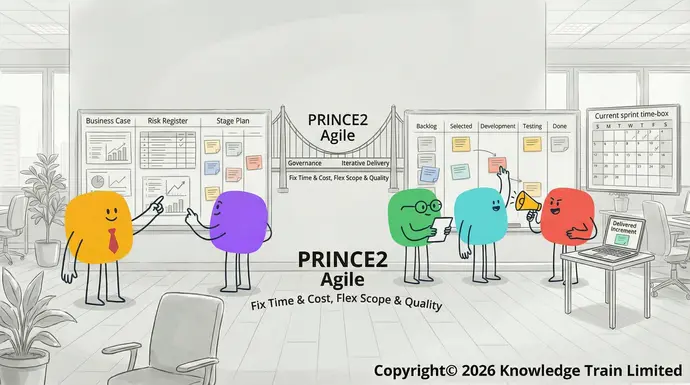
Utilizing Agile approaches on PRINCE2 projects therefore can bring the best of both worlds – the structure and direction of PRINCE2, coupled with the flexibility and responsiveness of Agile.
PRINCE2 is not concerned with how teams organize or the methods they use. It does however define a simple interface between the customer organisation which is paying for the project and the supplier organisation which provides the teams which do the specialist work.
Business focus and timely delivery
This therefore means that teams on a PRINCE2 project can use any development approach they choose – including any of the Agile approaches. Providing they comply with the interface defined by PRINCE2, teams can utilize the benefits of Agile (such as on-time delivery), whilst the customer maintains the benefits of PRINCE2’s focus on the business justification .
Quick PRINCE2 and Agile comparisonGoogle Project Management Certificate
| PRINCE2 | AgileKnowledge Train |
|---|---|
| Useful for the customer to justify a project19 Feb 2026 | |
PRINCE2 Agile gives practitioners both the control and governance to guide the project, whilst at the same time it provides the agility and ability to deliver rapidly in a changing business environment.
If you want to learn more about PRINCE2 Agile, or want to become certified, consider taking a Selecting the best PRINCE2 training providerPRINCE2 Agile course