PRINCE2 vs Agile or PRINCE2 Agile?

IntroductionTo understand how Lean works, you first need to know where it originated. The Lean we know today began its life as ‘Lean Manufacturing.’ Lean manufacturing was first designed for use in the automotive industry. It followed 2 primary concepts: That all processes should be automated as much as possible and that each process only creates what is needed for the next step in a continuous flow.
In 2015, AXELOS, the owners of PRINCE2 launched PRINCE2 Agile. Lean Agile and Lean Manufacturing still share many of the same ideas, i.e. eliminating wasteful processes to improve value and productivity. But, while Lean Manufacturing looks at how to streamline inventories, supply-chains, and human resources, Lean agile looks at software, digital tools, and features.PRINCE2 AgileAs mentioned, Lean has several ‘layers’ the comprise the method. We will first look at the principles that underpin the method and inform those activities and methods that follow. is an attempt to get the best of both worlds – the structure and governance of Enhance your skills with our expert-led coursesPRINCE2 , combined with the flexibility of Agile .Self-paced
This article compares PRINCE2 and Agile methods and approaches and explains how PRINCE2 Agile can bridge the gap between the two.Lean Six Sigma Yellow Belt self-paced online
PRINCE2 vs Agile
PRINCE2£499 +vat
PRINCE2 is the world’s most widely used project management methodology. The 5 Lean PrinciplesPRINCE2 qualificationsThe 5 Lean principles we use today have deviated only slightly from their first incarnation used in Lean Manufacturing. Like many are also a standard feature of project management job specifications in the UK and have grown in popularity since agile methodsPRINCE2, the rules that guide Lean are rational, logical, and based on the needs of the people who use them. They are not complex, and this simplicity has given them such longevity so that organisations can still apply them to their work today. was launched in 1996.When comparing Lean principles with those from the
Currently, over 100,000 Agile ManifestoPRINCE2 exams, it’s clear that both emphasise learning and a people-first approach while enabling are sat somewhere in the world every year.sustainable projects
Agile. The
‘Agile’ is an umbrella term used to refer to numerous product delivery methods, frameworks and techniques used by development teams.Agile
Agile approaches emerged from the software industry in the 1990’s, to try to overcome many of the problems which had beset traditional software projects. They were often delivered late, over budget, and with low quality. focus on continuous improvement also works well within Lean.
There are different The 5 principles of Lean are:Agile approachesDefine Value, the most famous being To generate value, we must first define what Scrum‘value’, is. The finer details may differ from project to project, but value is essentially anything a customer is willing to pay for. To maximize the value of a single product, we must take the time to discover our client’s needs.KanbanOften, customers will not be able to articulate what they want, or in some cases, they might not know what they want. This is especially common when it comes to software and newer technology. By gathering data through interviews, surveys, and other methods, organisations can help customers find the optimal solution to a problem they are trying to solve., Extreme Programming, and Only after we have uncovered what value means to our customers can we proceed.LeanMap the Value Stream. All Agile approaches are based upon the The second Lean principle is to map the 12 Agile principles‘value stream’.. This means using the customers’ idea of ‘value’ as an end-goal, then mapping all the processes contributing toward this goal. Anything that does not add value is waste and must be eliminated.
Who is PRINCE2 for?Establish Pull
PRINCE2 is a customer-focused Unused inventory is one of the biggest wastes in any production system. A pull-based system limits project management methodologywork in process. It offers a set of principles, practices, and processes to enable an organisation’s key managers to justify a project. It helps them understand “why should we do it (the project)?” and “are the benefits worth the costs and risks of doing the project?”. It also focuses on how to manage a project effectively to ensure it still is a worthwhile investment in a changing business environment. (WIP), ensuring that products are created only when needed and in the exact quantities required. Pull-based systems are made by following the value stream and working backward through the development cycle.
PRINCE2 was developed by the UK government in 1996 as a generic project management methodology.In a pull system, the tasks that must be completed are stored in a queue. Developers who are not currently occupied will go to the queue and take the item with the highest priority that they are able to complete.
Focus of PRINCE2Pursue Perfection
PrinciplesFollowing the first four principles helps eliminate almost all waste in development. But this 5th step is considered the most important of all.
PRINCE2 is based upon a set of A large part of Lean is about making the Lean mindset and continuous process improvement a part of organisational culture. For Lean to work as intended, staff must always strive to improve the way they work. Organisations must create an environment of learning, communication, and collaboration that facilitates continuous improvement and the pursuit of perfection.7 principlesApplying the Lean principles which guide all aspects of the method.The principles detailed above help create a framework that guides the
Since it is a project management methodology, it describes the roles and responsibilities of all members of the project management practicesproject management team
there are all kinds of products (outputs) produced by teams of people with various specialist skills. These teams have myriad ways of working and PRINCE2 does not try to guide how they should work.
Instead, PRINCE2 simply defines the interface between the project and these teams in terms of reporting, accountability, and the work to be done.Enhance your skills with our expert-led courses
Discover the essentials of agile and hear from industry expert Narinder Dhaliwal. Watch the video and gain practical insights from this engaging webinar.Self-organisation by teams is also one of the Agile principles. Agile teams determine their own tools and techniques to use (e.g. task backlogs, burn-down charts, Kanban boards), rather than these being mandated by a project manager .
PRINCE2 and Agile comparison
Planning
One key difference between PRINCE2 and Agile methods is that PRINCE2 is often described as a predictive (plan-based) approach, while Agile calls for short-term, incremental achievements independent of an over-arching plan (the adaptive approach).
This means that, while PRINCE2 enables the customer to remain focused on the project’s original business goals, Agile approaches are very responsive to changes in the project environment and customer requirements.Benefits of Agile methodologies
Agile approaches assume that the development process is (predictably) unpredictable. They encourage complete transparency, close collaboration and frequent delivery of usable sub-products that will eventually contribute to the final product delivered.
Levels of planSimon Buehring
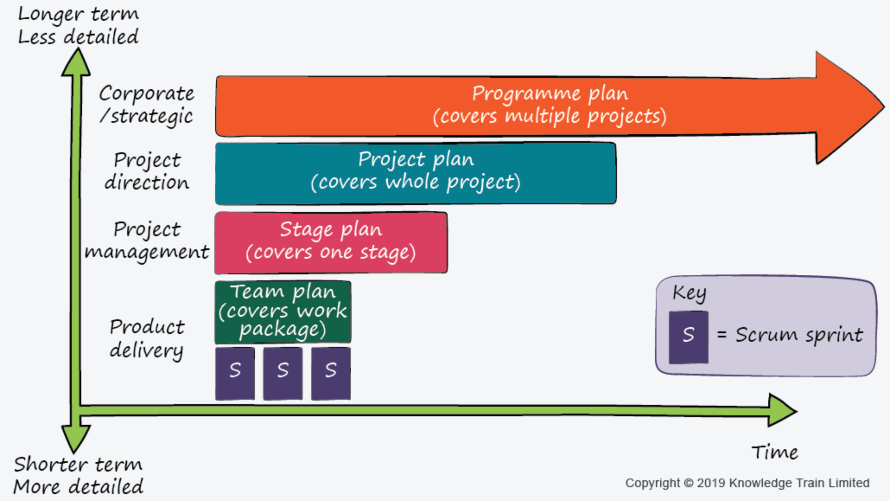
PRINCE2 has the concept of ‘23 Feb 2026levels of plan ’. This suggests that different plans are required by different levels of the project management team. There are 3 levels of plan in PRINCE2:Discover the benefits of Agile methodologies and how they streamline project management. Scroll down for a detailed overview.
- Long-term – this is a high-level project plan which is required by the key decision-makers (the project board).
- Medium-term – this is a stage plan required by the project manager for every stage of the project.
- Short-term – this is a team plan required by each team manager (leader) to cover the work done by their team. This is a detailed plan.
Sprints and timeboxing
Agile approaches such as ScrumScrum Master, take this concept even further by suggesting a detailed plan for each ‘sprint’. A Scrum sprint is based upon the key Agile concept of a ‘time-box’ – a fixed period of time typically ranging from between 1-4 weeks.
Delivering working productsSimon Buehring
At the end of every Scrum sprint a Scrum team delivers working software to the customer. Delivering working software at the end of each sprint guarantees that the software is never delivered late.20 Mar 2026
The customer receives ever increasing increments of working software until, at the end of the final sprint, they receive the fully built and tested system.
Time-boxes and team plansUnderstand what makes a successful Scrum Master and how to motivate your team effectively. Read on for insights.
The Agile concept of time-boxes or iterations fits in neatly with PRINCE2’s concept of a team plan because there can be one or more time-boxes within a team plan.
PRINCE2 doesn’t prescribe how many time-boxes a team plan should contain because that’s a decision for the self-organizing Agile team members.
PRINCE2 Agile addresses similar concepts to these in the form of ‘be on time and hit deadlines’ which is one of the five PRINCE2 Agile targets . Similarly, regular releases is one of the five focus areas in PRINCE2 Agile .How Agile Business Analyst (AgileBA) training and qualifications can help your career
Responding to change
Cost of changeSimon Buehring
One criticism of more predictive 19 Feb 2026project management approaches is that it is difficult and costly to manage changes. Changes are managed through formal change control processes, and decisions taken by a change authority.AgileBA training can elevate your career, offering both starter and advanced paths. Discover how by scrolling down.
In Agile approaches, changes can be done quickly. This is because customer requirements (e.g. software features) are described by the customer in the form of tasks which are prioritised in a backlog.
Because planning is never done further in advance than the next iteration (1-4 weeks usually), tasks can be quickly re-assigned a different priority, new tasks added, or unnecessary tasks removed.
Again, PRINCE2 Agile views change positively. One of the five targets in PRINCE2 Agile is the ‘ embrace change ’ target which sees change as something positive to be embraced, rather than something negative to be managed.
PRINCE2 doesn’t have to be waterfall
PRINCE2 vs PRINCE2 AgileLearn about the hurdles of shifting to Agile with insights from a top training provider. Read on for common organizational challenges.
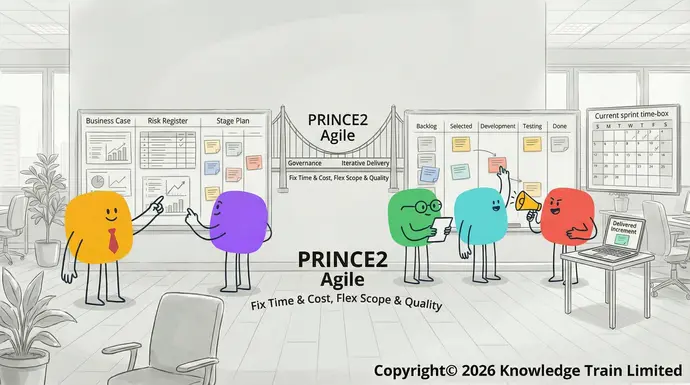
In 2015, in recognition that many people were struggling to find a way of applying PRINCE2 on Agile projects, AXELOS launched PRINCE2 Agile [2] .
PRINCE2 Agile is essentially the same as PRINCE2 . They both rely upon the exact same principles, practices, and processes. The only real difference is that the PRINCE2 Agile guidance explains in detail how to tailor these elements for Agile projects. In the PRINCE2 manual , whilst there are lots of examples of how to tailor PRINCE2 to different project context, it doesn’t go into the same amount of detail as the PRINCE2 Agile manual .
Fix or flex?
In particular, PRINCE2 Agile explains what to ‘ fix or flex ’ for the 6 performance targets of PRINCE2 (time, cost, quality, scope, risks, benefits).
For PRINCE2 Agile, time and cost are fixed. These cannot change. However, to be able to deliver what the customer truly needs, scope and the products’ quality criteria can be flexed.
What to flex must be agreed with the customer. Typically, to achieve this PRINCE2 Agile uses prioritization techniques such as MoSCoW , coupled with sprint backlogs.
The other 2 performance targets (benefits and risk) may be either fixed or flexed depending upon the customer’s needs.
Conclusion
Simply choosing to use a particular method or approach will never guarantee a project is always successful. In fact, any method or approach used without thinking will make a mess of any project.
The PRINCE2 focus on the business justification and whether a project is justified when the business environment changes remain its biggest assets. It helps to ensure that projects are based upon sound business sense.
The ability to respond quickly to changes with on-time delivery of products which deliver value to the customer is the biggest contribution of Agile approaches.
So, is it a matter of choosing either PRINCE2 or Agile ? I don’t think so. If you are looking for a robust project management methodology to use on Agile projects, then PRINCE2 Agile fits the bill perfectly.
PRINCE2 Agile gives practitioners both the control and governance to guide the project, whilst at the same time it provides the agility and ability to deliver rapidly in a changing business environment.
If you want to learn more about PRINCE2 Agile, or want to become certified, consider taking a Give us a callPRINCE2 Agile course .
Both +44 (0)207 148 5985PRINCE2 Agile Foundation and Or chat with us using the link at the bottom of the screen.PRINCE2 Agile PractitionerContact us with questions about the courses on this page, or about which project management certification or training is best for you. qualifications are available to choose from.Finance FAQs