
Key takeaways
An agile PMO succeeds by enabling value delivery and organisational change, not by enforcing process.<
- Agile adoption is an organisation-wide change programme, so the PMO must adapt its role and skills.
- Focus PMO support on value to the right stakeholders at the right time, tailored to each project’s needs.<
- Avoid mandating one set of practices; build pull by making support attractive and easy to access.
- Start with a small, willing project and measure progress by frequent delivery of working products.
- Develop centre-of-excellence services: standards, capability development, multi-project coordination, and stakeholder support.
Introduction<
PMOs
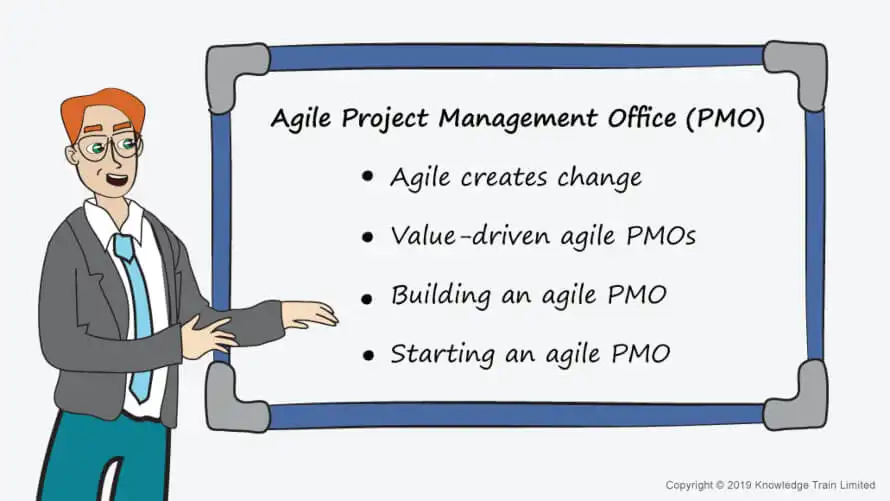
Agile creates change<
When an organization tries to adapt agile practices on its projects, it is setting out on a programme of change. These changes can affect stakeholders beyond the usual realm of the project. Therefore, to support the change to agile, a PMO must also change.
Value-driven agile PMOs
All projects should deliver the optimum value, to the right stakeholders, at the right time. A PMO objective is to smooth the path to achieving these goals.<
PMOs should tailor the support they give to projects depending upon the project’s unique circumstances. In the same way, an agile PMO should tailor its agile support to what each project needs to deliver the value the customer is expecting. Some might need specific assistance with training and coaching team members in certain agile practices. Others might need tools and templates.<
Agility requires practitioners adapt quickly to change. Therefore, an agile PMO must have its pulse on the customer to understand what it truly needs.<
Building an agile PMOp>Note: The APM PMQ qualification used to be known as the APMP qualification. An APM PMQ course is the updated version of the previous APMP course.
When starting out building an agile PMO, it is tempting to think of mandating a set of agile practices and templates across >","learningResourceType":"presentation","teaches":"Simon Buehringprojectsh3>Curriculum23 Feb 2026. That would be a mistake.3>
Becoming an agile organization requires the employees themselves understand why the change is taking place and having them take a role as active participants.h4>APM PMQExplore the best certifications for business analysis and how they can elevate your career prospects. Scroll down to find the right qualification for you.
Often when organizations mandate a top-down change, the initiative fails because the staff do not buy into the change.4>
Therefore, a much better approach to building an agile PMO is to let the project participants come to the agile PMO. When actively seeking the help of an agile PMO, those staff are far more likely to engage with the p>The APM PMQ courses (online and classroom) covers all topics from the APM Project Management Qualification syllabus. This includes the following topics: PMO> than if it is mandated from the top down.h5>Project context and operating environment
Starting an agile PMO5>
One key question to answer is ‘how to start building an agile PMO?’ After all, if the agile PMO is to get its first customers, there must be an initial project where its support is trialled and championed.ul>
The solution is to find a project, probably small, on which the team members are keen to try agile. Then to provide the training, mentoring and coaching to implement sensible agile practices and tools on that project.li>Business as usual
The team should measure progress solely on its ability to deliver working products early and regularly. The team must be based around self-motivated people who collaborate with the business. To minimize waste, the team should keep things simple. The team should also have regular retrospectives to improve the agile processes being used.>
Multi-skilled agile PMOsli>Project
Since moving an organisation from a more predictive, functional style organization to a more agile organisation required organizational change management. Therefore, the agile PMO must become conversant with > organisational change managementli>Project management frameworks, tools and techniques.>
This therefore requires the PMO and its staff to become more than just project management experts.li>Programme management
Centres of excellence>
Some agile PMOs deal with the challenges of helping organizations become more agile by becoming centres of excellence which provide a range of services. The best practice PMO framework li>Portfolio management P3O> describe the role and function of a PMO centre of excellence. This kind of li>Tools to understand the project environment. PMO structure> provides some of these services:>
Developing and implementing standardsh5>Structure of projects and organisations
Providing agile templates e.g. for 5> user storiesul> , test cases), and standardizing the use of agile toolsets.li>Organisation structures
li>Organisation riles
li>Project governance
>
>
h5>Project life cycle
5>
ul>