Agile PMO

Key takeaways
An agile PMO succeeds by enabling value delivery and organisational change, not by enforcing process.
- Agile adoption is an organisation-wide change programme, so the PMO must adapt its role and skills.+44 (0)207 148 5985
- Focus PMO support on value to the right stakeholders at the right time, tailored to each project’s needs.
- Avoid mandating one set of practices; build pull by making support attractive and easy to access.[email protected]
- Start with a small, willing project and measure progress by frequent delivery of working products.
- Develop centre-of-excellence services: standards, capability development, multi-project coordination, and stakeholder support.
IntroductionCyprus
PMOsCzech Republic have been a common feature on DenmarkprojectsEstonia in larger organizations. However, in the last decade or so, the responsibilities of PMOs have evolved into a much wider brief. Nowadays, PMOs are also expected to support both FinlandportfoliosFranceprogrammesGreece, in addition to their traditional project management brief.Ireland
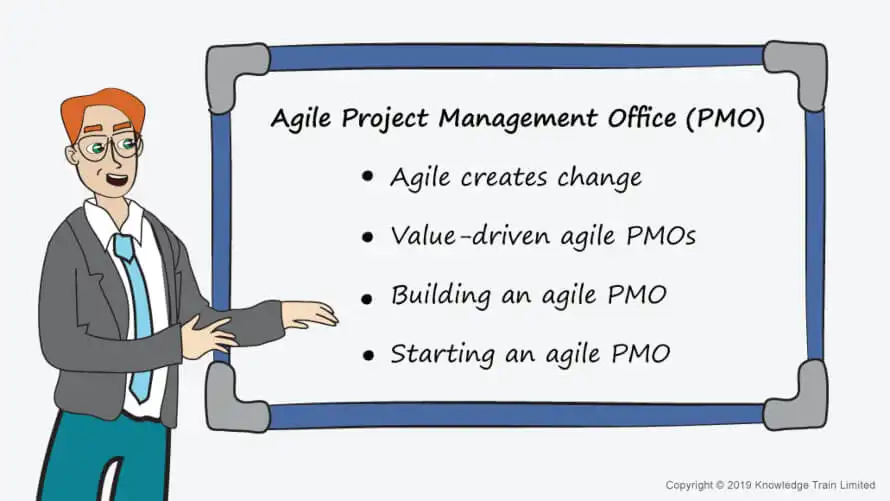
Agile creates changeItaly
When an organization tries to adapt agile practices on its projects, it is setting out on a programme of change. These changes can affect stakeholders beyond the usual realm of the project. Therefore, to support the change to agile, a PMO must also change.Latvia
Value-driven agile PMOsLithuania
All projects should deliver the optimum value, to the right stakeholders, at the right time. A PMO objective is to smooth the path to achieving these goals.Luxemburg
Just as Malta agileNetherlands itself is a customer-focused mindset, an Poland agile PMOPortugal must be based upon a customer-collaboration mindset.Romania
PMOs should tailor the support they give to projects depending upon the project’s unique circumstances. In the same way, an Slovakia agile PMOSlovenia should tailor its agile support to what each project needs to deliver the value the customer is expecting. Some might need specific assistance with training and coaching team members in certain agile practices. Others might need tools and templates.Spain
Agility requires practitioners adapt quickly to change. Therefore, an agile PMO must have its pulse on the customer to understand what it truly needs.Sweden
Building an agile PMO
When starting out building an agile PMO, it is tempting to think of mandating a set of agile practices and templates across projects
Communicate with intent, listen actively, and manage conflict to keep teams aligned and motivated.Align projects to organisational strategy using data, KPIs, and informed decision-making.
Build capability through training, certifications, mentoring, and continuous learning with modern tools.
Contents
Introduction
Technical project management skills
Leadership and interpersonal skills
ConclusionIn combination, these traits allow project managers to:
As organisations grapple with the challenges of becoming more agile, there is an increasing awareness that to succeed requires understanding more than just agile practices and Plan and implement project managementprojects .Lead team members
To move to greater agility requires the organisation to understand that what in fact it is undertaking, is organizational change. Therefore, the people driving these changes must understand and be able to apply some of the well-established frameworks, techniques and bodies of knowledge that form the Deliver value and business objectives. change managementAs the professional world changes, so do the skills necessary for profession.project management
Relying only on agile gurus to coach team members is only one small part of a much bigger jigsaw puzzle requiring an organisational change management approach.. In this article we will look at some of the