
Key takeaways Choose between the BCS Business Analysis Foundation, specialist practitioner-level modules, or the International Diploma, depending on your experience and how far you want to progress.
AI is already reshaping how project work is performed, especially the repetitive tasks that drain time and focus.
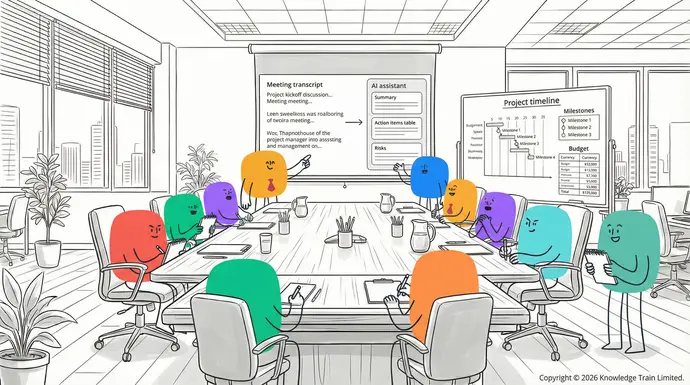
- AI can quickly turn meeting transcripts into summaries, action logs, draft schedules and initial risk lists, saving significant admin time.
- Outputs vary by tool and prompt, so results must be reviewed, corrected, and refined before use.Best for
- Project managers remain accountable, using AI as an assistant rather than delegating judgement and context.Prerequisites
- Fast technology cycles make unlearning and relearning essential career skills.Duration
- Adoption should be governed with clear approval, privacy, and security controls.Delivery options
Introduction
Artificial intelligence is rapidly transforming the field of Instructor-led, self-pacedproject management . From administrative efficiency to enhanced decision-making, AI offers a variety of benefits. This webinar provides a deep understanding of AI’s current and future applications in project management.BCS BA Foundation exam
Video
Watch the video, listen to the 60 minutes, multiple choiceaudio , or read the full BCS Foundation certificatetranscript below.Foundation
About Mashhood Ahmed
Mashhood Ahmed has over two decades of project management experience and a deep understanding of AI applications in various industries. He has shared his knowledge globally, enhancing project outcomes through innovative AI integration.Business Analysis Practice
Transcript3 days or 13 hours
Here’s the full transcript of the webinar.
00:00:00 Mashhood AhmedInstructor-led, self-paced Knowledge Train for giving me this opportunity to speak in front of this for crowd. So today I will be talking of about “The Rise of AI – How AI is Revolutionising the Project Management”. This is not something that will happen in the future, this is something happening right now today, and we will see that. How we can do this in a live demo in 20 minutes from now, right, so, let’s just stay there. So, before I get started, let me just make sure my slides are working. Yes, they are.BCS MBP exam
00:00:33 Mashhood Ahmed : There we go, my name is Mashhood Ahmad. I’m a certified human, I’m not a robot, I’m not a hologram, I’m a real person. right? So, if you would like to connect with me, you can scan the QR code. My LinkedIn profile and connected you know the LinkedIn. About my work, I have over 20 years of Project Management, Consulting and Programme Management experience worked in US, Canada and Middle East. I got my 60 minutes, multiple choicePMP certification back in 2008, so I’m an old guy with the PMP certification. Got my master’s from University of Waterloo and few years back I challenged myself to do something different and that was the engagement and speaking in front of the crowd that took me all over the world. I’ve been to South Africa, Tanzania, New Zealand, Singapore, you know Pakistan US and Canada, so many places in within US and Canada that I cannot even count. So that’s been my experience and I do volunteer for BCS Practitioner certificatePMI and a couple of other volunteer organisations. So, I highly recommend all of you to volunteer in whatever capacity you can, because that’s how they give back to the society, right. So that’s a good sign of our humanitarian side.Modelling Business Processes
00:01:51 Mashhood Ahmed : So, with that you know connecting the LinkedIn if you would like to and we’ll just get into the topic. Before I get started, I usually start my talk with patterns and the reason I like to talk about patterns is because patterns are everywhere. They tell us very important lessons in life, right? They tell us what’s gonna happen, how to map the pattern, how to see the pattern. So, our goal is to understand the pattern, follow the pattern. Either break the patterns or making patterns so that we are getting the edge from those patterns. So, learning from patterns, let’s just look at industrial revolution. So first industrial revolution that lasted over 150 years was about moving people from agricultural society to their national society, right? So that was the time when, you know, the agriculture industry saw like, farming equipment, tractor trailers and then we see the mechanisation. We saw the steam water power, some radio network and things like that. OK, that was 150 years long time frame. Then after World War II we get into second industrial revolution up until late 80s, early 90s.Requirements Engineering
00:03:06 Mashhood AhmedSee course: And that was all about mass production, assembly line, electricity, power grid, road network, rail network, aero planes flying all over the place. And that lasted about 60 to 65 years, depending how you calculate that time frame. And then in early 90s, we get into the computer automation in mid 90s, we saw the birth of Internet and we got like connected devices. People start talking, communicating and then that lasted about like 30 plus years now. Where we are today in 2024, we are looking at Cyber physical system AI technology, neural network and other new technologies. So, the important lesson here is 2 form, one time it takes for this revolution is shrinking, and the innovation growth that is happening in each in this revolution is much higher than before. That means it is very important for us to understand and learn these new technologies and new things as they come along for us. And also, we are the 1st generation who will experience multiple industrial revolutions in our lifetime. What I mean by that somebody you know like our parents, right? Most of our parents born maybe 40s or 50s, you know, and they spend their whole career in one industrial revolution right. They stayed there, they did some little bit of a change, and it was ok for the adoption. But we’re the 1st generation that will see multiple industrial revolution, meaning this fourth industrial revolution will be much shorter and innovation growth here will be much faster than we can catch up.
00:04:54 Mashhood Ahmed : With all things happening in generative AI, it’s impossible for anybody to catch up with all the things that have happened up there. So, what is important here is from these patterns is to have the important skill set and I would like to talk about two skill sets that are very important. These are not technological skill sets: this is a pure human skill set. Number one is our ability to unlearn. We need to unlearn the old ways of doing things, and we need to unlearn our old habits and old patterns. Then we need to supplement this with our ability to relearn, right? So, we need to relearn the new way, we need to adapt to the new ways of doing things. And we need to build our new habits so that we can have this continuous improvement throughout our life. So, this is very important, right? So, we need to unlearn how we do things and we need to relearn the new way and we need to be OK with not knowing everything that is happening in the technology. Or the business because it’s just really not possible to catch up with all the new innovation and the growth that is happening at the speed of the light.
00:06:10 Mashhood AhmedThose responsible for eliciting, analysing, documenting, and validating business requirements in projects and change initiatives.: So, with that, I’m going to move into the definition of AI. I believe everybody has seen some definition of AI. Everybody has a good understanding of what AI is, right? But for me it is simple which is, It’s the ability for the computers to perform tasks that normally requiring human intelligence or to imitate intelligent human behaviour such as problem solving, learning, reasoning, having the logical discussion right, visual perception, looking at the pictures a dog or a cat. Recognising voice, is this a male voice or a female voice, is this like a European accent, Australian accent or an American accent, right? So having that recognition and different languages and then we can put like a large amount of data. And patterns into this AI engine that can analyse this and give us the more intelligent results that we are looking at. So, with that, I will talk about the AI categories at the very high level. So, the first one is generative AI that can generate the content. It can generate images, it can generate videos, it can generate voice, any content that we are trying to play with generative AI is an example of generative AI. For the generative AI can also build the context that means it can infer from the information what is not being said and kind of fill those gaps. And when it does, sometimes it does it correctly, other times it does it incorrectly and it causes the hallucination.
00:07:50 Mashhood AhmedNone: The next one is the specialised AI, which is like a narrow AI that can do something very, very specific. So, the example I typically give is in healthcare, radiologists have been using AI to look at the images and see if there’s a cancer or if what type of problems are right. So, this is like image recognition kind of a problem. And what we could do is we could look at the image and say yes, this patient has 80% chance of cancer. This person patient does not right so and vice versa and then we have hybrid AI that can combine the both. So, what happens when we combine the both so, the same example of medical diagnosis. Now the doctors can say OK, this patient has cancer cells, if I treat this patient with this medication or this therapy, what would be the outcome? How the cancer will shrink, how it will impact the patient body because you know, cancer medications affect the human body very dangerously, right? So, we need to keep a balance up there and that’s an example of a hybrid AI where you can use specialised AI for the layer of generative AI images, pictures. And other details and see what the scenario or the simulation may look like.
00:09:09 Mashhood Ahmed3 days or 16 hours: So, some of the research findings I just put these two research findings on one slide. I’m pretty sure all of you have seen this one “AI won’t replace humans – but humans with AI will replace humans without AI”. Now if you take this same statement 100 or 200 years back, the farming equipment will not replace the farmers, but the farmer who use the farming equipment will replace the farmer who do not use the farming equipment. OK, so you replace AI with the technology of first industrial revolution, second visual revolution and this remains, this second remains the same that means we need to learn, and we need to adopt the AI and move forward. The second one, from 2019, Gartner research finding that “Says 80% of today’s Project Management task will be eliminated by 2030 as AI takes over”. It is not saying 80% of project management function or project managersInstructor-led, self-paced. It’s saying 80% of project management task. Let me ask this question to this, we have about 47 people here. Is there anyone in this room who loves to take the meeting minutes as a project manager? who tries to take taking the meeting minutes?
00:10:25 Mashhood AhmedBCS RE exam: Do we have anyone? I haven’t found one yet, somebody says haha, no way, right? So that’s the problem I see sometimes down there, there you go. So, I have done this, this talk or similar talk to like thousands of project managers across the globe. I haven’t find a single project manager who loves taking meeting minutes. And this is exactly what we will do today. We will have like a meeting minute; we will put into ChatGPT and Google Gemini. You’ll see some results and we will play with it to see what else we can do. So, with that, I’m going to talk about why all of this is happening right now. Because AI is one new terminology, it’s first was discussed by Alan Turing in 1950s right, so it’s been in the academic topic for last 80-90 years almost now right 70-80 years. However, now today we have the better algorithms. We have the good programmes, we have infrastructure, the cloud that can provide us all the things that we need. I mean 10 years back, 15 years back, you need to set up a data centre it takes like, you know, months and months now you can set up a data centre. And within three hours, as long as you know what you’re looking at, then the third point here is internet of things. Now we have connected devices, so we have more concise and more accurate data that was not available. The last point is structured and unstructured data, we all understand what is a structured data. It is the data in the spreadsheet in tables in the rows and columns, right. And in the third industrial revolution we solved the structured data problems, but the large amount of data is unstructured. Unstructured data means the videos, the documents, the PDFs, the document Repository, SharePoint, Google Drive, this drive, that has like thousands of documents. But nobody goes and read it, the example I gave as project manager did you write a lesson learned document from the project right?
00:12:34 Mashhood Ahmed60 minutes, multiple choice: But nobody needs it, I have to do as a project manager, I do it, I put on the repository nobody looks at it. Now with having that unsorted data access using AI, anybody can go and breathe that data and get some insight from it, and that’s gonna change the way the future would be. So quick overview of the generative AI landscape, we have Google has a product called Google Gemini. We will do a live demo with that ChatGPT has a ChatGPT version that is available to the market. Cloude has cloude 2 and 3 now 3.5 that is available to the public. And now they have the web version of it, that’s something I have not experienced by myself, but a lot of the people are talking really good value that they are getting from the cloude 3.5. Then we have also have Metal Llama from Facebook and Microsoft have their own product which is called Copilot. Copilot uses the ChatGPT in the back engine, but then this response you get from ChatGPT, and Copilot are different, right? So, there’s some fine tuning that was done there as well.
00:13:49 Mashhood AhmedBCS Practitioner certificate
{"@context":"http://schema.org","@type":"EducationEvent","name":"BCS Business Analysis Practice course","startDate":"2026-07-06","endDate":"2026-07-08","description":"BCS Business Analysis Practice course","url":"https://www.knowledgetrain.co.uk/business-analysis/business-analyst-course/bcs-business-analysis-certification/bcs-business-analysis-practice","eventStatus":"EventScheduled","eventAttendanceMode":"OnlineEventAttendanceMode","audience":{"@type":"Audience","name":"00:26:14 Mashhood Ahmed<p>The BCS Business Analysis Practice course is suitable for business analysts, business managers and team members, business change managers, software development professionals, and project managers seeking continuing professional development (CPD), and employees wanting an understanding of business analysis techniques and best practices.: Copy the same prompt, because I want to use this on the ChatGPT and let’s see what Gemini does. So now it’s telling me, number one I project manager need to engage the web team and the stakeholder to assess internal capabilities and resources and that should be done by July 11th. Now sometimes it picks up dates incorrectly and that’s something that we need to pay attention to right so, all the dates are incorrect in this case. Develop detailed project charter outlining scope, time and budget and risk present for chartered sponsor for approval, established communication plan. Begin identification of project risk and mitigation. Now if you look at these dates, it’s putting all these days at 11th of July and 18th of July and the reason being is because in the meeting we said that the project manager, said that he will get back to the sponsor within two weeks for the project charter. So, if you look from today’s date, two weeks is July 11th, so that does make sense, right? So, it kind of loses few contacts, but it kind of tried to build the context because we did not provide the meeting date when that meeting was actually happened. So, let’s see what the ChatGPT would do for the same prompt, I put this one in ChatGPT. So, now it is saying draft project charter project manager within two weeks, engage web team resource stabilities within two weeks coordinate with integration and Intel CRM teams. IT team need to have that discussion, and this is to be announced or to be discussed.
{"@context":"http://schema.org","@type":"EducationEvent","name":"BCS Foundation Certificate in Business Analysis course","startDate":"2026-07-13","endDate":"2026-07-15","description":"BCS Foundation Certificate in Business Analysis course","url":"https://www.knowledgetrain.co.uk/business-analysis/business-analyst-course/bcs-business-analysis-certification/bcs-business-analysis-foundation","eventStatus":"EventScheduled","eventAttendanceMode":"OnlineEventAttendanceMode","audience":{"@type":"Audience","name":" out there and they understand how the <p>The BCS Foundation certificate in Business Analysis course is suitable for business analysts, business managers and team members, business change managers, software development professionals, and project managers seeking continuing professional development (CPD), and employees wanting a foundation of business analysis techniques and best practices to call upon.projects
£1,3, prioritisation, resource optimisation, have a contingency plan. Regarding scope creep, have a clear scope definition, have a change control process, have a regular communication. Do an iterative development, integration, early testing, get experience resource. Have a good vendor collaboration and have some contingency plan and then some additional mitigation strategies. So, you see that out-of-the-box in the last 15-20 minutes, you just give some prompts and then start giving us a lot of information that if I have to type, if I know all those things by my head, if I have to type, that will easily take me anywhere from 30 minutes to one hour. Because that will take my brain power, now if I have this, I can copy paste and I can make my own. But never, ever copy paste and send it to your managers without reading it. That’s a suicidal mistake at your workplace, so please don’t do that. So, with that, I’m going to get to the last prompt, which is custom prompt, and we’ll change the direction here. I will ask what would you like to ask ChatGPT based on this meeting transcription.
00:38:52 Mashhood Ahmed: You can type, OK what question would you like to ask on this? Yes, so Layla is saying it’s rare that we do the verbatim minutes nowadays, we do the action and risk. Yes, and that’s the example that we saw in the second prompt I asked give me the action item table and that’s something is very, very useful for the project management.
00:39:27 Mashhood Ahmed: So typically, people would say like in when I get to this prompt is like OK, can it draft me like a statement of the work? Can it help me draft like a project charter? Can it create a risk diagrams? Yes, it can now I think the risk mitigation is based on the BAU. A unique project would not be using toolbox to provide any mitigation. Yes, you’re right so again, think of as I said that you know, think of these responses for generative AI as a response from a smart intern that you recently hired. He or she understands the project management but does not understand the details or is not experienced as a human. So, somebody’s asking can you generate again chart or project timelines.
00:40:17 Mashhood Ahmed: OK, good let’s just do that.
{"@context":"http://schema.org","@type":"EducationEvent","name":"BCS Requirements Engineering course","startDate":"2026-07-20","endDate":"2026-07-22","description":"BCS Requirements Engineering course","url":"https://www.knowledgetrain.co.uk/business-analysis/business-analyst-course/bcs-business-analysis-certification/bcs-requirements-engineering","eventStatus":"EventScheduled","eventAttendanceMode":"OnlineEventAttendanceMode","audience":{"@type":"Audience","name":"00:44:20 Mashhood Ahmed<p>A BCS Requirements Engineering course is suitable for business analysts, business managers and team members, business change managers, software development professionals, and project managers seeking continuing professional development (CPD), and employees wanting an understanding of business analysis techniques and best practices.: Now what you need to do is you need to build the AI governance within your team. You need some legal advisors. You need some privacy advocates, you need
{"@context":"http://schema.org","@type":"EducationEvent","name":"BCS Modelling Business Processes course","startDate":"2026-08-03","endDate":"2026-08-05","description":"BCS Modelling Business Processes course","url":"https://www.knowledgetrain.co.uk/business-analysis/business-analyst-course/bcs-business-analysis-certification/bcs-modelling-business-processes","eventStatus":"EventScheduled","eventAttendanceMode":"OnlineEventAttendanceMode","audience":{"@type":"Audience","name":" and <p>The BCS Modelling Business Processes course is suitable for business analysts, business managers and members of their team, business change managers and project managers seeking continuing professional development (CPD), and employees wanting an understanding of business process modelling.Agile
{"@context":"http://schema.org","@type":"EducationEvent","name":"BCS Foundation Certificate in Business Analysis course","startDate":"2026-09-07","endDate":"2026-09-09","description":"BCS Foundation Certificate in Business Analysis course","url":"https://www.knowledgetrain.co.uk/business-analysis/business-analyst-course/bcs-business-analysis-certification/bcs-business-analysis-foundation","eventStatus":"EventScheduled","eventAttendanceMode":"OnlineEventAttendanceMode","audience":{"@type":"Audience","name":"00:54:42 Jay Gao<p>The BCS Foundation certificate in Business Analysis course is suitable for business analysts, business managers and team members, business change managers, software development professionals, and project managers seeking continuing professional development (CPD), and employees wanting a foundation of business analysis techniques and best practices to call upon.: Thank you Mashhood, for the great presentation. Thanks, guys, for participating, we’ll be having a webinars roughly every other month and keep subscribed and we will let you know of the of the upcoming ones. Thank you.