How to write a business case

Scheduling
A business case forms an essential component of the curriculum of the : Enables users to set deadlines, create timelines, and manage project milestones and dependencies.best project management coursesResource allocation
Collaboration toolsYou may also use a business case to justify an investment you make in your personal life. For example, when you’re thinking of moving home to another area. You and your spouse will need to understand the costs of moving, the timescales and risks involved, and weigh these up against the benefits to be gained e.g. saving time traveling to your office, or your children able to go to a better school.
Why have a business case?: Facilitates communication, file sharing, and document collaboration among team members.
Projects should not just start on a whim or because of vanity – although a lot of money has been wasted over the years on such Reporting and analyticsprojects: Offers reporting capabilities and analytics to generate insights on project performance, progress, and resource utilisation..Time tracking
For business organisations, justification for a project usually takes a commercial form i.e. evaluating how much money could be made from the investment. For example, investing money in developing a new software app to bring first to market, might be deemed to bring certain monetary benefits (in terms of sales) which exceeds the costs of investment.: Allows users to monitor the time spent on tasks or projects for time management and billing purposes.
For government organisations, justification is probably not a commercial one, but could be based upon giving value for money to achieve certain benefits. For example, a public health campaign extolling the benefits of flu-vaccinations for elderly people, might be judged as giving greater value for money than having no campaign, and instead relying on treating patients in hospital once they have contracted the virus.Budget management
With so many competing claims being made on scarce funds, organisations need the assurance that the decision they are taking is the right one. After all, there will not be enough funds to pay for all the ideas for projects which are floating around the organisation.: Provides tools to track expenses, manage project finances, and compare against budget estimates.
Who uses a business case?Benefits of using project management tools
Business cases can be used by many different levels of management within an organisation. Not only are they used to justify the investment in an individual project, but also they are typically used by a Project management tools offer numerous benefits for organisations, teams, and individual project managers. Some of the key advantages include:portfolio managementEnhanced productivity office to help it decide which projects will contribute to the organisation’s strategic goals. That way, they can filter out the bad ideas for projects, and only fund projects which will contribute to strategic goals.: Project management tools help streamline workflows, automate tasks, and eliminate inefficiencies, leading to increased productivity.
A business case is also often used by a project sponsor or project executive to help it decide if they should invest in a specific project.Improved communication
In all cases, the business case must be written and approved prior to any major commitment of resources.: These tools facilitate seamless communication and information sharing among team members, reducing misunderstandings and delays.
What form does a business case take?Better resource utilisation
Business cases can take many forms – digital or analogue. The tools you use to create one are also many and varied. Common business tools such as Microsoft Office might be used. Rather than being a document or slide deck however, it could equally be in the form of an email.: Project management software assists in optimising the allocation of personnel, budgets, and other resources, leading to more efficient use of resources.
Equally, a business case could be written by hand on a whiteboard or flipchart, or on the back of a cigarette packet!Increased accountability
What you should always remember is that a business case does not have to be a huge long document. In fact, it should be as short as possible, and only include the most important information. That way it cuts out the noise and provides decision-makers with just the right information to enable them to take sensible decisions.: Clearly defining roles, responsibilities, and tasks within projects helps increase accountability among team members.
For those of you interested in Real-time visibilityproject management: Project management tools provide real-time visibility into project progress, enabling teams to track milestones, identify bottlenecks, and address issues proactively., the project management methodology known as Data-driven decision makingPRINCE2: Access to analytics and reporting capabilities allows teams to make informed decisions based on data and insights. focuses its decision-making on a project on having a viable business case.Standardised processes
Business case examples: Project management tools help establish standardised methodologies and processes across projects, improving consistency and efficiency.
We will now give you 2 business case examples. The first example is one which you might find useful for taking decisions in your personal life. The 2nd business case example is more business focused project.Remote work support
Business case example 1: Moving home: These tools enable effective collaboration and project management, even for distributed teams or remote workers.
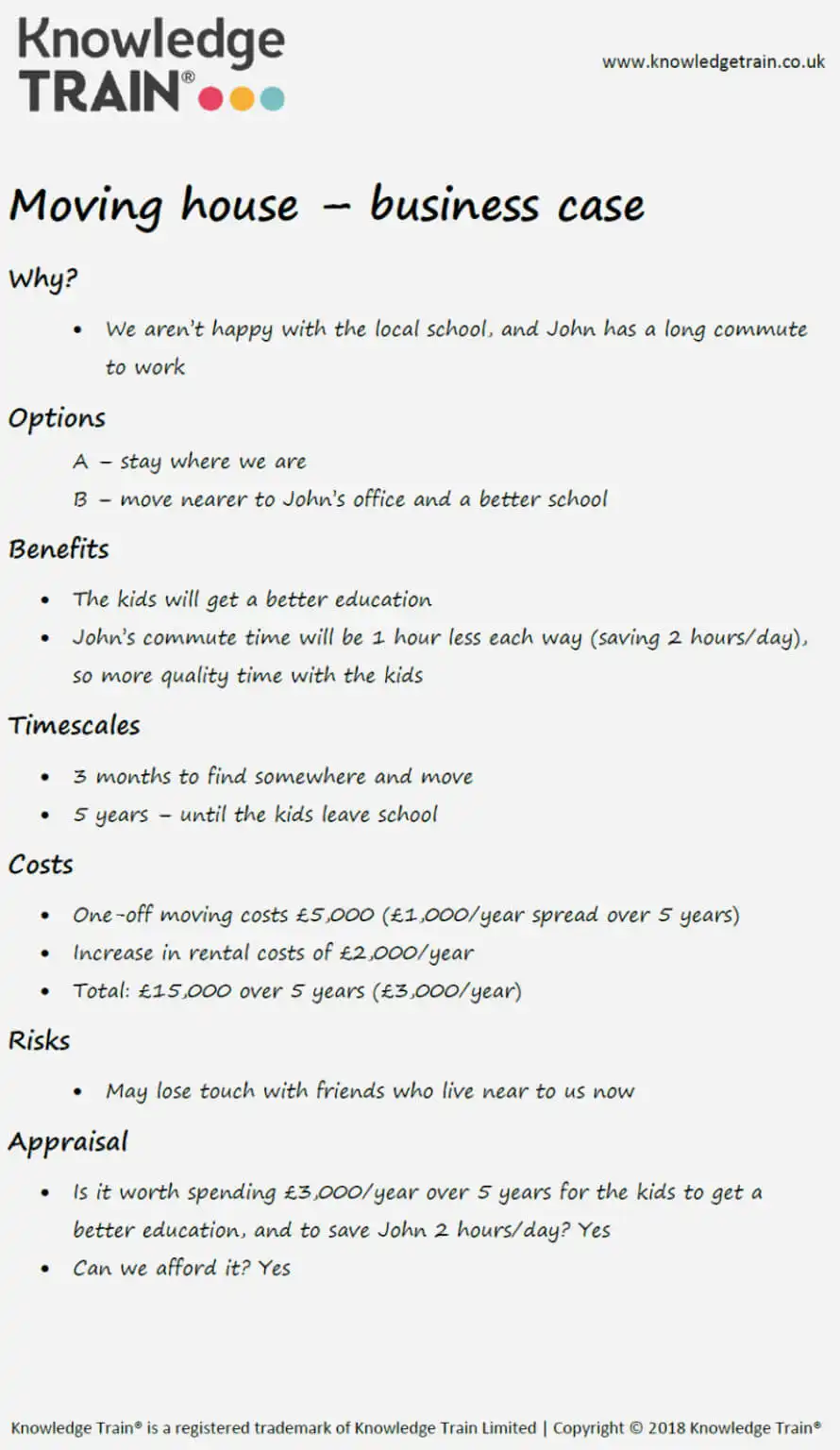
Suppose you and your spouse are considering moving to a new home. You will need to weigh up the pros and cons of moving. This is done using a business case. You might not call it that, but that’s what it is. Let’s look at an example.Types of project management software
ReasonCloud-based vs on-premise solutions
As you can see from the example, the first thing to be clear about in a business case is the reason for doing the project or activity. In this example, the couple has answered the question Project management software can be classified into two main categories based on their deployment models:Why?Cloud-based solutions In fact, there are two problems here – the local school and John’s long commute.Hosted on remote servers and accessed through web browsers.
Options consideredAdvantages: Low initial costs, automatic updates and maintenance, accessibility from any device with an internet connection.
A business case should weigh up the competing options which have been considered. After all, there is usually more than one option. Perhaps an alternative option would have been for John to change his job to one nearer their current house. However, this wouldn’t solve the issue with the school.Disadvantages: Dependence on internet connectivity, potential security and privacy concerns.
BenefitsOn-premise solutions
The benefits of a project or activity are the positive things you’re going to get back in return for your investment of time and money. In this case, the kids will get a better education, and John will save time each day.Installed and maintained on local servers within an organisation’s own infrastructure.
TimescalesAdvantages: Greater control over data security and customisation, offline access and usage, compliance with specific industry requirements.
It’s also important to understand how long the investment of resources will take. This is so that the organisation (or family in this case) knows when the resources will be freed up to work on other Disadvantages: Higher upfront costs, in-house IT support and maintenance required, limited scalability.projectsIndustry-specific vs general-purpose tools or activities.Project management software can also be categorised based on its intended target audience and industry:
There are usually 2 timescales to consider. First, the timescale of the project or activity – in this case 3 months to find a new house and move there. Second, the time over which the benefits shall be realized. In this case it’s 5 years until the kids leave school.Industry-specific tools:
CostsTailored to the unique needs and requirements of specific industries such as construction, software development, marketing, healthcare, etc.
The costs of doing the project or activity is the next important bit of information. On this project, the costs of moving to a new house will be £5,000. These are the project costs.Advantages: Specialised features and functionalities, compliance with industry-specific regulations and standards.
However, the couple will spend an additional £2,000/year for every year over which the business case is calculated. For a project in an organisation, this is usually referred to as the operational costs of maintaining and operating the projects outputs e.g. an IT system. At this point, the couple knows the total costs over the timescales when the benefits shall be realized.Disadvantages: Limited flexibility and adaptability outside the specific industry, potentially higher costs.
RisksGeneral-purpose tools:
For any activity or project, it’s also important to understand the major risks involved. Risks are the uncertain things which may or may not happen during the period of the investment. There is only one risk identified here, which is the risk that the couple might lose touch with friends who live close to them right now.Designed to cater to project management needs across various industries and sectors.
Investment appraisalAdvantages: Flexibility, broader adoption and user base, often more cost-effective.
The next section is where the costs and timescales and risks are weighed up. For this project, it’s a simple decision for the couple to decide if it’s worth spending money over the next 5 years to give their kids better schooling and to save John 2 hours a day commuting.Disadvantages: May lack certain industry-specific functionalities or customisation options.
For an organisation to decide if an investment is worthwhile, however, there are several different ways in which it can decide about the investment.The choice between different types of project management software depends on factors like organisational requirements, budget constraints, industry regulations, and specific project needs. By considering these factors, teams can select the most suitable solution to effectively manage their projects and optimise efficiency.
Often in organisations there are rules defined to help business analysts or Enhance your skills with our expert-led coursesproject managers write what’s called an investment appraisal. In the next example, we’ll look at one example known as net benefits.
Business case example 2: Handheld device project
Imagine a heating repair services company that uses a paper-based set of forms filled in by an engineer during site visits. The spare parts required to fix the heater are recorded on a form which is given to staff to process back in the office. They then order the parts, and schedule a follow-up visit for the engineer to fix the heater.Instructor-led
Let’s now look at this example business case.File attachments and comments
Executive summaryIntegrations with popular apps and services.
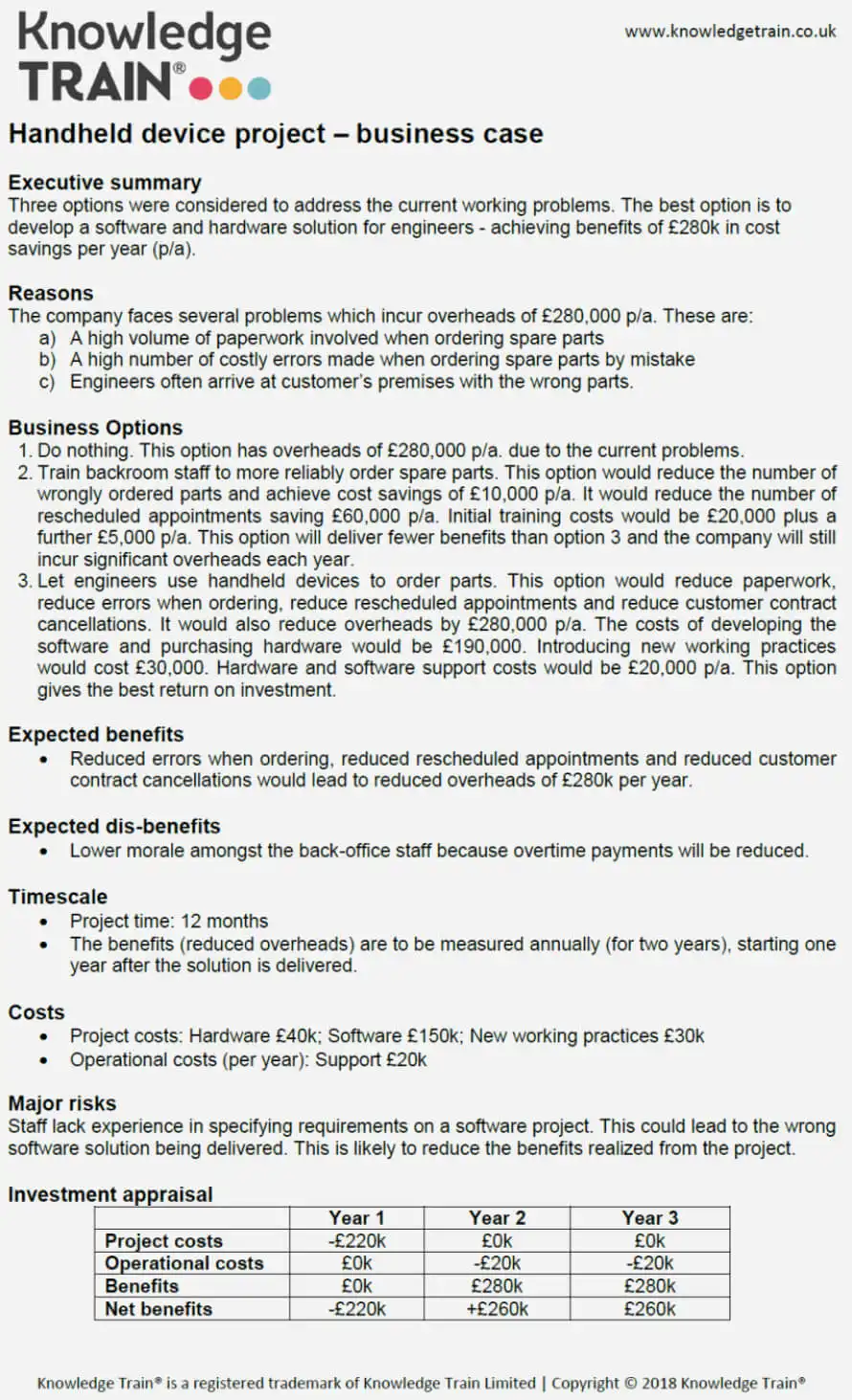
This sample business case contains an executive summary. This section briefly describes the selected option and the key benefits it will bring.Pros
ReasonsEasy to get started and use
Dis-benefitsCan get messy with more complex projects
This example also contains a dis-benefit which is that the back-office staff morale will be lower due to reduced overtime payments. A dis-benefit, if you’re wondering, is a negative consequence of a project. It’s not the same as a risk which implies something uncertain. A dis-benefit is something which you know will happen because of the project and it has negative consequences for the organisation. It’s the opposite of a benefit!Advanced features require paid plans.
TimescalesAsana
Just as we saw in the previous example, the business case contains 2 timescales – the project timescales (i.e. the time it will take to complete the project) and the benefits realization timescales (i.e. the time over which benefits are expected to be realized).Asana
Costs is a highly versatile task and project management tool that provides features useful to teams of all sizes and skill levels. The free version offers many of the main features to help
Again, there are 2 costs – project costs and the ongoing operational costs over the benefits realization timescale. When the decision is taken whether to invest in this project, the total costs (i.e. project costs and ongoing operational costs) are weighed against the expected benefits over the same time period.track projects
Risks and tasks.
One major risk has been identified in this example, but on your project, there could be many risks.Features
Investment appraisalMultiple views for projects (list, board, and timeline)
The final section is the investment appraisal. The investment technique used in this example is called net benefits. As you can see from the table, the project and operational costs are recorded for each year of the investment.Dependencies and subtasks for advanced task management
The project lasts 1 year which is why the project costs are zero after year 1. Of course, the benefits won’t be realized until the solution is in place and the company starts to use the handheld devices.Basic reporting and dashboards
The net benefits are simply the total benefits minus the total costs. This shows that the company will start to get a return on its investment sometime towards the end of year 2. This knowledge is vital if the decision-makers are to take a sensible decision about whether to invest in the project.Team collaboration and communication tools
Business case templateMobile apps for iOS and Android.
This simple Prosbusiness case templateEasy-to-use interface with customisable workflows is free to download.Robust free plan for up to 15 team members
SummaryExtensive integration options with other tools and services.
A business case is the most important document on any project. That’s because it justifies the investment.Cons
It helps an organisation be clear about why a project is needed, and what the results of the investment will be. This is crucial because no organisation has unlimited funds to spend on an unlimited number of projects. Therefore, a business case gives confidence to senior managers when deciding to invest in one project rather than another.Advanced features have a learning curve
However, as you have seen in this article, a business case is something which you can find useful when taking major decisions in your own personal life. Remember – a business case doesn’t need to be a lengthy document. It could easily be a few notes scribbled on the back of something or even sent in an email.Some features not available in the free version
Whatever form your business case takes, remember one thing – it will help you or your organisation take sensible decisions about committing time and resources to a project or activity.Some users may find the interface busy or cluttered.
Remember, if you want to learn more about developing a business case, and learn many of the techniques useful for assessing business problems, consider attending a classroom ClickUpbusiness analyst courseClickUp. is a full-featured project management software that is not lacking in its free plan. It offers a lot of functionality and works with various
Strong security features and measures in place.
What makes a good business case?Cons
As you have seen in this article, there’s several important bits of information which goes into a business case. Don’t spend unnecessary time though adding information which isn’t required. Your project sponsor will have to read your business case before they approve it, and you don’t want to make their job any harder than it already is!Limited storage space in the free plan
There are several things you can use to check whether your business case is adequate or not. Here’s a checklist of 13 questions to ask yourself before you submit your business case to your sponsor for approval:Some advanced features locked behind higher-tier plans
- Are the reasons for the project consistent with the corporate, Steeper learning curve for new users.portfolioActiveCollab or ActiveCollabprogramme management is a project management software that is catered to freelancers and small teams that need basic project tracking functionality. The free plan offers many basic features useful for smaller projects. strategies?Features
- Is the Task management and team collaborationproject planTime tracking and workload management aligned with the business case? (e.g. are the costs and timescales in the project plan correctly reflected in the business case?)Basic invoicing capabilities
- Are the benefits clearly identified and justified?File sharing and storage
- Is it clear how the benefits will be realized?Email integration.
- Is it clearly defined what will judged a successful outcome?Pros
- Is the preferred business option clearly stated, along with the reasons why?Simple, no-frills, user interface
- If the project requires external procurement, is the preferred sourcing option stated, and why?Built-in time tracking and invoicing tools
- Is it clearly stated how any necessary funding will be obtained?Good for client-based projects.
- Does the business case include non-financial, as well as financial criteria?Cons
- Does the business case include operations and maintenance costs and risks?Limited features in the free plan
- Does the business case include project costs and risks?Lacks more advanced reporting and analytics