How to write a business case

Key takeaways
A business case helps decision-makers judge whether an investment is worth the time, money and risk.
- State the reason for the activity and ensure it aligns with organisational strategy.
- Compare realistic options, including doing nothing, and clearly justify the preferred choice.
- Separate project costs and timescales from ongoing operational costs and benefit realisation timescales.
- Define benefits in measurable terms and distinguish outcomes from benefits so performance can be tracked.
- Include known dis-benefits and major risks, plus mitigations, to avoid one-sided decisions.
- Use an investment appraisal, such as net benefits and break-even timing, to test viability.
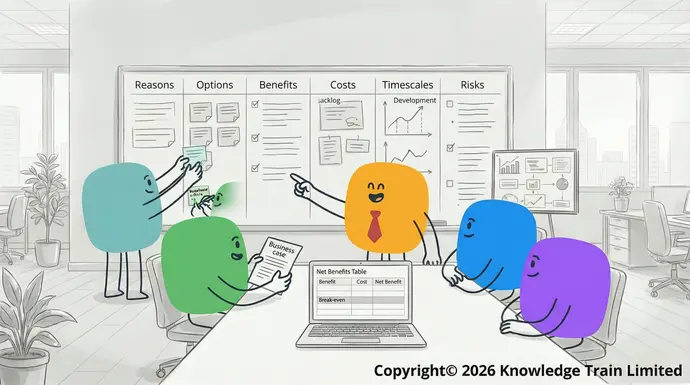
Introduction
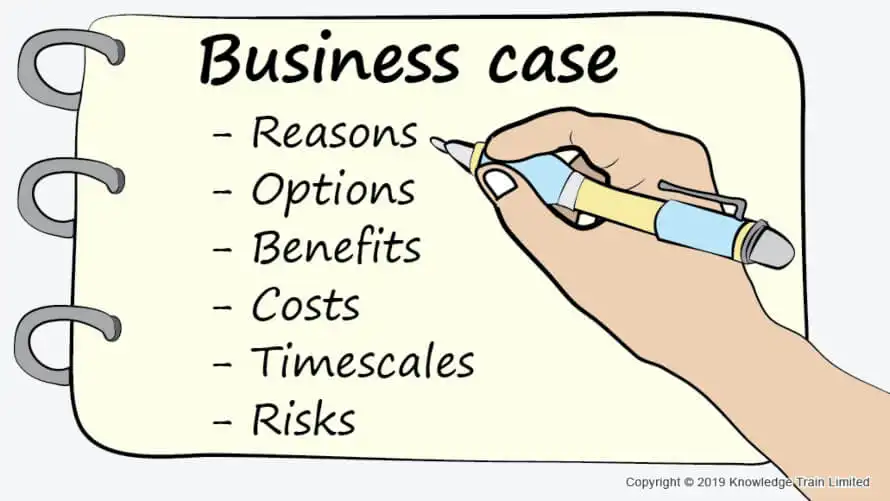
This article explains how to write a business case. It includes 2 business case examples and a free business case template for you to download.
You’re probably reading this article because you want to know how to write a business case. Perhaps your organisation is embarking on a major project to develop a new product. Or, perhaps you’re thinking of moving house so your family can enjoy a better life. In either case, you write a business case to ensure the investment is worthwhile.
In this article we’ll give you 2 business case examples, provide you with a simple business case template for you to use, and explain how to write a business case.
What is a business case?
A business case is the justification for some activity (e.g. a project) undertaken by your organisation. It weighs up the timescales, costs and risks of doing the activity against the benefits to be gained. Think of it as weighing up the pros and cons and then taking a sensible decision.
A business case forms an essential component of the curriculum of the best project management courses.
Personal business case
You may also use a business case to justify an investment you make in your personal life. For example, when you’re thinking of moving home to another area. You and your spouse will need to understand the costs of moving, the timescales and risks involved, and weigh these up against the benefits to be gained e.g. saving time traveling to your office, or your children able to go to a better school.
Why have a business case?
Projects should not just start on a whim or because of vanity – although a lot of money has been wasted over the years on such projects.
For business organisations, justification for a project usually takes a commercial form i.e. evaluating how much money could be made from the investment. For example, investing money in developing a new software app to bring first to market, might be deemed to bring certain monetary benefits (in terms of sales) which exceeds the costs of investment.
For government organisations, justification is probably not a commercial one, but could be based upon giving value for money to achieve certain benefits. For example, a public health campaign extolling the benefits of flu-vaccinations for elderly people, might be judged as giving greater value for money than having no campaign, and instead relying on treating patients in hospital once they have contracted the virus.
With so many competing claims being made on scarce funds, organisations need the assurance that the decision they are taking is the right one. After all, there will not be enough funds to pay for all the ideas for projects which are floating around the organisation.
Who uses a business case?
Business cases can be used by many different levels of management within an organisation. Not only are they used to justify the investment in an individual project, but also they are typically used by a portfolio management office to help it decide which projects will contribute to the organisation’s strategic goals. That way, they can filter out the bad ideas for projects, and only fund projects which will contribute to strategic goals.
A business case is also often used by a project sponsor or project executive to help it decide if they should invest in a specific project.
In all cases, the business case must be written and approved prior to any major commitment of resources.
What form does a business case take?
Business cases can take many forms – digital or analogue. The tools you use to create one are also many and varied. Common business tools such as Microsoft Office might be used. Rather than being a document or slide deck however, it could equally be in the form of an email.
Equally, a business case could be written by hand on a whiteboard or flipchart, or on the back of a cigarette packet!
What you should always remember is that a business case does not have to be a huge long document. In fact, it should be as short as possible, and only include the most important information. That way it cuts out the noise and provides decision-makers with just the right information to enable them to take sensible decisions.
For those of you interested in project management, the project management methodology known as PRINCE2 focuses its decision-making on a project on having a viable business case.
Business case examples
We will now give you 2 business case examples. The first example is one which you might find useful for taking decisions in your personal life. The 2nd business case example is more business focused project.
Business case example 1: Moving home
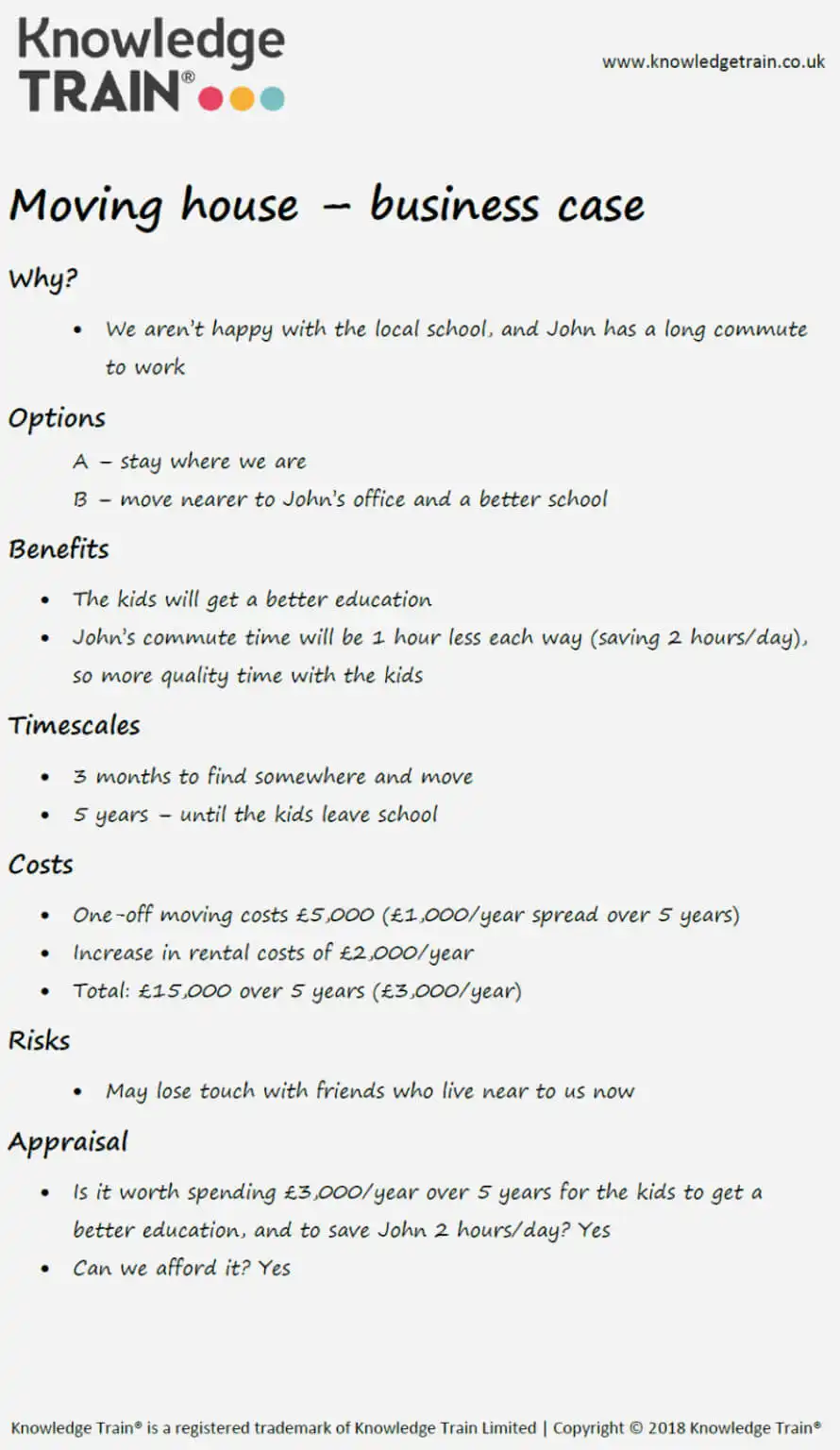
Suppose you and your spouse are considering moving to a new home. You will need to weigh up the pros and cons of moving. This is done using a business case. You might not call it that, but that’s what it is. Let’s look at an example.
Reason
As you can see from the example, the first thing to be clear about in a business case is the reason for doing the project or activity. In this example, the couple has answered the question Why? In fact, there are two problems here – the local school and John’s long commute.
Options considered
A business case should weigh up the competing options which have been considered. After all, there is usually more than one option. Perhaps an alternative option would have been for John to change his job to one nearer their current house. However, this wouldn’t solve the issue with the school.
Benefits
The benefits of a project or activity are the positive things you’re going to get back in return for your investment of time and money. In this case, the kids will get a better education, and John will save time each day.
Timescales
It’s also important to understand how long the investment of resources will take. This is so that the organisation (or family in this case) knows when the resources will be freed up to work on other projects or activities.
For any activity or project, it’s also important to understand the major risks involved. Risks are the uncertain things which may or may not happen during the period of the investment. There is only one risk identified here, which is the risk that the couple might lose touch with friends who live close to them right now.
Investment appraisal
The next section is where the costs and timescales and risks are weighed up. For this project, it’s a simple decision for the couple to decide if it’s worth spending money over the next 5 years to give their kids better schooling and to save John 2 hours a day commuting.
For an organisation to decide if an investment is worthwhile, however, there are several different ways in which it can decide about the investment.
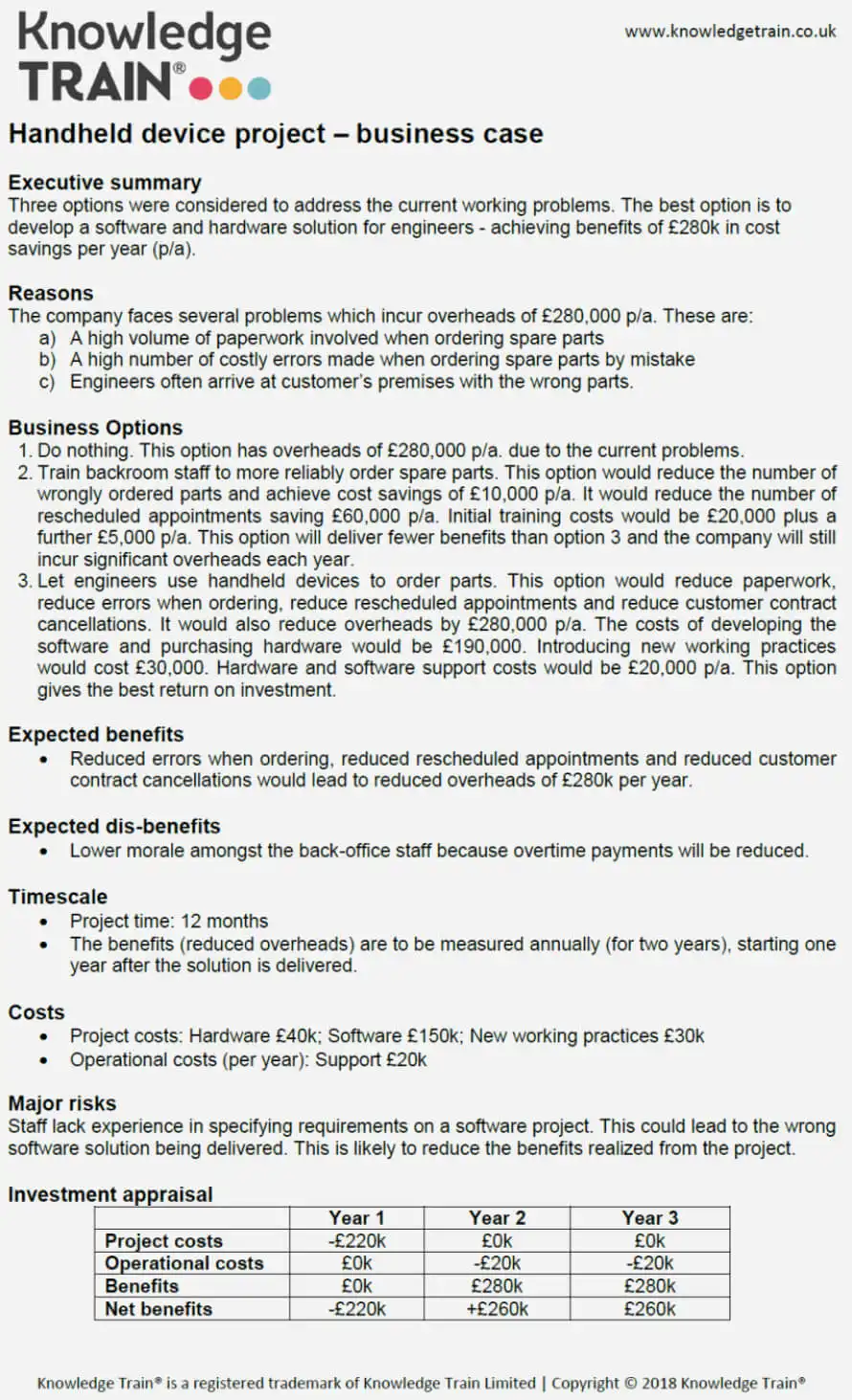
Often in organisations there are rules defined to help business analysts or project managers write what’s called an investment appraisal. In the next example, we’ll look at one example known as net benefits.
Business case example 2: Handheld device project
Imagine a heating repair services company that uses a paper-based set of forms filled in by an engineer during site visits. The spare parts required to fix the heater are recorded on a form which is given to staff to process back in the office. They then order the parts, and schedule a follow-up visit for the engineer to fix the heater.
How do you write a good business case?
A good business case must contain certain key information including:
- The reasons for doing the project;
- The business options which have been considered, including the base business options of do nothing, so something, or do something else;
- Project and operational costs;
- Project and operational timescales;
- Benefits, expressed in measurable terms;
- Investment appraisal (or cost benefit analysis);
- Major risks and their mitigation plans;
How long is a business case?
A good business should be long enough that it contains all the information needed for the decision-makers to take an informed decision about whether to invest in the project. That means, remove any waffle, and only include information which helps decision-making.