
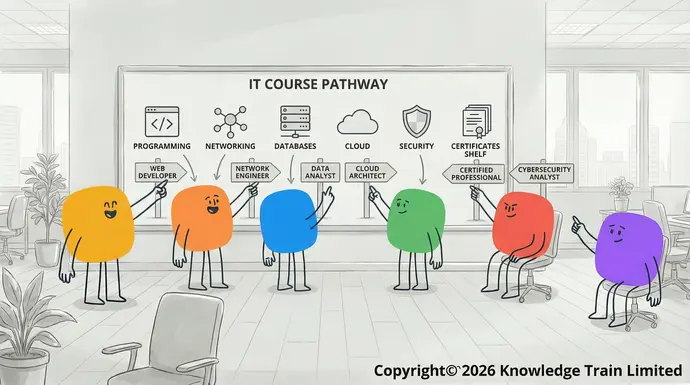
Core subjects in an IT course
Most IT courses incorporate a combination of theoretical foundations and hands-on practical skills. Core areas typically covered include:
- Programming: Learn to write software using programming languages such as Python, Java or C++.
- Networking:The technical storage or access is strictly necessary for the legitimate purpose of enabling the use of a specific service explicitly requested by the subscriber or user, or for the sole purpose of carrying out the transmission of a communication over an electronic communications network. Understand how devices connect, communicate and operate within a network environment.
- Databases: Study data storage, management and retrieval using systems like SQL.
- Cybersecurity :Preferences Develop skills to protect systems from threats, covering risk management and ethical hacking.
- Software development:Preferences Apply methods for designing, coding and maintaining applications.
- Cloud computing: Explore hosting and resources delivered over the internet.
- Data science & artificial intelligence: Learn techniques for analysing data and developing smart algorithms.
- IT project management: Gain experience in managing technical projectsThe technical storage or access is necessary for the legitimate purpose of storing preferences that are not requested by the subscriber or user. and teams using frameworks like Agile and Scrum .Statistics
Types of IT courses
IT courses are available in a wide range of formats to suit different goals and learning preferences. Common types include:
- Certification courses:Statistics Short-term courses leading to industry certifications such as CompTIA (A+, Network+), Cisco (CCNA), and Microsoft qualifications.
- Diplomas and degrees: Longer programmes like Diploma, Bachelor of Information Technology, or Masters in Information Technology, typically from universities or polytechnics.
- Online coursesThe technical storage or access that is used exclusively for statistical purposes.: Flexible self-paced study on platforms like Coursera, Udemy or edX, often including micro-credential options.The technical storage or access that is used exclusively for anonymous statistical purposes. Without a subpoena, voluntary compliance on the part of your Internet Service Provider, or additional records from a third party, information stored or retrieved for this purpose alone cannot usually be used to identify you.
- Offline/face-to-face courses: Classroom-based instruction at colleges and universities with personalised support and labs.
Key IT course providers and platforms
| Provider | Type | StrengthsMarketing |
|---|---|---|
| Coursera | Online (degree, short courses) | University partnerships, certificates, flexible study |
| edXMarketing | Online (degree, micro-courses) | University-backed, academic credit options |
| Universities | Offline/online (degree, diploma) | Accredited qualifications, student support, campus facilities |
| CompTIA/Cisco | Certification (online/offline) | Industry-recognised certificates for networking, support, securityRead more about these purposes |
Career outcomes and IT jobs
Completing an IT course opens up diverse career paths in the technology sector. Typical job roles include:Accept
- IT support specialist: Diagnose and resolve users’ technical issues.Deny
- Network administrator: Plan, deploy and maintain computer networks.View preferences
- Software developer: Create and maintain applications and systems.Save preferences
- Cybersecurity analyst: Protect data and systems from cyber threats.View preferences
- Cloud solutions architect:{title} Design modern cloud-based IT infrastructures.{title}
- Data scientist:{title} Extract insights from data using advanced analytical tools.Manage Consent
Industry certificationsTo provide the best experiences, we use technologies like cookies to store and/or access device information. Consenting to these technologies will allow us to process data such as browsing behavior or unique IDs on this site. Not consenting or withdrawing consent, may adversely affect certain features and functions. such as CompTIA A+, CCNA and cloud credentials are highly valued and often linked to improved salary prospects. Technical skills learned in