What is an IT course?

Key takeaways
IT courses combine theory and practical work to build job-ready digital skills.
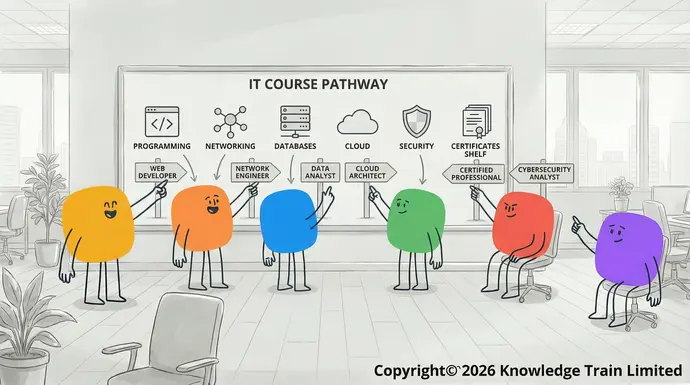
- Most programmes cover programming, networking, databases, cyber security, cloud computing, and project delivery.
- You can choose from certifications, diplomas or degrees, plus online or face-to-face study formats.
- Industry credentials such as CompTIA, Cisco, Microsoft, AWS, and CISSP can strengthen employability and salary prospects.
- Common outcomes include IT support, network administration, software development, cyber security, cloud roles, and data careers.
- Contact us with questions about the courses on this page, or about which project management certification or training is best for you. Develop skills to protect systems from threats, covering Finance FAQsrisk managementContact and ethical hacking.Cookies
- Software development:Privacy Apply methods for designing, coding and maintaining applications.Terms
- Cloud computing:Customer Support Explore hosting and resources delivered over the internet.
- Data science & artificial intelligence:[email protected] Learn techniques for analysing data and developing smart algorithms.Join Our Team
- IT project management: Gain experience in managing technical [email protected]projects Copyright © 2005-2026 Knowledge Train Limited. and teams using frameworks like Registered in UK: 5566983. Agile Registered VAT: GB872413526. and Knowledge TrainScrum®. is a registered trademark of Knowledge Train Limited.
Types of IT courses 20 Old Bailey, London, EC4M 7AN, England, United Kingdom.
IT courses Knowledge Train are experts in project management, PRINCE2, agile and change management training and certification. Choose from a full range of instructor-led and self-paced are available in a wide range of formats to suit different goals and learning preferences. Common types include:project management courses
- Certification courses:, a Short-term courses leading to industry PRINCE2 coursecertifications, or an such as CompTIA (A+, Network+), Cisco (CCNA), and Microsoft qualifications.agile project management course
- Diplomas and degrees: to boost your career. Longer PRINCE2programmes® like Diploma, Bachelor of Information Technology, or Masters in Information Technology, typically from universities or polytechnics., MSP
- Online courses®:, ITIL Flexible self-paced study on platforms like Coursera, Udemy or edX, often including micro-credential options.®
- Offline/face-to-face courses:, P3O Classroom-based instruction at colleges and universities with personalised support and labs.
Key IT course providers and platforms
| Provider® | Type, PRINCE2 | Strengths® |
|---|---|---|
| Coursera Agile, RESILIA | Online (degree, short courses)® | |
- Search
- Software developer: Create and maintain applications and systems.
- Cybersecurity analyst: Protect data and systems from cyber threats.
- Cloud solutions architect: Design modern cloud-based IT infrastructures.
- Data scientist: Extract insights from data using advanced analytical tools.
Industry certificationsRequest a quote such as CompTIA A+, CCNA and cloud credentials are highly valued and often linked to improved salary prospects. Technical skills learned in IT courses are increasingly required in fields like finance, healthcare, education and more. For further details see UK government digital skills guidance and university career services.
Certifications and further development
Certifications demonstrate expertise in key IT disciplines. Leading certificates include:
- CompTIA A+, Network+, Security+;
- Cisco CCNA, CCNP;
- Microsoft Certified Fundamentals, Solutions Associate;Manage Consent
- AWS Certified Cloud Practitioner;
- Certified Information Systems Security Professional (CISSP).To provide the best experiences, we use technologies like cookies to store and/or access device information. Consenting to these technologies will allow us to process data such as browsing behavior or unique IDs on this site. Not consenting or withdrawing consent, may adversely affect certain features and functions.
Many learners progress to degree programmes after initial certificates, undertaking a Bachelor of Information Technology or a Masters in Information Technology to further their careers.
FAQs
What qualifications do you need for an IT course?Functional
Entry requirements vary by course level. Introductory courses usually require basic computer skills, while degrees may require A-levels or equivalent. Certification courses generally have no prerequisites.
What subjects are studied in Information Technology?
Common subjects include programming, networking, databases, cybersecurity , cloud computing, software development, and data science.Functional
Which IT course is best for beginners?
Courses in basic computer literacy, CompTIA IT Fundamentals, or introductory programming are suitable for beginners. Online platforms and colleges provide flexible entry-level options. Always active
Are online IT courses recognised by employers?
Many online IT courses , especially those offering certificates from recognised providers (Coursera, edX, CompTIA, Cisco), are valued by employers. Accredited courses and certifications are particularly well-regarded.
What careers can I pursue after completing an IT course?The technical storage or access is strictly necessary for the legitimate purpose of enabling the use of a specific service explicitly requested by the subscriber or user, or for the sole purpose of carrying out the transmission of a communication over an electronic communications network.
Typical roles include IT support, network administration, cybersecurity analyst, software developer, and data scientist. Advanced positions may require additional experience or qualifications.