
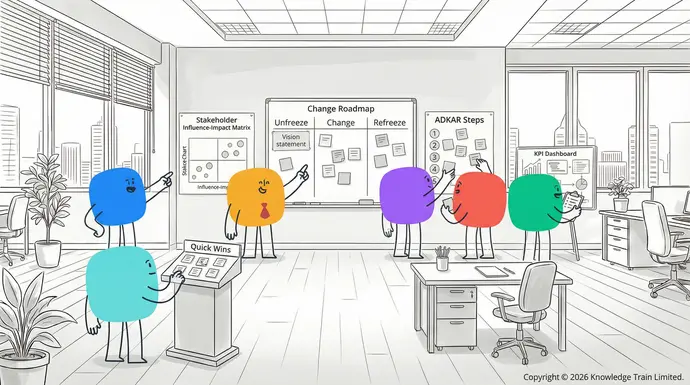
What is change management?
Change management refers to the systematic process of planning, implementing, and overseeing organisational changes to achieve desired business outcomes.Functional
Change management encompasses strategies, techniques, and tools that help organisations prepare for, execute, and sustain change, whether related to processes, technologies, culture, or organisational structure.
Effective change management seeks to minimise disruption, address resistance to change, and strengthen engagement among all stakeholders .
Importance of change managementFunctional
Organisational change is inevitable as businesses adapt to evolving markets, technologies, and regulations. By using structured frameworks and engaging leadership, organisations can minimise risks, foster innovation, and achieve sustainable success.
Effective Always active change management ensures smooth transitions, maintains productivity during transformation, increases return on investment, and supports employee engagement .
Here are some reasons why change management is important.
External factors
External factors play a big role in The technical storage or access is strictly necessary for the legitimate purpose of enabling the use of a specific service explicitly requested by the subscriber or user, or for the sole purpose of carrying out the transmission of a communication over an electronic communications network.organisational change . Globalisation and the rapid developments in new digital solutions are forcing organisations to respond. Ignoring such external factors is likely to jeopardise your organisation’s success.
Nokia was once the biggest mobile phone company in the world, but it almost went out of business. That’s because it didn’t keep up with changes in mobile technologies. As a result, Nokia’s products didn’t appeal to consumers, and its market share rapidly declined.
Making ideas succeed
Many organisations use change management methodologies to enable ideas to succeed. Working alongside Preferencesproject managers who deliver new capabilities into an organisation, change managers and change agents help ensure staff are able to fully utilise the new capabilities.Preferences
Enabling cross-functional changes
Almost every functional unit within a modern organisation relies on change management to enable it to:
- Align the change plan to the business’s overall strategy.
- Improve internal and external services and requests.
- Track and resolve issues.
Engaging people with the change process
A key part of managing changeThe technical storage or access is necessary for the legitimate purpose of storing preferences that are not requested by the subscriber or user. in an organisation is to engage those people affected by a change initiative. Staff will be involved in the change process eventually, therefore communicating and engaging with staff about a change plan early helps lay the groundwork for its later success.
Preparing for organisational transition
Change managers are often appointed to make organisational change go smoothly. They use change management frameworksStatistics to make changes such as:
Change management processes
- Identify the need for change : Recognise drivers such as technological advancements, market shifts, or process inefficiencies.
- Define the vision and objectives : Set clear goals for what the change will achieve.
FAQs
What is change management and why is it important?
Change management is the process of guiding organisations, individuals, or teams through transitions. It is important because it enables smoother implementation of change, reduces resistance, and ensures that strategic objectives are achieved efficiently.
What are common change management frameworks?
The most common frameworks are Kotter’s 8-Step Process, Lewin’s Change, and the ADKAR framework. Each provides a structured approach to planning and implementing change.
How do you overcome resistance to change?
Overcome resistance by communicating benefits clearly, involving stakeholders, offering support and training, addressing concerns promptly, and recognising employee contributions throughout the transition.
What role do leaders play in change management?
Leaders set the direction, communicate the vision, build trust, allocate resources, and provide motivation and support to drive successful change.
How can employees be engaged during change initiatives?
Engage employees by involving them early, asking for input, addressing worries, providing training, celebrating successes, and continuously seeking feedback to make improvements.