Change management: models, steps, and best practices

Key takeaways
Effective change management blends clear planning with sustained support for adoption.
- Use structured frameworks such as Kotter, Lewin, or ADKAR to sequence activities and maintain momentum.[email protected]
- Visible leadership sponsorship and consistent communication reduce uncertainty and resistance.
- Engage stakeholders early, using influence and impact mapping to target effort where it matters most.
- Integrate change work with project delivery so training, readiness, risks, and benefits stay aligned. +44 (0)207 148 5985
- Measure adoption with KPIs and feedback, then reinforce new behaviours through governance, coaching, and policy.Courses
What is change management?Foundation
Change managementLearn the fundamentals of the governance framework. refers to the systematic process of planning, implementing, and overseeing organisational changes to achieve desired business outcomes.Practitioner
Change management encompasses strategies, techniques, and tools that help organisations prepare for, execute, and sustain change, whether related to processes, technologies, culture, or organisational structure.Includes Foundation & Practitioner combined option.
Effective change management seeks to minimise disruption, address resistance to change, and strengthen engagement among all Better Business Casesstakeholders™.Foundation
Importance of change managementLearn the fundamentals of Better Business cases.
Organisational change is inevitable as businesses adapt to evolving markets, technologies, and regulations. By using structured frameworks and engaging leadership, organisations can minimise risks, foster innovation, and achieve sustainable success.Practitioner
Effective Includes Foundation & Practitioner combined option.change managementP3O ensures smooth transitions, maintains productivity during transformation, increases return on investment, and supports ®employee engagementFoundation .Learn the fundamentals of the P3O project management office.
Here are some reasons why change management is important.Practitioner
External factorsIncludes Foundation & Practitioner combined option.
External factors play a big role in Workshopsorganisational changeIntroduction to Project Management . Globalisation and the rapid developments in new digital solutions are forcing organisations to respond. Ignoring such external factors is likely to jeopardise your organisation’s success.1-day workshop to learn the basics of project management.
Nokia was once the biggest mobile phone company in the world, but it almost went out of business. That’s because it didn’t keep up with changes in mobile technologies. As a result, Nokia’s products didn’t appeal to consumers, and its market share rapidly declined.Project Management Essentials
Making ideas succeed 2-day workshop to learn how to manage projects without getting certified.
Many organisations use change management methodologies to enable ideas to succeed. Working alongside Writing Business Cases project managersHalf-day workshop to learn to write robust business cases. who deliver new capabilities into an organisation, AI in Project Management change managersLearn how to use AI tools in everyday project work. and change agents help ensure staff are able to fully utilise the new capabilities.ARTIFICIAL INTELLIGENCE (AI)
Enabling cross-functional changesBCS AI
Almost every functional unit within a modern organisation relies on change management to enable it to:Foundation
- Align the change plan to the business’s overall strategy.Learn the fundamentals of artificial intellegence.
- Improve internal and external services and requests.AI Project Governance Framework (AIPGF)
- Track and resolve issues.Foundation
Engaging people with the change processLearn the fundamentals of the governance framework.
A key part of Practitioner managing changeIncludes Foundation & Practitioner combined option.
- : Launch the initiative, ensuring leadership guidance and active support from Business Analysis Foundation change agentsLearn the fundamentals of business analysis..Modelling Business Processes
- Manage resistance to changeGain practitioner certificate in modelling business processes.: Identify the sources of resistance and address them through communication and support.Business Analysis Practices
- Monitor progress and reinforceGain practitioner certificate in business analysis practices.: Use metrics to track success and celebrate milestones.Requirements Engineering
- Sustain changeGain practitioner certificate in requirements engineering.: Embed new ways of working into culture and practices for lasting results.Business Analysis International Diploma
Change management frameworksAll 4 courses bundled into this Diploma certification package.
Several AgileBAchange management frameworks® guide organisations through transitions. The most prominent include: – Agile Business Analysis
- Kotter’s 8-Step ProcessFoundation training
- Lewin’s Change FrameworkLearn the fundamentals of Agile Business Analysis.
- ADKAR frameworkPractitioner
Kotter’s 8-Step Process4-day course including Foundation.
- Establish a sense of urgencyPMI
- Form a guiding coalition®
- Create a vision for changePMI-PBA
- Communicate the visionSelf-paced course to prepare you for the exam (exam not included).
- Empower broad-based actionBusiness Analysis Learning Library (BALL)™
- Generate short-term winsCHANGE MANAGEMENT
- Consolidate gains and produce more changeAPMG Change Management
- Anchor new approaches in the cultureFoundation
Example: A retailer launching a new digital platform began with urgency around changing customer expectations, formed a cross-functional team, communicated a compelling vision, and celebrated early improvements to build momentum.Learn the fundamentals of enterprise change management.
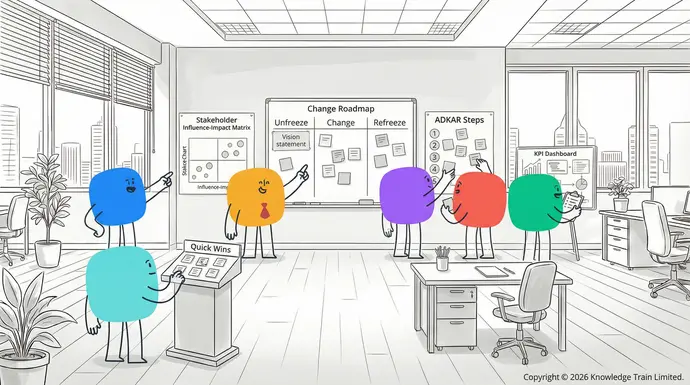
Lewin’s Change ModelPractitioner
- UnfreezeIncludes Foundation & Practitioner combined option.: Prepare the organisation to accept change by challenging the status quo.PROGRAMME MANAGEMENT
- ChangeMSP: Transition through adoption of new behaviours and processes.®
- RefreezeFoundation : Stabilise the organisation by embedding changes into everyday practice.Learn the fundamentals of programme management.
Example: A manufacturer seeking to improve quality first destabilised old habits, implemented new protocols, then reinforced behaviours through training and recognition.Practitioner
ADKAR modelIncludes Foundation & Practitioner combined option.
- AwarenessINFORMATION TECHNOLOGY (IT) of the need for changeITIL
- Desire® to support the changeFoundation
- KnowledgeLearn the fundamentals of ITIL service management. of how to changeStrategist DPI
- Ability3-day ITIL Strategist: Direct, Plan & Improve (DPI) course. to implement changeSpecialist: DSV
- Reinforcement3-day ITIL Specialist: Drive Stakeholder Value (DSV) course. to sustain changeSpecialist: CDS
Example: In a software roll-out, employees learned why the upgrade was essential (Awareness, Desire), received hands-on workshops (Knowledge, Ability), and were rewarded for adoption (Reinforcement).3-day ITIL Specialist: Create, Deliver and Support (CDS) course.
Change management challengesIT Learning Library (ITLL)™
Organisations frequently encounter obstacles when managing change. Common challenges include:BUSINESS LEARNING LIBRARY (BLL)™
- Resistance to changeAgile Learning Library (ALL)™: Employees may fear job loss, uncertainty, or increased responsibilities.Business Analysis Learning Library (BALL)™
Compliance Learning Library (CLL)™SolutionIT Learning Library (ITLL)™: Foster open communication, involve employees in decision-making, and provide adequate support.Business solutions - Poor communication_blank: Inadequate information can cause confusion and low morale.Free tools
AboutSolution_blank: Communicate regularly, using clear and consistent messaging across channels. - Lack of leadership commitment: Without executive support, initiatives may falter.
Solution: Gain leadership buy-in and ensure visible commitment throughout the transition. - Cultural misalignmentBlog: Change may conflict with existing organisational culture.
EXPLORE SUBJECTSSolutionSelect your preferred subject.: Integrate change efforts with culture change and organisational development strategies. - Insufficient resources or planningPROJECT MANAGEMENT QUALIFICATIONS & WORKSHOPS: Poor planning can delay or derail change projects.Select your preferred qualification or workshop.
SolutionPRINCE2 COURSES: Invest in Select your preferred training course below:project management , transition planning, and risk assessment.APM COURSES
Change management and business functionsSelect your preferred training course below:
- Organisational development : Change management techniques are often a core part of organisational development, aiming for long-term improvement in effectiveness.AGILE PROJECT MANAGEMENT COURSES
- Project managementSelect your preferred training course below:: Integrating change management with project managementPRINCE2 AGILE COURSES ensures project deliverables are adopted and sustained.Select your preferred training course below:
- Business transformation : Large-scale initiatives such as mergers or digitalisation depend on robust change management for success.BETTER BUSINESS CASES COURSES
- Stakeholder engagementSelect your preferred training course below:: Identifying and actively involving key stakeholders is crucial in minimising resistance and ensuring buy-in.
- LeadershipP3O COURSES: Strong, credible leadership drives the success of change initiatives through clear direction and support.Select your preferred training course below:
Change management best practices
- Establish clear communication strategiesWORKSHOPS tailored to different stakeholder groups.Select your preferred workshop below:
- Appoint dedicated change agents to guide and support the change process.AGILE QUALIFICATIONS
- Use data to inform decisionsSelect your preferred qualification. and measure progress through key performance indicators (KPIs).
- Encourage feedbackAGILE PROJECT MANAGEMENT COURSES from employees at every stage.Select your preferred training course below:
- Provide training and support to build new skills and confidence.PRINCE2 AGILE COURSES
- Integrate change into company cultureSelect your preferred training course below: to ensure lasting results.
| ModelSelect your preferred training course below: | Core Steps | Main FocusAGILE BUSINESS ANALYSIS COURSES |
|---|---|---|
| Kotter’s 8-StepSelect your preferred training course below: | 8 outlined steps | Building urgency, vision, momentumBUSINESS ANALYSIS QUALIFICATIONS |
| Lewin’s ChangeSelect your preferred qualification. | Unfreeze, Change, Refreeze | Preparing, transitioning, embeddingBCS BUSINESS ANALYSIS COURSES |
| ADKARSelect your preferred training course below: | Awareness, Desire, Knowledge, Ability, Reinforcement | Individual adoption stagesAGILE BUSINESS ANALYSIS COURSES |
FAQsMSP COURSES
What is change management and why is it important?Select your preferred training course below:
Change management is the process of guiding organisations, individuals, or teams through transitions. It is important because it enables smoother implementation of change, reduces resistance, and ensures that strategic objectives are achieved efficiently.
What are common change management frameworks?PMI COURSES
The most common frameworks are Kotter’s 8-Step Process, Lewin’s Change, and the Select your preferred training course below:ADKAR framework. Each provides a structured approach to planning and implementing change.PMI COURSES
How do you overcome resistance to change?Select your preferred training course below:
Overcome resistance by communicating benefits clearly, involving stakeholders, offering support and training, addressing concerns promptly, and recognising employee contributions throughout the transition.
What role do leaders play in change management?PRINCE2 COURSES
Leaders set the direction, communicate the vision, build trust, allocate resources, and provide motivation and support to drive successful change.Select your preferred training course below:
How can employees be engaged during change initiatives?
Engage employees by involving them early, asking for input, addressing worries, providing training, celebrating successes, and continuously seeking feedback to make improvements.APM COURSES