Change management modelsProject Management Essentials

Key takeawaysPRINCE2
Different change models suit different scales of change and different human impacts.®
- Use Lewin’s three stages to frame straightforward organisational change from start to stabilisation. Agile
- Apply Kotter’s eight steps when coordinating large, complex transformation programmes.Foundation
- Use Senge’s systems view to understand how change spreads and affects individual staff over time.Learn the fundamentals of the PRINCE2 Agile method.
- Borrow Satir and Kubler Ross to anticipate emotional responses and reduce disruption during change.Practitioner
- Use ADKAR to diagnose and build individual readiness through Awareness, Desire, Knowledge, Ability, and Reinforcement.Includes Foundation & Practitioner combined option.
- Apply McKinsey 7-S to align key organisational elements and track progress and issues clearly.Scrum
IntroductionBUSINESS ANALYSIS
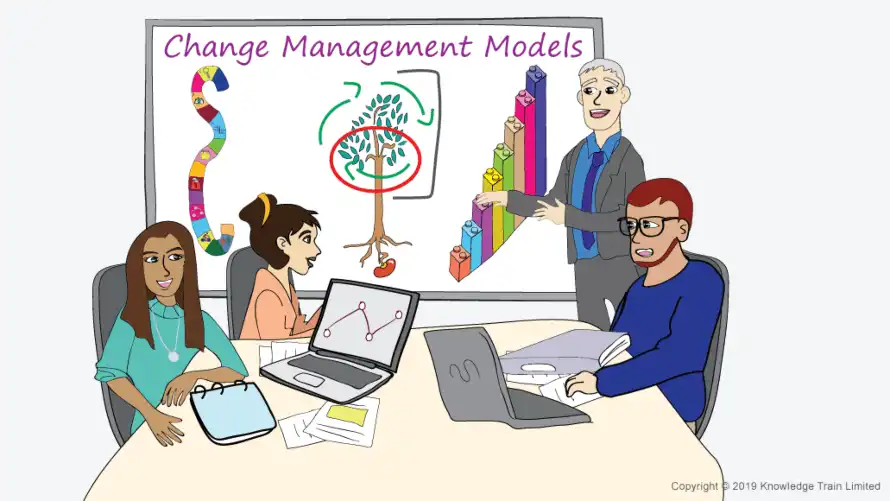
Some BCS Business Analysischange managementBusiness Analysis Foundation models can be used to analyse change on an enterprise level. Others are best suited to understanding how change affects individual members of staff.Learn the fundamentals of business analysis.
Below, we have information on some of the most popular Modelling Business Processes change modelsGain practitioner certificate in modelling business processes.. Click to see colourful infographics of each model.Business Analysis Practices
Lewin change modelGain practitioner certificate in business analysis practices.
Developed by Kurt Lewin in the 19040’s, this model remains a cornerstone of organisational changeRequirements Engineering – using a simple 3-step method to successfully implement change in organisations both large and small.Gain practitioner certificate in requirements engineering.
Read more and see a colourful infographic about the Business Analysis International Diploma Lewin change management modelAll 4 courses bundled into this Diploma certification package. here.AgileBA
3-day ITIL Specialist: Drive looked at change in terms of biological and ecological metaphors. Using this perspective, he developed a robust model for the management of change, particularly regarding the effect on individual members of staff.
Read more and see a colourful infographic about the Senge change management model here. Stakeholder Value (DSV) course.
Satir change modelSpecialist: CDS
Virginia Satir was an author and therapist. Satir’s model was made to help therapists understand the human response to death and trauma. Interestingly, this model was quickly appropriated by quick-thinking change managers and repurposed to help reduce the impact of change on businesses.3-day ITIL Specialist: Create, Deliver and Support (CDS) course.
Read more and see a colourful infographic about the IT Learning Library (ITLL)™Satir change modelBUSINESS LEARNING LIBRARY (BLL)™ here.Agile Learning Library (ALL)™
ADKAR modelBusiness Analysis Learning Library (BALL)™
The ADKAR model breaks change into 5 component elements — Awareness, Desire, Knowledge, Ability, and Reinforcement. The ADKAR model is also a key element of the Prosci change management methodology.Compliance Learning Library (CLL)™
Read more and see a colourful infographic about the IT Learning Library (ITLL)™ADKAR modelBusiness solutions here._blank