
Key takeawaysKnowledge
Different change models suit different scales of change and different human impacts. through tailored training, mentoring, and easy access to reference materials.
- Use Lewin’s three stages to frame straightforward organisational change from start to stabilisation.Convert
- Apply Kotter’s eight steps when coordinating large, complex transformation programmes.Knowledge
- Use Senge’s systems view to understand how change spreads and affects individual staff over time. into
- Borrow Satir and Kubler Ross to anticipate emotional responses and reduce disruption during change.Ability
- Use ADKAR to diagnose and build individual readiness through Awareness, Desire, Knowledge, Ability, and Reinforcement. with practice, coaching, and performance-based feedback.
- Apply McKinsey 7-S to align key organisational elements and track progress and issues clearly.Use
IntroductionIntroduction to the ADKAR model
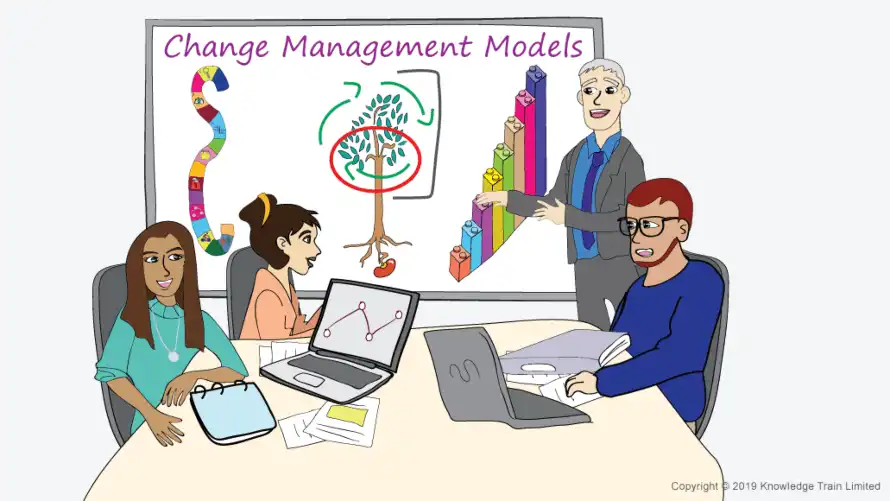
Some Understanding change managementchange managementIn today’s constantly changing organisational landscape, models can be used to analyse change on an enterprise level. Others are best suited to understanding how change affects individual members of staff.change management
Below, we have information on some of the most popular is crucial. Organisations must adapt to remain competitive and relevant. change modelsChange management. Click to see colourful infographics of each model. provides a structured approach to transitioning individuals, teams, and whole organisations from a current state to a desired future state. The goal is to minimise resistance and maximise engagement. Here, the
Lewin change modelADKAR
Developed by Kurt Lewin in the 19040’s, this model remains a cornerstone of model shines as a strategic framework. It offers a clear, step-by-step process that leaders can use to guide their teams through change effectively.organisational changeOrigins and purpose of ADKAR – using a simple 3-step method to successfully implement change in organisations both large and small.The ADKAR model was developed by Jeff Hiatt, founder of Prosci, through research conducted from 1994 to 2002. This research analysed the change patterns of over 700 organisations, leading to a practical, results-oriented approach to managing change at the individual level. Prosci’s research revealed that successful change occurs when
Read more and see a colourful infographic about the organisational change managementLewin change management model and individual change management intersect. It comprises five key elements: here.Awareness
Kotter change modelThe five elements of the ADKAR model
Kotter’s 8-step model is suitable for large change initiatives in complex organisations. Kotter expanded on the work of Kurt Lewin to develop a more complex, more intricate model for the Element 1: Awarenessmanagement of changeThe .Awareness
Read more and see a colourful infographic about the element is foundational in the ADKAR model. It ensures individuals recognise the necessity for change, setting the stage for subsequent actions. Without awareness, employees may resist or misunderstand the change initiative, leading to challenges in implementation.Kotter change management modelImportance of awareness here.Awareness is crucial as it creates a shared understanding of the change. It clarifies the reasons behind the shift, reducing anxiety and speculation. This understanding is vital for aligning individual goals with organisational objectives. When employees comprehend the need for change, they are more inclined to support it. This support eases the transition and lays a solid groundwork for the next elements.