Harnessing the power of SWOT analysis for effective strategies4-day course including Foundation.

Key takeawaysFoundation training
SWOT works best when it is specific, balanced, and turned into decisions.Learn the fundamentals of Agile Business Analysis.
- Use SWOT to separate internal strengths and weaknesses from external opportunities and threats, so strategy is grounded in reality.Practitioner
- Collect detailed evidence from staff input, market research, and financials to avoid vague, unhelpful statements.4-day course including Foundation.
- Apply the MECE approach to keep categories distinct and complete, reducing overlap and blind spots.PMI
- Convert every SWOT point into an action, priority, or mitigation plan, or the exercise adds little value.®
- Revisit SWOT regularly and strengthen it with PESTLE, five forces, and digital tools for clearer analysis.PMI-PBA
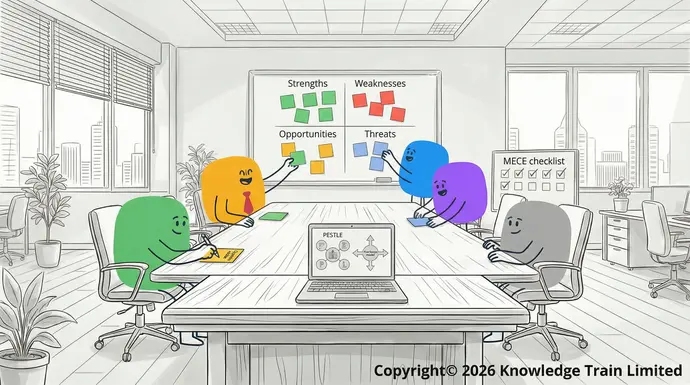
Introduction to SWOT analysis
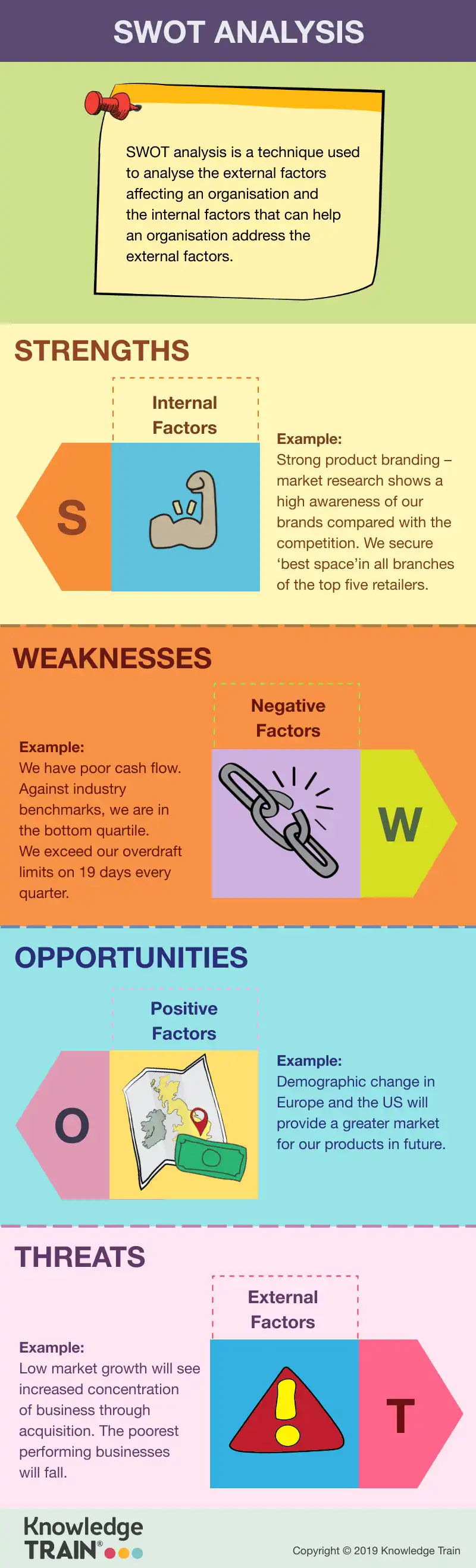
P3O COURSESWeaknesses are internal limitationsSelect your preferred training course below: that could hinder organisational performance. Common examples include inefficient processes, outdated technology, or a small human resources department. Identifying these challenges is crucial for improvement. Addressing weaknesses can involve streamlining operations or investing in new technology. By recognising and addressing these areas, organisations can minimise their impact and transform them into strengths. This proactive approach fosters resilience and adaptability in a competitive environment.
Spotting opportunitiesWORKSHOPS
Opportunities are external factors that your organisation can exploit for growth. These could include technological advancements, emerging markets, or favourable regulatory changes. Identifying opportunities requires a keen eye on industry trends and market dynamics. For example, a company might spot an opportunity in a growing demand for sustainable products. By aligning its offerings with this trend, the company can capture new market segments. Seizing such opportunities can drive innovation and expansion, setting your organisation on a path to sustained growth.Select your preferred workshop below:
Understanding threats
Threats are external AGILE QUALIFICATIONSrisksSelect your preferred qualification. that could negatively impact your organisation. These might include market fluctuations, new competitors, or changing consumer preferences. Identifying threats is crucial for developing mitigation strategies. For instance, a threat could be a competitor launching a similar product. To counter this, an organisation might innovate or enhance its value proposition. By understanding and preparing for these threats, organisations can shield themselves from potential setbacks. This forward-thinking approach ensures long-term stability and success.
In conclusion, conducting a SWOT analysis is a systematic process that requires preparation and thoughtful evaluation. By focusing on specific data and utilising appropriate tools, you can gain valuable insights that inform strategic planning. This not only enhances decision-making but also fosters a proactive approach to navigating challenges and seizing opportunities. The psychological benefits are noteworthy, as a structured analysis reduces stress and enhances focus and confidence. This comprehensive understanding ensures that your organisation is well-equipped to tackle future challenges.AGILE PROJECT MANAGEMENT COURSES
MECE framework in SWOT analysis
Introduction to MECE frameworkAPMG CHANGE MANAGEMENT COURSES
The Select your preferred training course below:MECE framework stands for “Mutually exclusive, collectively exhaustive”. It is a problem-solving approach used to organise information in a way that ensures clarity and completeness. The framework divides information into distinct, non-overlapping categories that cover all possible scenarios. This approach prevents duplication and omissions, making it a valuable tool in strategic analysis. Its significance lies in its ability to simplify complex data, providing a clear and structured view of the situation at hand. By ensuring that all aspects are covered without redundancy, the MECE framework supports effective decision-making.PROGRAMME MANAGEMENT QUALIFICATIONS