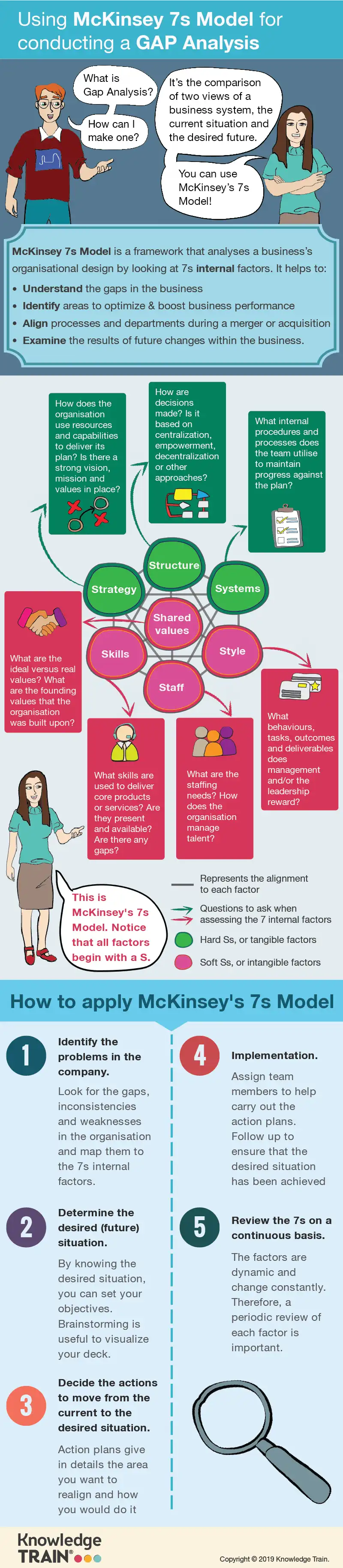
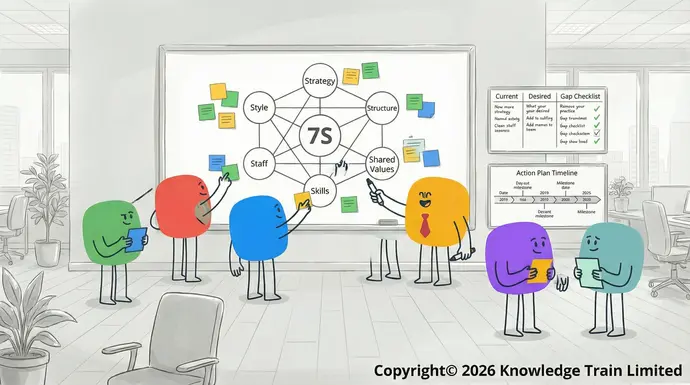
- The 7S model links three hard elements and four soft elements, so changes in one area affect the others.Contents
- Start by assessing the current state of strategy, structure, systems, shared values, style, staff, and skills using stakeholder input.
- Identify the most damaging gaps, such as strategy that the structure cannot deliver or skills that do not match role needs.Introduction to McKinsey 7S
- Create an action plan with measurable objectives, owners, and timelines, and review progress regularly to sustain alignment.
- Use complementary tools for external factors, as the model focuses mainly on internal organisational elements.The 7 elements
- : These are the core principles and beliefs that guide the organisation’s behaviour. Shared values form the foundation of corporate culture and influence decision-making at all levels. They should align with the organisation’s mission and strategy.: This refers to the organisational hierarchy and how different departments and teams are organised. The structure determines reporting lines, decision-making authority, and communication channels. An optimal structure facilitates efficient operations and supports the implementation of the strategy.Skills
- Systems: This element represents the collective capabilities and expertise of the organisation’s workforce. It includes both technical and soft skills. Continuously developing and aligning skills with strategic objectives is essential for maintaining competitive advantage.: These encompass all procedures, processes, and technologies that support daily operations. Systems include everything from StyleIT: This refers to the leadership approach and overall organisational culture. The management style influences employee motivation, communication patterns, and decision-making processes. An effective style fosters innovation, collaboration, and high performance. infrastructure to performance management processes. Well-designed systems enhance productivity and ensure consistent quality across the organisation.Staff
Soft elements: This element encompasses human resource management practices, including recruitment, training, and retention strategies. It focuses on ensuring the right people are in the right roles and are properly motivated and developed.
The four Understanding and aligning these seven elements is crucial for achieving organisational effectiveness and successfully implementing change initiatives.soft elementsEnhance your skills with our expert-led courses are less tangible but equally crucial for organisational success:
- Shared values : These are the core principles and beliefs that guide the organisation’s behaviour. Shared values form the foundation of corporate culture and influence decision-making at all levels. They should align with the organisation’s mission and strategy.
- SkillsSelf-paced: This element represents the collective capabilities and expertise of the organisation’s workforce. It includes both technical and soft skills. Continuously developing and aligning skills with strategic objectives is essential for maintaining competitive advantage.BCS Foundation Certificate in Business Analysis self-paced online
- Style : This refers to the leadership approach and overall organisational culture. The management style influences employee motivation, communication patterns, and decision-making processes. An effective style fosters innovation, collaboration, and high performance.£499 +vat
- Staff : This element encompasses human resource management practices, including recruitment, training, and retention strategies. It focuses on ensuring the right people are in the right roles and are properly motivated and developed.
Understanding and aligning these seven elements is crucial for achieving organisational effectiveness and successfully implementing change initiatives.
. Each component should be evaluated individually to understand its present condition. Engage with key stakeholders to gather insights and perspectives. Use surveys and interviews to collect data, ensuring a comprehensive understanding of each element. The goal is to establish a clear baseline that will guide future improvements and alignments., Identifying gaps and misalignmentssystemsOnce the current state is assessed, focus on identifying any gaps and misalignments among the seven elements. These discrepancies can hinder organisational effectiveness and should be addressed promptly. Compare the current state with the desired future state to pinpoint areas needing attention. Look for inconsistencies between , strategyshared values and , structurestyle, or mismatches in , skillsstaff and , and staffskills deployment. Prioritise issues that have the most significant impact on performance. This step is crucial for setting the foundation for an actionable plan that addresses these discrepancies.. Each component should be evaluated individually to understand its present condition. Engage with key stakeholders to gather insights and perspectives. Use surveys and interviews to collect data, ensuring a comprehensive understanding of each element. The goal is to establish a clear baseline that will guide future improvements and alignments.Developing an action plan
Identifying gaps and misalignmentsWith a clear understanding of gaps and misalignments, the next step involves crafting an actionable plan. This plan should address each of the seven elements with specific, measurable objectives. Assign responsibilities and timelines to ensure accountability. Develop strategies to realign misaligned elements, such as restructuring teams or enhancing
Once the current state is assessed, focus on identifying any gaps and misalignments among the seven elements. These discrepancies can hinder organisational effectiveness and should be addressed promptly. Compare the current state with the desired future state to pinpoint areas needing attention. Look for inconsistencies between skillsstrategy through targeted training. Regularly review progress and adjust the plan as necessary to maintain alignment. Effective communication is key; keep all stakeholders informed and engaged throughout the process. This strategic approach encourages sustainable change and enhances organisational performance. and Applications of the 7S frameworkstructureStrategic planning, or mismatches in The McKinsey 7S Model serves as a powerful tool for skillsstrategic planning and . It provides a comprehensive framework for assessing an organisation’s current state and aligning all elements towards future goals. By examining each of the seven components, leaders can identify areas that require adjustment to support new strategies. This holistic approach ensures that all aspects of the organisation are considered when developing and implementing strategic initiatives.In deployment. Prioritise issues that have the most significant impact on performance. This step is crucial for setting the foundation for an actionable plan that addresses these discrepancies.change management
Developing an action plan, the 7S Framework proves invaluable. It offers a structured approach to navigating complex organisational transformations. By analysing the interdependencies between the seven elements, change leaders can anticipate potential challenges and develop more effective change strategies. The model helps identify which elements need to be modified to support the desired change and ensures that all aspects of the organisation are aligned during the transition process.
With a clear understanding of gaps and misalignments, the next step involves crafting an actionable plan. This plan should address each of the seven elements with specific, measurable objectives. Assign responsibilities and timelines to ensure accountability. Develop strategies to realign misaligned elements, such as restructuring teams or enhancing Benefits and limitationsskillsKey advantages through targeted training. Regularly review progress and adjust the plan as necessary to maintain alignment. Effective communication is key; keep all stakeholders informed and engaged throughout the process. This strategic approach encourages sustainable change and enhances organisational performance.The
Applications of the 7S frameworkMcKinsey 7S Model
Strategic planning provides a comprehensive framework for organisational analysis and improvement. It ensures alignment between
The McKinsey 7S Model serves as a powerful tool for strategystrategic planning, . It provides a comprehensive framework for assessing an organisation’s current state and aligning all elements towards future goals. By examining each of the seven components, leaders can identify areas that require adjustment to support new strategies. This holistic approach ensures that all aspects of the organisation are considered when developing and implementing strategic initiatives.structure
Organisational change management, and other key elements, promoting holistic change. By considering both hard and soft elements, it creates a balanced approach that improves overall organisational performance.
In Potential drawbackschange managementDespite its benefits, the model has limitations. It may be time-consuming to apply thoroughly, requiring significant resources and stakeholder engagement. Additionally, the model focuses on internal elements whilst external factors such as market conditions and competition are not directly addressed. This may require complementary frameworks for comprehensive analysis., the 7S Framework proves invaluable. It offers a structured approach to navigating complex organisational transformations. By analysing the interdependencies between the seven elements, change leaders can anticipate potential challenges and develop more effective change strategies. The model helps identify which elements need to be modified to support the desired change and ensures that all aspects of the organisation are aligned during the transition process.Case study: McKinsey 7S in action
Benefits and limitationsAn international
Key advantagesmanufacturing company
The successfully utilised the McKinsey 7S ModelMcKinsey 7S Model provides a comprehensive framework for organisational analysis and improvement. It ensures alignment between to enhance operational efficiency. Facing challenges in aligning their global operations, the company applied the model to assess and realign their strategystrategy, and structurestructure, and other key elements, promoting holistic change. By considering both hard and soft elements, it creates a balanced approach that improves overall organisational performance.. They identified that their
Potential drawbackssystems
Despite its benefits, the model has limitations. It may be time-consuming to apply thoroughly, requiring significant resources and stakeholder engagement. Additionally, the model focuses on internal elements whilst external factors such as market conditions and competition are not directly addressed. This may require complementary frameworks for comprehensive analysis. were outdated and required modernisation to support their strategic goals. By addressing these misalignments, they improved coordination and communication across different regions. The intervention also focused on developing
Case study: McKinsey 7S in actionskills
An international among staff through targeted training manufacturing companyprogrammes successfully utilised the . As a result, the company experienced increased productivity and a more cohesive organisational culture, demonstrating the model’s effectiveness in fostering sustainable change.McKinsey 7S ModelConclusion to enhance operational efficiency. Facing challenges in aligning their global operations, the company applied the model to assess and realign their The strategyMcKinsey 7S Model and offers a robust framework for analysing and improving organisational effectiveness. By assessing elements like structurestrategy. They identified that their systems were outdated and required modernisation to support their strategic goals. By addressing these misalignments, they improved coordination and communication across different regions. The intervention also focused on developing skills among staff through targeted training programmes, . As a result, the company experienced increased productivity and a more cohesive organisational culture, demonstrating the model’s effectiveness in fostering sustainable change.structure
Conclusion,
The systemsMcKinsey 7S Model, and offers a robust framework for analysing and improving organisational effectiveness. By assessing elements like shared values
staff is utilised for evaluating organisational effectiveness by analysing seven interdependent elements: , and strategyskills, .structureHow do organisations benefit from the model?, Organisations benefit by achieving alignment between these elements, which enhances overall efficiency and effectiveness. It aids in identifying gaps and formulating targeted action plans.systemsAre there any limitations?, The model requires significant resources to implement properly and primarily focuses on internal factors, which may necessitate additional frameworks for external analysis.shared valuesInfographic, Subscribe to our exclusive offers and promotionsstyle , Subscribe nowstaff , and skills{"@context":"https://schema.org","@type":"ImageObject","contentUrl":"https://www.knowledgetrain.co.uk/training-courses/mckinsey-7-s-model-business-analysis-technique-890x501.webp","description":"PRINCE2 Careers","license":"https://www.knowledgetrain.co.uk/license","acquireLicensePage":"https://www.knowledgetrain.co.uk/license","creditText":"Knowledge Train","uploadDate":"2023-05-16T07:19:20.000Z","copyrightNotice":"© 2023 Knowledge Train Limited. All rights reserved.","creator":{"@type":"Organization","name":"Knowledge Train","url":"https://www.knowledgetrain.co.uk"}}.
How do organisations benefit from the model?{"@context":"https://schema.org","@type":"ImageObject","contentUrl":"https://www.knowledgetrain.co.uk/training-courses/res/images/business-analysis/mckinsey-s-s-model-gap-analysis-infographic-800x3660.webp","description":"McKinsey 7-S model business analysis technique infographic.","license":"https://www.knowledgetrain.co.uk/license","acquireLicensePage":"https://www.knowledgetrain.co.uk/license","creditText":"Knowledge Train","uploadDate":"2023-05-16T07:19:20.000Z","copyrightNotice":"© 2023 Knowledge Train Limited. All rights reserved.","creator":{"@type":"Organization","name":"Knowledge Train","url":"https://www.knowledgetrain.co.uk"}}
Organisations benefit by achieving alignment between these elements, which enhances overall efficiency and effectiveness. It aids in identifying gaps and formulating targeted action plans.
Are there any limitations?Related articles
The model requires significant resources to implement properly and primarily focuses on internal factors, which may necessitate additional frameworks for external analysis.
Infographic