Key takeaways£499 +vat
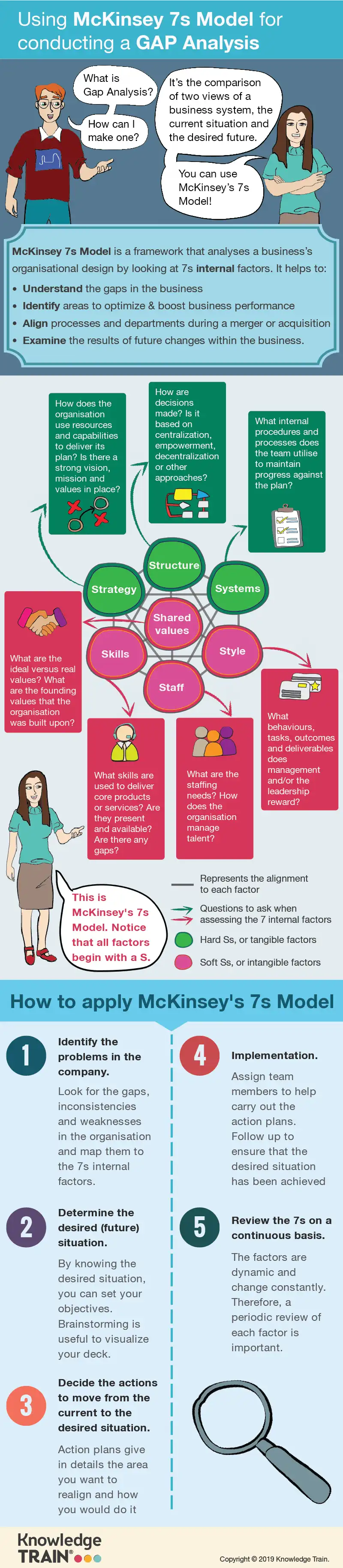
Use the 7S model to improve performance by aligning what the organisation does with how it operates and behaves.
Introduction to the McKinsey 7S modelCategorising causes
Origins and developmentAfter brainstorming, organise the identified causes into
The relevant categoriesMcKinsey 7S model. These categories can be standard ones like Methods, Materials, and Manpower, or custom ones tailored to your specific context. Proper categorisation helps in visualising the problem from different angles and ensures no potential cause is overlooked. emerged in 1978, developed by consultants Tom Peters, Robert Waterman Jr., Richard Pascale and Anthony Athos at McKinsey & Company. This innovative framework addressed a critical gap in organisational theory. Prior to its creation, companies primarily focused on structural aspects for effectiveness. The 7S Model expanded this perspective, recognising that multiple interconnected factors contribute to organisational success.Analysing and prioritising causes
Overview of the 7S frameworkThe final step is to
The model comprises analyse and prioritise the causesseven elements. Evaluate each potential cause in terms of its impact on the problem. Use techniques such as voting or ranking to identify the most critical causes for further investigation. Focusing on these key factors will help in developing targeted and effective solutions., categorised as either ‘hard’ or ‘soft’:Practical applications and case studies
Hard elements are easier to identify and manage:Fishbone diagrams are widely used across various industries to identify and resolve complex issues. In
- Strategymanufacturing
- Structure, these diagrams help pinpoint inefficiencies in production processes, leading to improved efficiency and reduced waste. By systematically analysing potential causes, manufacturers can address issues such as equipment malfunctions or material defects.
- Systems.In the
Soft elements:healthcare
- Shared values sector, fishbone diagrams are instrumental in enhancing patient safety and care quality. They allow healthcare professionals to identify factors contributing to medical errors or delays in treatment, leading to better patient outcomes.
- SkillsIn the
- Styleservice
- Staff. industry, companies employ fishbone diagrams to improve customer satisfaction. By analysing complaints and service delivery processes, businesses can identify root causes of customer dissatisfaction and implement effective solutions. This results in enhanced service quality and customer loyalty.
These components form a cohesive system, emphasising that changes in one area inevitably affect others. The model’s strength lies in its holistic approach, highlighting the importance of alignment across all elements. By considering these factors collectively, organisations can achieve greater effectiveness and navigate change more successfully.Case studies showcasing success
The 7 elements of the McKinsey modelSeveral organisations have successfully employed fishbone diagrams to tackle complex challenges. A notable example is a
- dealing with high complaint rates used fishbone diagrams to investigate recurring issues. The analysis highlighted problems such as inadequate staff training and poor communication channeIT infrastructure to performance management processes. Well-designed systems enhance productivity and ensure consistent quality across the organisation.
Soft elements
Implementing the McKinsey 7S model
Analysing current stateSubscribe now
To effectively implement the McKinsey 7S Model , begin by examining your organisation’s current state. This involves a thorough analysis of the seven elements: {"@context":"https://schema.org","@type":"ImageObject","contentUrl":"https://www.knowledgetrain.co.uk/training-courses/fishbone-diagrams-business-analysis-technique-890x501.webp","description":"PRINCE2 Careers","license":"https://www.knowledgetrain.co.uk/license","acquireLicensePage":"https://www.knowledgetrain.co.uk/license","creditText":"Knowledge Train","uploadDate":"2023-05-16T06:50:34.000Z","copyrightNotice":"© 2023 Knowledge Train Limited. All rights reserved.","creator":{"@type":"Organization","name":"Knowledge Train","url":"https://www.knowledgetrain.co.uk"}}strategy , {"@context":"https://schema.org","@type":"ImageObject","contentUrl":"https://www.knowledgetrain.co.uk/training-courses/res/images/business-analysis/fishbone-diagrams-business-analysis-technique-infographic-800x3120.webp","description":"Fishbone diagrams business analysis technique infographic.","license":"https://www.knowledgetrain.co.uk/license","acquireLicensePage":"https://www.knowledgetrain.co.uk/license","creditText":"Knowledge Train","uploadDate":"2023-05-16T06:50:34.000Z","copyrightNotice":"© 2023 Knowledge Train Limited. All rights reserved.","creator":{"@type":"Organization","name":"Knowledge Train","url":"https://www.knowledgetrain.co.uk"}}structure , Related articlessystems ,
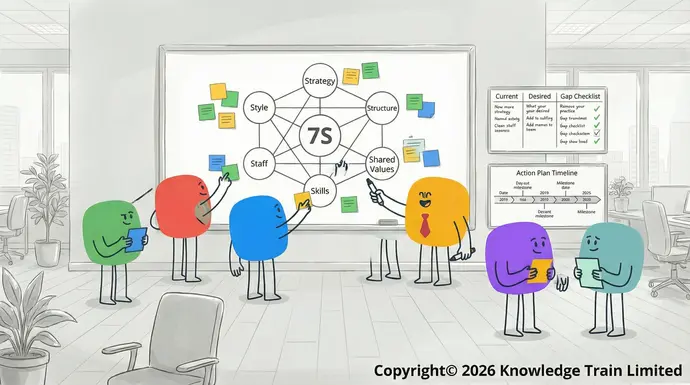
With a clear understanding of gaps and misalignments, the next step involves crafting an actionable plan. This plan should address each of the seven elements with specific, measurable objectives. Assign responsibilities and timelines to ensure accountability. Develop strategies to realign misaligned elements, such as restructuring teams or enhancing skills through targeted training. Regularly review progress and adjust the plan as necessary to maintain alignment. Effective communication is key; keep all stakeholders informed and engaged throughout the process. This strategic approach encourages sustainable change and enhances organisational performance.
Applications of the 7S framework
Strategic planning
The McKinsey 7S Model serves as a powerful tool for strategic planningUncovering the benefits of PESTLE analysis for informed decision-making. It provides a comprehensive framework for assessing an organisation’s current state and aligning all elements towards future goals. By examining each of the seven components, leaders can identify areas that require adjustment to support new strategies. This holistic approach ensures that all aspects of the organisation are considered when developing and implementing strategic initiatives.
Organisational change managementSimon Buehring
In 19 Feb 2026change management , the 7S Framework proves invaluable. It offers a structured approach to navigating complex organisational transformations. By analysing the interdependencies between the seven elements, change leaders can anticipate potential challenges and develop more effective change strategies. The model helps identify which elements need to be modified to support the desired change and ensures that all aspects of the organisation are aligned during the transition process.Discover the impact of PESTLE analysis on strategic planning. Scroll down to see how this tool can guide your business decisions and enhance your competitive edge.
Benefits and limitations
Key advantages
The McKinsey 7S Model provides a comprehensive framework for organisational analysis and improvement. It ensures alignment between strategy , structureBusiness analyst certification: What it is and how to get certified, and other key elements, promoting holistic change. By considering both hard and soft elements, it creates a balanced approach that improves overall organisational performance.
Potential drawbacksSimon Buehring
Despite its benefits, the model has limitations. It may be time-consuming to apply thoroughly, requiring significant resources and stakeholder engagement. Additionally, the model focuses on internal elements whilst external factors such as market conditions and competition are not directly addressed. This may require complementary frameworks for comprehensive analysis.30 Apr 2026
Case study: McKinsey 7S in action
An international Discover the essentials of business analyst certification, from leading qualification types to preparation, costs, and career benefits. Start your path to professional recognition and new business analysis opportunities.manufacturing company successfully utilised the McKinsey 7S Model to enhance operational efficiency. Facing challenges in aligning their global operations, the company applied the model to assess and realign their strategy and structure . They identified that their You want to become a business analyst?systems were outdated and required modernisation to support their strategic goals. By addressing these misalignments, they improved coordination and communication across different regions. The intervention also focused on developing Simon Buehringskills19 Feb 2026 among staff through targeted training programmesDiscover different motivations for pursuing a career as a business analyst. Learn what drives BA professionals by reading more.. As a result, the company experienced increased productivity and a more cohesive organisational culture, demonstrating the model’s effectiveness in fostering sustainable change.
Conclusion
The McKinsey 7S Model offers a robust framework for analysing and improving organisational effectiveness. By assessing elements like systems shared values , organisations can achieve greater alignment and efficiency. Although implementing the model requires effort, its benefits in fostering sustainable change are substantial. We encourage organisations to apply this framework to identify misalignments and develop targeted action plans. By doing so, they can enhance performance and create a cohesive organisational culture. Embracing the McKinsey 7S Model can lead to long-term success and resilience in a competitive environment.
FAQs
What is the McKinsey 7S model used for?
The McKinsey 7S Model is utilised for evaluating organisational effectiveness by analysing seven interdependent elements: strategy , structure , Unlock your creative and organisational potential with mind mapssystems , Simon Buehringshared values19 Feb 2026, styleExplore the potential of mind maps to enhance your creativity and organisational skills. Scroll down to learn practical tips and techniques that you can start using today., staff , and skills .
How do organisations benefit from the model?
Organisations benefit by achieving alignment between these elements, which enhances overall efficiency and effectiveness. It aids in identifying gaps and formulating targeted action plans.
Are there any limitations?Unlocking organisational potential with the POPIT model
The model requires significant resources to implement properly and primarily focuses on internal factors, which may necessitate additional frameworks for external analysis.
InfographicSimon Buehring