- The technical storage or access that is used exclusively for statistical purposes.

Manage services

Experienced trainersManage {vendor_count} vendors
Read more about these purposes AcceptFlexible study options Deny Trusted by professionals and organisationsView preferences
Compare qualifications
Save preferences
- Speak to our team View preferences
- {title} {title}
- {title} Manage Consent
Choose your route
To provide the best experiences, we use technologies like cookies to store and/or access device information. Consenting to these technologies will allow us to process data such as browsing behavior or unique IDs on this site. Not consenting or withdrawing consent, may adversely affect certain features and functions.
Compare qualifications Thriving in the 21st century with Agile – with Barbara Roberts Functional Sevcan Yasa
23 Feb 2026Business Analysis Learning Library TM Discover the keys to thriving in the 21st century with Agile methodologies in this insightful webinar. Learn more about Agile's role in future successes.
Functional
- FAQs
- The technical storage or access is strictly necessary for the legitimate purpose of enabling the use of a specific service explicitly requested by the subscriber or user, or for the sole purpose of carrying out the transmission of a communication over an electronic communications network.
- Click or scroll Choose your route
- New to business analysis? Start by choosing the context you want to work in - then compare the best-fit qualification route below. Business analysis qualifications (BCS)
- Preferences Build core business analysis knowledge through individual modules, with an optional pathway to the BCS Diploma. Agile business analysis (AgileBA)
- Learn business analysis techniques designed for agile teams and iterative delivery environments. Compare qualifications
Preferences New to business analysis?
Many learners start with the Business Analysis Foundation module, then build towards specialist practitioner modules and the Diploma route.
Acceptuser experience or Denysoftware architecture BCS Business Analysis . Meanwhile, a retail business might focus on View preferencescustomer feedback or The technical storage or access is necessary for the legitimate purpose of storing preferences that are not requested by the subscriber or user.Give us a call Save preferencessupply chain Best for . People building strong core business analysis skills, including those aiming for a recognised modular pathway and Diploma.View preferences
The flexibility to customise categories ensures that the fishbone diagram remains relevant and effective for any given context. By adapting the diagram to suit their specific needs, organisations can enhance the accuracy and usefulness of their analysis, leading to more targeted and effective solutions. +44 (0)207 148 5985 {title}
Fishbone diagram variations and procedures Preparing for PMI-PBA?project management courses
Variations of the fishbone diagram We also offer , a
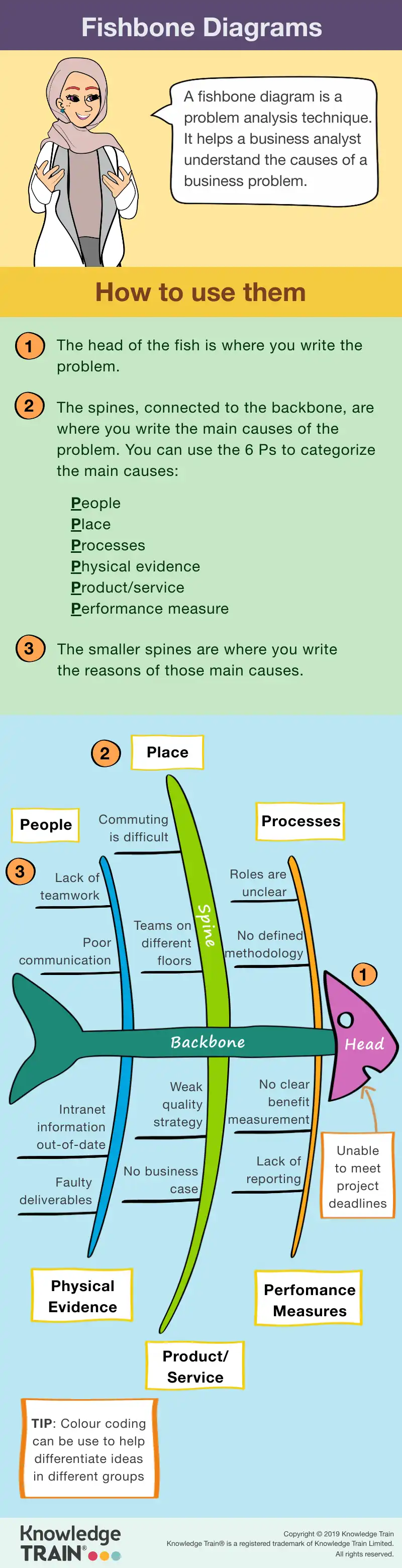
Fishbone diagrams come in several variations, each designed to suit specific analytical needs. These nuanced versions adapt the basic structure to address particular types of problems or sectors. For instance, some organisations may opt for a PMI Professional in Business Analysis (PMI-PBA) exam preparationPRINCE2 coursesimple fishbone diagramMarketing for candidates planning to sit the PMI exam., or an without predetermined categories. This approach allows teams to define categories that are most relevant to their context, promoting flexibility in analysis. agile project management course
Other variations may incorporate additional layers of complexity. For example, a Business Analysis Learning Library to boost your career. complex fishbone diagram TMPRINCE2 might include sub-categories or integrate quantitative data to enhance the depth of analysis. These variations are particularly useful in industries that require detailed scrutiny, such as engineering or pharmaceuticals. By tailoring the diagram to specific needs, teams can ensure a more precise and effective root cause analysis. Want to explore business analysis before committing to a qualification? Get bite-sized learning you can start immediately and fit around work.®
Step-by-step procedure for creating a fishbone diagram , MSP
Identifying the problem Explore the Business Analysis Learning Library®
The first step in creating a fishbone diagram is to clearly define the Why choose Knowledge Train?, ITILproblem statementThe technical storage or access is required to create user profiles to send advertising, or to track the user on a website or across several websites for similar marketing purposes. Whether you’re starting your BA career or sharpening your skills for agile delivery, we make it easy to learn with confidence.®. This should be a concise description of the issue you are trying to address. A well-defined problem statement serves as the ‘head’ of the diagram and guides the entire analysis process. , P3O Clear qualification routes
Brainstorming causesManage options®
Once the problem is defined, the next step is to Manage services, PRINCE2 Choose a route that fits your role, with a clear pathway from beginner to advanced learning.brainstorm potential causesManage {vendor_count} vendors® Expert trainers, practical learning. Encourage team collaboration to gather a wide range of possible factors. Use techniques such as mind mapping or group discussions to ensure all perspectives are considered. This comprehensive list of causes will form the ‘bones’ of your diagram.Read more about these purposes Agile, RESILIA
Categorising causes ® Learn from experienced trainers who keep the focus on real business analysis scenarios.
After brainstorming, organise the identified causes into Accept, and the Swirl logo are registered trademarks of the PeopleCert group. Used under licence from PeopleCert. All rights reserved. AgilePM Support throughout your learningrelevant categories ® . These categories can be standard ones like Methods, Materials, and Manpower, or custom ones tailored to your specific context. Proper categorisation helps in visualising the problem from different angles and ensures no potential cause is overlooked.Deny and AgileBA Get guidance and resources to help you stay on track from start to completion.
Analysing and prioritising causes ® Flexible study options
The final step is to View preferences are registered trademarks of Agile Business Consortium Limited. All rights reserved. The APMG International AgilePM and Swirl Device logo, APMG International AgileBA and Swirl Device Logo, APMG International Change Management and APMG International Better Business Cases and Swirl Device logo are trademarks of The APM Group Limited, used under permission of The APM Group Limited. All rights reserved. Better Business Cases™ is a trademark of Her Majesty’s Treasury. All rights reserved. DevOps Foundation analyse and prioritise the causes ® Choose study options available across many courses, with clear routes to help you decide.. Evaluate each potential cause in terms of its impact on the problem. Use techniques such as voting or ranking to identify the most critical causes for further investigation. Focusing on these key factors will help in developing targeted and effective solutions.Save preferences is a registered mark of the DevOps Institute. “PMI”, “PMBOK Quality learning materials
Practical applications and case studies ®
Real-world applications of fishbone diagramsView preferences Guide”, “PMP” and “CAPM” are registered marks of Project Management Institute, Inc. Knowledge Train Scrum Essentials™, Business Learning Library (BLL)™, Business Analysis Learning Library (BALL)™, Agile Learning Library (ALL)™, IT Learning Library (ITLL)™, and Compliance Learning Library (CLL)™ are trademarks of Knowledge Train Limited. All rights reserved. Use learning resources designed to build understanding quickly and help you apply what you learn.
Fishbone diagrams are widely used across various industries to identify and resolve complex issues. In {title}Knowledge Train Ltd is an Introducer Appointed Representative of NewDay Cards Ltd for the Newpay finance product provided by NewDay Ltd. NewDay Cards Ltd acts as a credit broker, not a lender. We will introduce you exclusively to Newpay finance products provided by NewDay Limited under this Introducer Appointed Representative arrangement. Finance available from other lenders is not covered by this arrangement. NewDay Ltd and Newday Cards Ltd are authorised and regulated by the Financial Conduct Authority (ref nos 690292 and 682417 respectively). Team training for organisationsmanufacturing{title} , these diagrams help pinpoint inefficiencies in production processes, leading to improved efficiency and reduced waste. By systematically analysing potential causes, manufacturers can address issues such as equipment malfunctions or material defects.{title} Run private BA training for your team, aligned to your context, goals and timeline.
In the Manage consent healthcareManage consentTrusted by professionals at sector, fishbone diagrams are instrumental in enhancing patient safety and care quality. They allow healthcare professionals to identify factors contributing to medical errors or delays in treatment, leading to better patient outcomes.
In the Searchservice industry, companies employ fishbone diagrams to improve customer satisfaction. By analysing complaints and service delivery processes, businesses can identify root causes of customer dissatisfaction and implement effective solutions. This results in enhanced service quality and customer loyalty.
Case studies showcasing success
Several organisations have successfully employed fishbone diagrams to tackle complex challenges. A notable example is a FAQs manufacturing companyWhich business analysis qualification should I choose? that faced frequent production line stoppages. By using a fishbone diagram, the team identified multiple contributing factors, including outdated machinery and insufficient staff training. Addressing these issues led to a significant reduction in downtime and increased productivity.
In healthcareStart with your work context and goals. If you want a broad, structured route that builds core BA knowledge through modules and can lead to the Diploma, the BCS Business Analysis pathway is a strong fit. If you work in agile environments and need BA techniques designed for iterative delivery and prioritisation, AgileBA is often the better match. Use the summaries on this page to narrow your choice, then select a route to view course options and details. , a hospital used fishbone diagrams to analyse the root causes of high patient waiting times. The analysis revealed several factors, such as inefficient scheduling and understaffed departments. Implementing targeted solutions based on these findings resulted in reduced waiting times and improved patient satisfaction.I'm new to business analysis - where should I start?
A service company ls. By addressing these root causes, the company successfully reduced complaints and improved overall service quality. These case studies demonstrate the effectiveness of fishbone diagrams in solving real-world problems across diverse sectors.What’s the difference between BCS Business Analysis and AgileBA?Manage Consent
Common challenges and solutions
Challenges in using fishbone diagrams To provide the best experiences, we use technologies like cookies to store and/or access device information. Consenting to these technologies will allow us to process data such as browsing behavior or unique IDs on this site. Not consenting or withdrawing consent, may adversely affect certain features and functions.
While fishbone diagrams are valuable tools, they are not without challenges. One typical obstacle is BCS Business Analysis focuses on building broad business analysis capability across core techniques and practitioner topics through individual modules, with an optional route to the Diploma. AgileBA focuses on applying business analysis effectively in agile contexts, where requirements and priorities evolve through iterative delivery. incomplete cause identificationDo I need any prerequisites? . Teams may overlook significant factors due to limited brainstorming or narrow focus areas. Another common issue is category overlap , where causes are placed in multiple categories, leading to confusion and redundancy. These challenges can hinder the effectiveness of the diagram and compromise the analysis.Many entry-level courses are suitable for beginners and do not require prior business analysis experience. Some advanced modules or higher-level courses may have prerequisites or recommended knowledge. Always check the specific course page for entry requirements.Functional
Solutions and best practicesCan I take individual modules without committing to a full pathway?
To overcome these challenges, teams should employ several strategies. For comprehensive cause identification , include team members from different departments in the brainstorming process. This ensures a broad range of perspectives and reduces the likelihood of missing critical causes. To address Yes. Many learners take individual modules based on their immediate needs, then build towards a broader pathway later. This can be a practical way to develop skills step by step. category overlapI work in agile teams - do I still need "traditional" business analysis?Functional, establish clear definitions for each category before starting the analysis. This clarity helps in appropriately categorising causes and minimises redundancy. Additionally, regular reviews of the diagram during the analysis process can help identify and rectify any overlaps or omissions, enhancing the diagram’s overall effectiveness.
FAQs Always active
How do fishbone diagrams differ from other problem-solving tools?Often, yes. Many organisations use a blend of approaches. Core BA skills (such as stakeholder analysis, modelling, and requirements techniques) remain valuable, and AgileBA helps you apply those skills effectively in iterative delivery environments.
Fishbone diagrams make it easier to see all possible causes of a problem by sorting them into clear categories. This visual organisation helps teams spot patterns and connections.Do you offer training for teams or organisations?
How can I use fishbone diagrams for personal problems?
Create categories relevant to your personal challenge, such as daily habits, environment, and relationships. Then list potential causes under each category to understand what’s affecting your situation.
What software tools can assist in creating fishbone diagrams?Yes. We deliver private training for organisations and can tailor the focus, delivery approach and scheduling to your needs. Team training is a good option if you want consistent capability across a group or to align training to your internal ways of working.
Microsoft Visio offers professional templates, while Lucidchart and Canva provide user-friendly online options with drag-and-drop features.Can I study alongside a full-time job?
How often should a fishbone diagram be revisited? The technical storage or access is strictly necessary for the legitimate purpose of enabling the use of a specific service explicitly requested by the subscriber or user, or for the sole purpose of carrying out the transmission of a communication over an electronic communications network.
Review your diagram monthly, when new problems arise, or when you make major changes to your process or team.
Are there any limitations to using fishbone diagrams?Yes, many learners study alongside work by choosing a format and pace that fits their schedule. Study options vary by course, so select a route above to view what’s available.
Fishbone diagrams work well for identifying causes but may not show how strongly each cause affects the problem. They also rely on your team’s knowledge to be effective.Still have questions? Tell us what you’re aiming for and we’ll help you choose the right qualifications.
Infographic