What is Agile?Simon Buehring

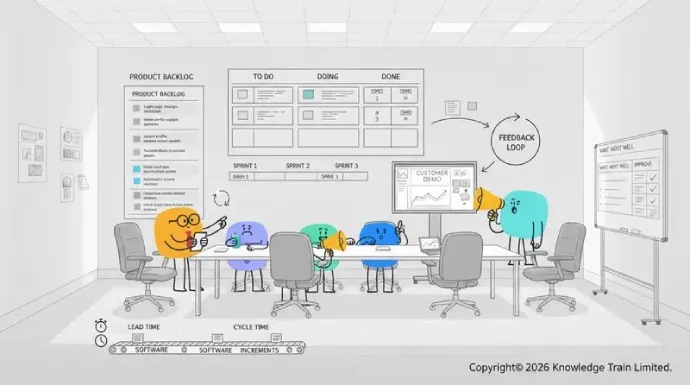
Agile refers to a set of principles and practices that guide teams in developing software products through incremental delivery, adaptive planning, and continual improvement. Agile emphasises iterative development, close team collaboration, and frequent customer feedback to deliver high-quality solutions quickly and efficiently.
Agile methodology at a glance
| Aspect | Description |
|---|---|
| Purpose | Deliver working software frequently, respond to change rapidly |
| Key values | Individuals and interactions, working software, customer collaboration, responding to change |
| Approach | Iterative, adaptive, and incremental |
| Popular frameworks | Scrum , Kanban, Extreme Programming (XP) |
| Stakeholders | Customers, product owners, cross-functional teams, Scrum Masters |
Summary of the Agile Manifesto and Its values
The Agile Manifesto , published in 2001 by 17 software development experts, established the foundation for Agile methodologies . It promotes four core values and twelve underlying principles to guide teams toward continuous improvement and customer satisfaction.
Agile Manifesto: Four valuesGive us a call
- Individuals and interactions over processes and tools
- Working software over comprehensive documentation
- Customer collaboration over contract negotiation+44 (0)207 148 5985
- Responding to change over following a plan
Agile principlesOr chat with us using the link at the bottom of the screen.
- CookiesCollaborate daily between business people and developers
- Build PrivacyprojectsTerms around motivated individuals and provide supportCustomer Support
- Convey information face-to-face whenever possible
- Working software is the primary measure of progress[email protected]
- Maintain a sustainable development paceJoin Our Team
- Continuous attention to technical excellence and good design
- Simplicity – the art of maximising the work not done – is essential[email protected]
- Self-organising teams produce the best architectures, requirements, and designs Copyright © 2005-2026 Knowledge Train Limited.
- Regularly reflect and adapt to improve effectiveness Registered in UK: 5566983.
Historical origins and evolution of Agile Registered VAT: GB872413526.
The Agile approach originated in the late 1990s as software teams sought alternatives to rigid project management models like the Knowledge TrainWaterfall® model. In 2001, seventeen thought leaders signed is a registered trademark of Knowledge Train Limited. the Agile Manifesto 20 Old Bailey, London, EC4M 7AN, England, United Kingdom., formalising Agile values and sparking the formation of the Agile Alliance. Since then, Agile has evolved beyond software development into Knowledge Train are experts in project management, PRINCE2, agile and change management training and certification. Choose from a full range of instructor-led and self-paced project managementproject management courses
| Frequent, partial releasesSearch | Full product delivered at project end | |
| Risk |
Further Resources
FAQs
The 12 Agile principles include prioritising customer satisfaction through early and continual delivery, welcoming changing requirements, delivering working software frequently, fostering daily collaboration, supporting motivated teams, preferring face-to-face communication, using working software as the main progress measure, maintaining a sustainable pace, focusing on technical excellence, maximising simplicity, enabling self-organising teams, and reflecting regularly for process improvement.
What is the difference between Agile and waterfall?
Agile is iterative, adaptable, and focuses on incremental delivery with frequent stakeholder feedback. The technical storage or access is strictly necessary for the legitimate purpose of enabling the use of a specific service explicitly requested by the subscriber or user, or for the sole purpose of carrying out the transmission of a communication over an electronic communications network.Waterfall is linear, sequential, and requires upfront planning, often only allowing changes late in the project cycle.
What are Scrum and Kanban frameworks?
Scrum is an Agile framework that organises work into fixed-length sprints and uses roles like Product Owner and PreferencesScrum Master . Kanban is a visual method for managing workflow, limiting work in progress, and focusing on incremental improvements.
How does Agile improve team collaboration?
Agile improves collaboration through daily communication, cross-functional team structures, and regular stakeholder engagement, ensuring all members align towards shared goals.Preferences