
Self-pacedAgile combines a mindset with practical routines that help teams deliver value in changing conditions.
- Agile prioritises working software, collaboration, and adapting plans based on frequent feedback.
- Iterative, incremental delivery reduces risk by surfacing issues and learning earlier.
- Scrum uses timeboxed sprints and clear roles to create a predictable cadence for delivery and review.
- Kanban improves flow by visualising work and limiting work in progress to expose bottlenecks.Project management courses
- Healthy Agile adoption relies on clear roles, shared quality standards, and sustainable pace.Compare project management qualifications and practical workshops. Choose the route that fits your role, experience and goals.
- Measure outcomes and flow with metrics like lead time and defect rate, then refine through retrospectives.
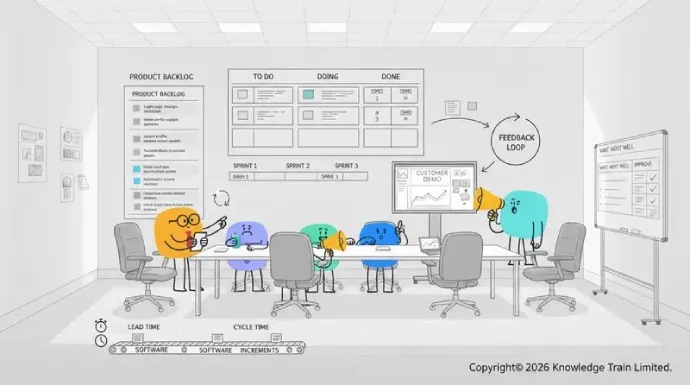
Summary of the Agile Manifesto and Its values
The Agile Manifesto, published in 2001 by 17 software development experts, established the foundation for Agile methodologiesCompare qualifications. It promotes four core values and twelve underlying principles to guide teams toward continuous improvement and customer satisfaction.
Agile Manifesto: Four values Workshops and practical skills
- Individuals and interactions over processes and tools For people who want practical project management skills quickly, with a Knowledge Train certificate.
- Working software over comprehensive documentation
- Customer collaboration over contract negotiation
- Responding to change over following a planExplore workshops
Agile principles
Agile is supported by twelve guiding principles, intended to help teams create successful products in an ever-changing environment. These principles inform day-to-day Agile practices.Already know what you’re looking for?
- Satisfy the customer through early and continuous delivery of valuable software Jump straight to
- Welcome changing requirements, even late in developmentAPM
- Deliver working software frequently, from a couple of weeks to a couple of months,
- Collaborate daily between business people and developersPRINCE2
- Build , projectsAgilePM around motivated individuals and provide support,
- Convey information face-to-face whenever possiblePRINCE2 Agile
- Working software is the primary measure of progress, or
- Maintain a sustainable development pacepractical workshops
- Continuous attention to technical excellence and good design.
- Simplicity – the art of maximising the work not done – is essentialCompare qualifications
- Self-organising teams produce the best architectures, requirements, and designsUse these summaries to choose a qualification. Use the buttons to view course options and details.
- Regularly reflect and adapt to improve effectivenessProject management qualifications
Historical origins and evolution of Agile
The Agile approach originated in the late 1990s as software teams sought alternatives to rigid project management models like the New to project management?Waterfall Start with a Foundation-level qualification (such as PRINCE2 Foundation or APM PFQ), or choose a practical workshop to build confidence first. model. In 2001, seventeen thought leaders signed the Agile Manifesto , formalising Agile values and sparking the formation of the Agile Alliance. Since then, Agile has evolved beyond software development into project managementAPM, product development, and operations.
Benefits of Agile
- Flexibility: Respond rapidly to changing customer needs and market conditions.Best for
- Continuous improvement:Professionals who want broad project management knowledge rather than training in one specific method. Regular retrospectives help teams adapt and improve their processes.
- Customer satisfaction:Choose this if… Frequent delivery ensures customer requirements are met early and often.You want broader project management knowledge and terminology that employers recognise across industries.
- Transparency: Iterative development and open communication foster stakeholder trust.You’ll leave with
- Reduced risk:An APM qualification route (PFQ/PMQ and specialist options where applicable) and broad knowledge you can apply across projects and industries. Incremental delivery allows for earlier issue detection and correction.
- Enhanced team collaboration:APM courses Cross-functional teams communicate daily to resolve challenges efficiently.
Agile vs waterfall modelPRINCE2
| Aspect | Agile | Waterfall |
|---|---|---|
| ProcessBest for | Iterative and incrementalPeople new to project management, and professionals working in organisations with formal governance, reporting and defined project stages. | Sequential and linear |
| FlexibilityChoose this if… | Adaptive to changeYou need a method with defined roles, management stages, and clear controls for planning, reporting and decision-making. | Resistant to change after initial planning |
| Customer involvementYou’ll leave with | High, continuous feedbackA PRINCE2 certification route (Foundation and Practitioner options) and a practical approach to plan, control and deliver projects. | Typically only during requirements and acceptance stages |
| DeliveryPRINCE2 courses | Frequent, partial releases | Full product delivered at project endAgilePM |
| Risk | Problems discovered early | Issues often found late |
Agile frameworks and practicesBest for
Scrum frameworkProject professionals and aspiring project managers working with agile delivery teams.
Scrum is a widely adopted Agile framework structured around short, timeboxed periods called Choose this if…sprintsYou need to understand agile project delivery while still managing time, cost and governance expectations.. Teams maintain a product backlogYou’ll leave with of features and tasks, delivering increments of working software at the end of each sprint. Roles in Scrum include Product Owner, An AgilePM certification route (Foundation and Practitioner options) and practical techniques for planning and managing agile projects.Scrum Master , and Development Team. Daily stand-ups, sprint planning, reviews, and retrospectives reinforce team collaboration and transparency.AgilePM courses
Kanban
Kanban emphasises visualising work, limiting work in progress, and optimising flow. Teams use Kanban boards to track tasks and identify bottlenecks, often integrating continuous improvement practices.PRINCE2 Agile
User stories and Product Backlog
Features are typically described as user stories in a product backlog. This backlog is prioritised by the Product Owner and guides the work to be pulled into each sprint or iteration.Best for
Agile project managementProject professionals (or aspiring project managers) who need PRINCE2 governance and agile delivery working together.
Agile project management focuses on iterative planning, adaptive resource allocation, and continuous stakeholder engagement. Leaders support self-organising, cross-functional teams, encourage regular customer feedback, and facilitate incremental value delivery.Choose this if…
Key concepts: Iterative and incremental deliveryYou want to keep PRINCE2 governance while using agile practices in delivery teams.
Agile projects proceed in small iterations, each resulting in an incrementally improved product. This iterative approach enables rapid adaptation, regular feedback, and incremental value to stakeholders.
Team collaboration and cross-functional teamsYou’ll leave with
Agile emphasises collaboration between customers, stakeholders, and team members from diverse disciplines. Cross-functional teams are empowered to make decisions and deliver complete solutions within each iteration.A PRINCE2 Agile certification route (Foundation and Practitioner options) and knowledge and skills on tailoring PRINCE2 for agile contexts.
Continuous improvement practices
Agile teams conduct regular retrospectives to identify areas for improvement and adjust their processes. This culture of continuous improvement leads to increased quality, productivity, and team morale over time.PRINCE2 Agile courses
FAQs These qualifications can still be a strong starting point, especially at Foundation level.
What is Agile methodology?
The 12 Agile principles include prioritising customer satisfaction through early and continual delivery, welcoming changing requirements, delivering working software frequently, fostering daily collaboration, supporting motivated teams, preferring face-to-face communication, using working software as the main progress measure, maintaining a sustainable pace, focusing on technical excellence, maximising simplicity, enabling self-organising teams, and reflecting regularly for process improvement.Best for
What is the difference between Agile and waterfall?PMO professionals and those moving into PMO roles shaping a portfolio, programme or project office.
Agile is iterative, adaptable, and focuses on incremental delivery with frequent stakeholder feedback. WaterfallChoose this if… is linear, sequential, and requires upfront planning, often only allowing changes late in the project cycle.You need clearer governance, consistent standards and reporting, and a practical model for how a PMO should operate.
What are Scrum and Kanban frameworks?
ScrumYou’ll leave with is an Agile framework that organises work into fixed-length sprints and uses roles like Product Owner and A P3O qualification route and practical guidance for selecting, setting up and running effective PMO services.Scrum Master . Kanban is a visual method for managing workflow, limiting work in progress, and focusing on incremental improvements.P3O courses
How does Agile improve team collaboration?
Agile improves collaboration through daily communication, cross-functional team structures, and regular stakeholder engagement, ensuring all members align towards shared goals.Better Business Cases