
| Project Risk Single Certificate Level 1 Iterative, adaptive, and incremental | |
| Popular frameworksEnhance your project risk management skills. | ScrumAgilePM, Kanban, Extreme Programming (XP)® |
| Stakeholders – Agile Project Management | Customers, product owners, cross-functional teams, Scrum MastersFoundation |
Summary of the Agile Manifesto and Its valuesLearn the key principles of Agile Project Management.
The Practitioner Agile ManifestoIncludes Foundation & Practitioner combined option., published in 2001 by 17 software development experts, established the foundation for PRINCE2Agile methodologies®. It promotes four core values and twelve underlying principles to guide teams toward continuous improvement and customer satisfaction. Agile
Agile Manifesto: Four valuesFoundation
- Individuals and interactions over processes and toolsLearn the fundamentals of the PRINCE2 Agile method.
- Working software over comprehensive documentationPractitioner
- Customer collaboration over contract negotiationIncludes Foundation & Practitioner combined option.
- Responding to change over following a planAI Project Governance Framework (AIPGF)
Agile principlesFoundation
Agile is supported by twelve guiding principles, intended to help teams create successful products in an ever-changing environment. These principles inform day-to-day Agile practices.Learn the fundamentals of the governance framework.
- Satisfy the customer through early and continuous delivery of valuable softwarePractitioner
- Welcome changing requirements, even late in developmentIncludes Foundation & Practitioner combined option.
- Deliver working software frequently, from a couple of weeks to a couple of monthsBetter Business Cases
- Collaborate daily between business people and developers™
- Build Foundation projectsLearn the fundamentals of Better Business cases.Includes Foundation & Practitioner combined option.
- Convey information face-to-face whenever possibleP3O
- Working software is the primary measure of progress®
- Maintain a sustainable development paceFoundation
- Continuous attention to technical excellence and good designLearn the fundamentals of the P3O project management office.
- Simplicity – the art of maximising the work not done – is essentialPractitioner
- Self-organising teams produce the best architectures, requirements, and designsIncludes Foundation & Practitioner combined option.
- Regularly reflect and adapt to improve effectivenessWorkshops
Historical origins and evolution of AgileIntroduction to Project Management
The Agile approach originated in the late 1990s as software teams sought alternatives to rigid project management models like the 1-day workshop to learn the basics of project management.WaterfallProject Management Essentials model. In 2001, seventeen thought leaders signed 2-day workshop to learn how to manage projects without getting certified.the Agile ManifestoWriting Business Cases , formalising Agile values and sparking the formation of the Agile Alliance. Since then, Agile has evolved beyond software development into Half-day workshop to learn to write robust business cases.project managementAI in Project Management , product development, and operations.Learn how to use AI tools in everyday project work.
Benefits of AgileARTIFICIAL INTELLIGENCE (AI)
- Flexibility:BCS AI Respond rapidly to changing customer needs and market conditions.Foundation
- Continuous improvement:Learn the fundamentals of artificial intellegence. Regular retrospectives help teams adapt and improve their processes.AI Project Governance Framework (AIPGF)
- Customer satisfaction:Foundation Frequent delivery ensures customer requirements are met early and often.Learn the fundamentals of the governance framework.
- Transparency:Practitioner Iterative development and open communication foster stakeholder trust.Includes Foundation & Practitioner combined option.
- Reduced risk:Workshops Incremental delivery allows for earlier issue detection and correction.AI in Project Management
- Enhanced team collaboration:Learn how to use AI tools in everyday project work. Cross-functional teams communicate daily to resolve challenges efficiently.AGILE
Agile vs waterfall modelAgilePM
| Practitioner | AgileIncludes Foundation & Practitioner combined option. | WaterfallPRINCE2 |
|---|---|---|
| Process® | Iterative and incremental Agile | Sequential and linearFoundation |
| FlexibilityLearn the fundamentals of the PRINCE2 Agile method. | Adaptive to changePractitioner | Resistant to change after initial planningIncludes Foundation & Practitioner combined option. |
| Customer involvementScrum | High, continuous feedbackScrum Essentials | Typically only during requirements and acceptance stagesSelf-paced training course to learn the essentials of Scrum. |
| DeliveryScrum Master | Frequent, partial releasesChoose Scrum Alliance or Scrum.org Scrum Master training courses. | Full product delivered at project endScrum Product Owner |
| RiskChoose Scrum Alliance or Scrum.org Product Owner training courses. | Problems discovered earlyAgileBA | Issues often found late® |
Agile frameworks and practices – Agile Business Analysis
Scrum frameworkFoundation
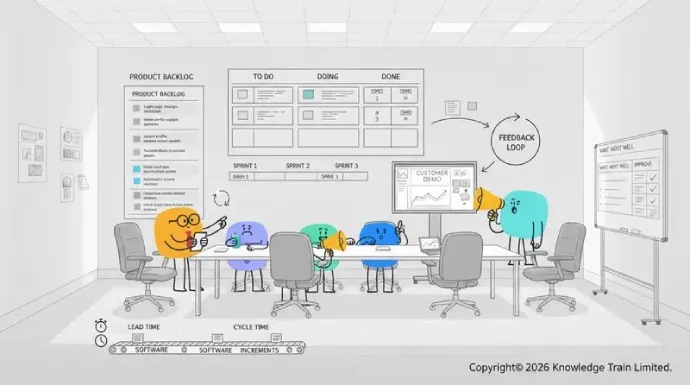
ScrumLearn the fundamentals of Agile Business Analysis. is a widely adopted Agile framework structured around short, timeboxed periods called Practitioner sprints4-day course including Foundation.. Teams maintain a Lean Six Sigmaproduct backlogYellow Belt of features and tasks, delivering increments of working software at the end of each sprint. Roles in Scrum include Product Owner, Self-paced training course to gain LSS Yellow Belt.Scrum MasterPMI, and Development Team. Daily stand-ups, sprint planning, reviews, and retrospectives reinforce team collaboration and transparency.®
KanbanPMI-ACP
Kanban emphasises visualising work, limiting work in progress, and optimising flow. Teams use Kanban boards to track tasks and identify bottlenecks, often integrating continuous improvement practices.Self-paced course to prepare you for the exam (exam not included).
User stories and Product BacklogKanban
Features are typically described as Estimating for Agile Foundationuser storiesAgile Learning Library (ALL)™ in a product backlog. This backlog is prioritised by the Product Owner and guides the work to be pulled into each sprint or iteration.BUSINESS ANALYSIS
Agile project managementBCS Business Analysis
Agile project managementBusiness Analysis Foundation focuses on iterative planning, adaptive resource allocation, and continuous stakeholder engagement. Leaders support self-organising, cross-functional teams, encourage regular customer feedback, and facilitate incremental value delivery.Learn the fundamentals of business analysis.
Key concepts: Iterative and incremental deliveryModelling Business Processes
Agile projects proceed in small iterations, each resulting in an incrementally improved product. This iterative approach enables rapid adaptation, regular feedback, and incremental value to stakeholders.Gain practitioner certificate in modelling business processes.
Team collaboration and cross-functional teamsBusiness Analysis Practices
Agile emphasises collaboration between customers, stakeholders, and team members from diverse disciplines. Cross-functional teams are empowered to make decisions and deliver complete solutions within each iteration.Gain practitioner certificate in business analysis practices.
Continuous improvement practicesRequirements Engineering
Scrum MasterPROGRAMME MANAGEMENT. Kanban is a visual method for managing workflow, limiting work in progress, and focusing on incremental improvements.MSP
How does Agile improve team collaboration?®
Agile improves collaboration through daily communication, cross-functional team structures, and regular stakeholder engagement, ensuring all members align towards shared goals.Foundation