
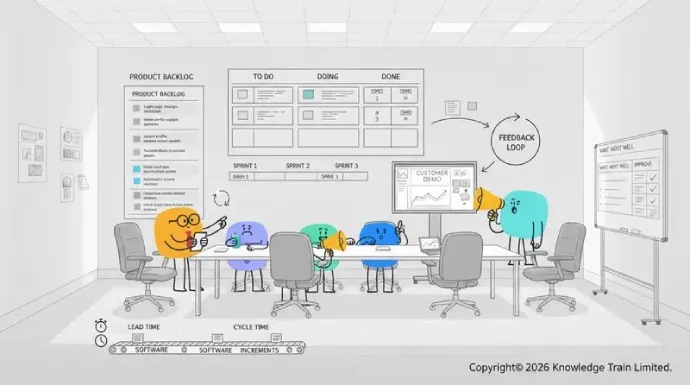
Definition of AgilePRINCE2
Agile® refers to a set of principles and practices that guide teams in developing software products through incremental delivery, adaptive planning, and continual improvement. Agile emphasises iterative development, close team collaboration, and frequent customer feedback to deliver high-quality solutions quickly and efficiently.Foundation
PRINCE2Agile methodologies®. It promotes four core values and twelve underlying principles to guide teams toward continuous improvement and customer satisfaction. Agile
Agile Manifesto: Four valuesFoundation
- Individuals and interactions over processes and toolsLearn the fundamentals of the PRINCE2 Agile method.
- Working software over comprehensive documentationPractitioner
- Customer collaboration over contract negotiationIncludes Foundation & Practitioner combined option.
- Responding to change over following a planAI Project Governance Framework (AIPGF)
of features and tasks, delivering increments of working software at the end of each sprint. Roles in Scrum include Product Owner, Foundation Scrum MasterLearn the fundamentals of Agile Business Analysis., and Development Team. Daily stand-ups, sprint planning, reviews, and retrospectives reinforce team collaboration and transparency.Practitioner
Self-paced course to prepare you for the exam (exam not included). focuses on iterative planning, adaptive resource allocation, and continuous stakeholder engagement. Leaders support self-organising, cross-functional teams, encourage regular customer feedback, and facilitate incremental value delivery.Kanban
Key concepts: Iterative and incremental deliveryEstimating for Agile Foundation
Agile projects proceed in small iterations, each resulting in an incrementally improved product. This iterative approach enables rapid adaptation, regular feedback, and incremental value to stakeholders.Agile Learning Library (ALL)™
Team collaboration and cross-functional teamsBUSINESS ANALYSIS
Agile emphasises collaboration between customers, stakeholders, and team members from diverse disciplines. Cross-functional teams are empowered to make decisions and deliver complete solutions within each iteration.BCS Business Analysis
Continuous improvement practicesBusiness Analysis Foundation
Agile teams conduct regular retrospectives to identify areas for improvement and adjust their processes. This culture of continuous improvement leads to increased quality, productivity, and team morale over time.Learn the fundamentals of business analysis.
Further ResourcesModelling Business Processes
FAQsGain practitioner certificate in business analysis practices.
What is Agile methodology?Requirements Engineering
Agile methodologyGain practitioner certificate in requirements engineering. is a set of practices and values that promote adaptive planning, evolutionary development, early delivery, and continual improvement. Agile methods empower teams to respond quickly to change and collaborate closely with stakeholders.Business Analysis International Diploma
What are the 12 principles of Agile?All 4 courses bundled into this Diploma certification package.
The AgileBA12 Agile principles® include prioritising customer satisfaction through early and continual delivery, welcoming changing requirements, delivering working software frequently, fostering daily collaboration, supporting motivated teams, preferring face-to-face communication, using working software as the main progress measure, maintaining a sustainable pace, focusing on technical excellence, maximising simplicity, enabling self-organising teams, and reflecting regularly for process improvement. – Agile Business Analysis