What is Agile?Ireland

Key takeaways19 Feb 2026
Agile combines a mindset with practical routines that help teams deliver value in changing conditions.
- Agile prioritises working software, collaboration, and adapting plans based on frequent feedback.
- Iterative, incremental delivery reduces risk by surfacing issues and learning earlier.
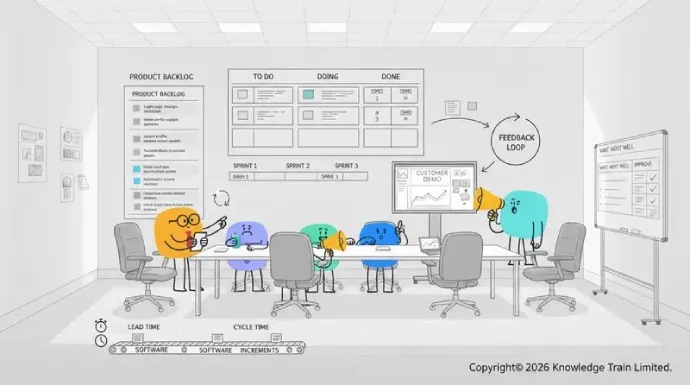
- Scrum uses timeboxed sprints and clear roles to create a predictable cadence for delivery and review.
- Kanban improves flow by visualising work and limiting work in progress to expose bottlenecks.
- Healthy Agile adoption relies on clear roles, shared quality standards, and sustainable pace.
- Measure outcomes and flow with metrics like lead time and defect rate, then refine through retrospectives.
Agile Manifesto: Four values and product management become increasingly important in today’s business environment, it is critical to understand their respective roles and how they complement each other to tackle complex challenges effectively. This article will explore the key differences between the two, including specific responsibilities, skills and traits required, career paths, and other aspects.
- Individuals and interactions over processes and toolsBy understanding these distinctions, individuals and organisations can make informed decisions about how to best leverage both disciplines to achieve their objectives and drive success.
- Working software over comprehensive documentationDefining project management and product management
- Customer collaboration over contract negotiationWhat is project management?
- Responding to change over following a planProject management
Agile principles is a discipline of planning, implementing, and controlling a project with specific goals and a timeline.
Agile is supported by twelve guiding principles, intended to help teams create successful products in an ever-changing environment. These principles inform day-to-day Agile practices.Project managers
- Satisfy the customer through early and continuous delivery of valuable software oversee various tasks, including planning and scheduling the project tasks, allocating resources,
- Welcome changing requirements, even late in developmentrisk
- Deliver working software frequently, from a couple of weeks to a couple of months and issue management
- Collaborate daily between business people and developers, and ensuring the project is delivered on time and within budget. The key objectives of project management are to meet the project’s deadlines and milestones, ensure quality control, promote team collaboration, and report on the progress to stakeholders.
- Build What is product management?projectsProduct management, on the other hand, is responsible for the entire lifecycle of a product, from its initial concept to its retirement. The role of a around motivated individuals and provide supportproduct manager
- Convey information face-to-face whenever possible includes defining the product’s vision and strategy, conducting market research and analysis, prioritising product features and improvements, and working with cross-functional teams to ensure the successful delivery of the product. Product management’s main objectives are to understand customer needs and pain points, align product development with business objectives, optimise product value and market fit, and drive product adoption and revenue growth.
- Working software is the primary measure of progressCommon misconceptions and overlaps
- Maintain a sustainable development paceWhile project and product management serve different functions, there are overlaps that can lead to misunderstandings. Some common misconceptions include believing that
- Continuous attention to technical excellence and good designproject managers
- Simplicity – the art of maximising the work not done – is essential have authority over product decisions, expecting product managers to handle day-to-day project tasks, and assuming the roles are interchangeable.
- Self-organising teams produce the best architectures, requirements, and designsBoth roles are distinct but complementary. Project managers are often focused on execution and delivery, while product managers provide strategic guidance and have a long-term vision for the product. The two roles need to work together in successful organisations to leverage their unique skill sets and achieve the best outcomes.
- Regularly reflect and adapt to improve effectivenessEnhance your skills with our expert-led courses
Historical origins and evolution of Agile
The Agile approach originated in the late 1990s as software teams sought alternatives to rigid project management models like the Waterfall model. In 2001, seventeen thought leaders signed Instructor-ledthe Agile ManifestoIntroduction to Project Management course, formalising Agile values and sparking the formation of the Agile Alliance. Since then, Agile has evolved beyond software development into project management£499 +vat, product development, and operations.
Benefits of AgileSee all dates
- Flexibility: Respond rapidly to changing customer needs and market conditions.
- Continuous improvement: Regular retrospectives help teams adapt and improve their processes.Instructor-led
- Customer satisfaction:Project Management Essentials Frequent delivery ensures customer requirements are met early and often.
- Transparency:£999 +vat Iterative development and open communication foster stakeholder trust.
- Reduced risk:See all dates Incremental delivery allows for earlier issue detection and correction.Key differences between project managers and product managers
- Enhanced team collaboration:Role focus and scope Cross-functional teams communicate daily to resolve challenges efficiently.Project managers
Agile vs waterfall model are primarily focused on execution and delivery. They drive the implementation of specific projects and are responsible for managing the team to deliver project goals within constraints. Project managers focus on getting the job done.
| AspectProduct managers | Agile, on the other hand, are responsible for strategy and vision. They are tasked with defining what should be built and why, shaping the product roadmap and ensuring alignment with business objectives. In essence, product managers think about the product’s life cycle and market position, while project managers are more concerned with the day-to-day activities. | WaterfallTimeline and lifecycle involvement |
|---|---|---|
| ProcessProject managers | Iterative and incremental work within defined start and end dates, whereas product managers are involved in a product’s lifecycle indefinitely. A project manager guides a project from initiation to closure and then transitions to the next project or opportunity. On the other hand, a product manager’s responsibilities continue as long as the product exists in the market. They manage updates, improvements and adapt to market needs, so their involvement is ongoing. | Sequential and linearDecision-making authority |
| FlexibilityProject managers are tactical decision-makers, operating within project constraints. They are responsible for decisions about task prioritisation, resource allocation, and risk management, but they typically don’t have authority to make decisions about the overall project’s scope or direction. In contrast, product managers have strategic decision-making power. They decide what features the product should have, how it should be positioned in the market, and when to pivot based on customer feedback or market changes. Product managers make decisions that have long-term implications for the product. | Adaptive to changeStakeholder management | Resistant to change after initial planningProject managers primarily work with internal teams and stakeholders directly involved in project execution. They coordinate between team members, manage project-related communication, and report to project sponsors or department heads. Product managers interact with a wider range of stakeholders. This includes not only internal teams like engineering, design, marketing and sales but also external ones. They gather insights from customers, understand market trends and work with multiple departments to ensure product-market fit. |
| Customer involvementThese differences in roles, responsibilities and operational focus highlight the unique contributions of both project managers and product managers to an organisation. While project managers are essential for executing specific initiatives, product managers play a pivotal role in setting strategic direction, thus guiding the overall product development and market success. | High, continuous feedbackSkills and qualifications | Typically only during requirements and acceptance stagesProject manager skills |
| DeliveryProject managers | Frequent, partial releases need to possess a range of skills to lead | Full product delivered at project endprojects |
| Risk effectively. Some of the key skills include: | Problems discovered earlyPlanning and scheduling | Issues often found late: Project managers should be skilled in developing realistic timelines, managing project milestones, and keeping projects on track. |
Product management tools and frameworksWaterfall is linear, sequential, and requires upfront planning, often only allowing changes late in the project cycle.Product managers
What are Scrum and Kanban frameworks? utilise specialised tools to define and communicate product strategy effectively. Some tools and frameworks commonly used by product managers include:
ScrumProduct road mapping software is an Agile framework that organises work into fixed-length sprints and uses roles like Product Owner and : Tools like ProductPlan or Aha! help create visual roadmaps that outline product vision, features, and timelines. These tools are used to align stakeholders and guide development efforts.Scrum MasterUser story mapping and prioritisation. Kanban is a visual method for managing workflow, limiting work in progress, and focusing on incremental improvements.: Techniques such as the
How does Agile improve team collaboration?MoSCoW
Agile improves collaboration through daily communication, cross-functional team structures, and regular stakeholder engagement, ensuring all members align towards shared goals. method or story mapping workshops can assist product managers in organising and prioritising features based on user needs and business value. These approaches ensure that product development focuses on delivering maximum value to customers.