
| PRINCE2Popular frameworks | Scrum, a process describes which project management team role is responsible for taking decisions and when. Processes are where the principles and , Kanban, Extreme Programming (XP)practices of PRINCE2 |
| Stakeholders are applied. The 7 processes in PRINCE2 are: | Customers, product owners, cross-functional teams, Scrum MastersStarting up a project |
Summary of the Agile Manifesto and Its valuesDirecting a project
The Initiating a projectAgile ManifestoControlling a stage, published in 2001 by 17 software development experts, established the foundation for Managing product deliveryAgile methodologiesManaging a stage boundary. It promotes four core values and twelve underlying principles to guide teams toward continuous improvement and customer satisfaction.Closing a project
Agile Manifesto: Four values
- Individuals and interactions over processes and toolsDownload the PRINCE2 processes ebook
- Working software over comprehensive documentation
| Customer involvementproject manager | High, continuous feedback must review any lessons from previous projects which can usefully be applied on this project. | Typically only during requirements and acceptance stagesOne part of the project brief is the |
| Deliveryproject product description | Frequent, partial releases which describes the project’s major products or outcomes. Another part is the | Full product delivered at project endproject approach |
| Risk which describes the options for delivering the solution e.g. whether the work will be outsourced or done in-house. It also contains the | Problems discovered earlyoutline business case | Issues often found late containing the business justification. |
Agile frameworks and practicesEnhance your skills with our expert-led courses
Scrum framework
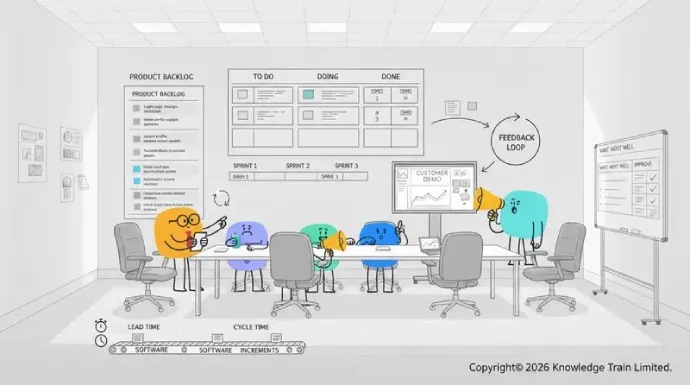
Scrum is a widely adopted Agile framework structured around short, timeboxed periods called sprintsInstructor-led. Teams maintain a PRINCE2 Practitioner (with Foundation) courseproduct backlog of features and tasks, delivering increments of working software at the end of each sprint. Roles in Scrum include Product Owner, £1,899 +vatScrum Master , and Development Team. Daily stand-ups, sprint planning, reviews, and retrospectives reinforce team collaboration and transparency.See all dates
Kanban
Kanban emphasises visualising work, limiting work in progress, and optimising flow. Teams use Kanban boards to track tasks and identify bottlenecks, often integrating continuous improvement practices.
User stories and Product Backlog
Features are typically described as Self-paceduser storiesPRINCE2 Practitioner (with Foundation) self-paced online in a product backlog. This backlog is prioritised by the Product Owner and guides the work to be pulled into each sprint or iteration.
Agile project management£1,399 +vat
Agile project management focuses on iterative planning, adaptive resource allocation, and continuous stakeholder engagement. Leaders support self-organising, cross-functional teams, encourage regular customer feedback, and facilitate incremental value delivery.
Key concepts: Iterative and incremental delivery
Agile projects proceed in small iterations, each resulting in an incrementally improved product. This iterative approach enables rapid adaptation, regular feedback, and incremental value to stakeholders.Instructor-led
Team collaboration and cross-functional teamsPRINCE2 Foundation course
Agile emphasises collaboration between customers, stakeholders, and team members from diverse disciplines. Cross-functional teams are empowered to make decisions and deliver complete solutions within each iteration.
Continuous improvement practices£1,299 +vat
Agile teams conduct regular retrospectives to identify areas for improvement and adjust their processes. This culture of continuous improvement leads to increased quality, productivity, and team morale over time.
Further ResourcesSee all dates
FAQsTo enable the project board to make key decisions and exercise overall control while delegating day-to-day management of the project to the project manager. In this way, the project board becomes accountable for the project’s success.
What is Agile methodology?Objectives
Appropriate management direction and control are provided during the project.What are the 12 principles of Agile?
The The project remains viable.12 Agile principlesThe business layer has a connection to the project. include prioritising customer satisfaction through early and continual delivery, welcoming changing requirements, delivering working software frequently, fostering daily collaboration, supporting motivated teams, preferring face-to-face communication, using working software as the main progress measure, maintaining a sustainable pace, focusing on technical excellence, maximising simplicity, enabling self-organising teams, and reflecting regularly for process improvement.Plans for realizing the post-project benefits are managed and reviewed.
What is the difference between Agile and waterfall?Trigger
Agile is iterative, adaptable, and focuses on incremental delivery with frequent stakeholder feedback. This process starts after the Waterfallstarting up a project is linear, sequential, and requires upfront planning, often only allowing changes late in the project cycle. process has completed and is triggered by a
What are Scrum and Kanban frameworks?request to initiate the proje
Scrumct is an Agile framework that organises work into fixed-length sprints and uses roles like Product Owner and .Scrum MasterWhat happens?. Kanban is a visual method for managing workflow, limiting work in progress, and focusing on incremental improvements.The process is performed by the project board who
How does Agile improve team collaboration?manage by exception
Agile improves collaboration through daily communication, cross-functional team structures, and regular stakeholder engagement, ensuring all members align towards shared goals. – it monitors via reports and controls through a small number of decision points. There is no need for regular ‘progress meetings’ with the project manager.