
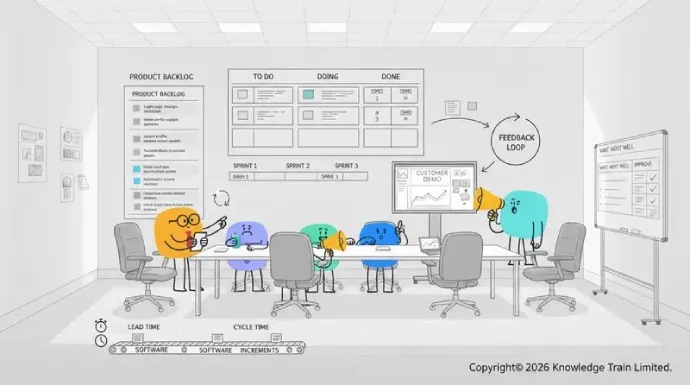
Definition of Agile
AgileCompare refers to a set of principles and practices that guide teams in developing software products through incremental delivery, adaptive planning, and continual improvement. Agile emphasises iterative development, close team collaboration, and frequent customer feedback to deliver high-quality solutions quickly and efficiently.
Agile methodology at a glance
| Aspect | DescriptionDelivery |
|---|---|
| Purpose | Deliver working software frequently, respond to change rapidly |
| Key values | Individuals and interactions, working software, customer collaboration, responding to changeEnrol |
| Approach | Iterative, adaptive, and incremental |
| Popular frameworks | ScrumWhy us, Kanban, Extreme Programming (XP) |
| Stakeholders | Customers, product owners, cross-functional teams, Scrum Masters |
Summary of the Agile Manifesto and Its valuesFAQs
The Agile Manifesto , published in 2001 by 17 software development experts, established the foundation for Agile methodologiesClick or scroll. It promotes four core values and twelve underlying principles to guide teams toward continuous improvement and customer satisfaction.MSP qualifications at a glance
Agile Manifesto: Four valuesMSP (Managing Successful Programmes) provides a proven framework for delivering complex change and benefits across multiple projects. It helps organisations align programmes with strategic objectives.
- Individuals and interactions over processes and toolsWhether you’re starting with MSP Foundation, progressing to MSP Practitioner, or taking a combined route, these qualifications show you can manage programmes with structure, governance, and confidence.
- Working software over comprehensive documentationCompare course options
- Customer collaboration over contract negotiationRecognised globally
- Responding to change over following a planMSP is widely adopted by public and private sector organisations, giving you a qualification that is recognised by employers around the world.
Agile principlesFlexible pathways
Agile is supported by twelve guiding principles, intended to help teams create successful products in an ever-changing environment. These principles inform day-to-day Agile practices.Choose Foundation, Practitioner, or a combined route so you can start at the right level and progress at the pace that suits your experience.
- Satisfy the customer through early and continuous delivery of valuable softwareCareer benefits
- Welcome changing requirements, even late in developmentStrengthen your profile for programme manager, transformation lead, or senior project roles by demonstrating expertise in managing strategic change initiatives.
- Deliver working software frequently, from a couple of weeks to a couple of monthsCompare MSP course options
- Collaborate daily between business people and developers See how MSP Foundation, Practitioner, and the combined route differ so you can choose the qualification that best matches your experience, career goals, and preferred learning journey.
- Build projects around motivated individuals and provide supportBest for
- Convey information face-to-face whenever possiblePrerequisites
- Working software is the primary measure of progressDuration
- Maintain a sustainable development paceDelivery options
- Continuous attention to technical excellence and good designExam included
- Simplicity – the art of maximising the work not done – is essentialExam format
- Self-organising teams produce the best architectures, requirements, and designsQualification gained
- Regularly reflect and adapt to improve effectivenessView courses
Historical origins and evolution of Agile
The Agile approach originated in the late 1990s as software teams sought alternatives to rigid project management models like the Waterfall model. In 2001, seventeen thought leaders signed Foundationthe Agile ManifestoSee course, formalising Agile values and sparking the formation of the Agile Alliance. Since then, Agile has evolved beyond software development into project management , product development, and operations.
Benefits of AgileNew or aspiring programme professionals, or project managers who want a solid introduction to MSP principles, practices, and terminology.
- Flexibility: Respond rapidly to changing customer needs and market conditions.None
- Continuous improvement: Regular retrospectives help teams adapt and improve their processes.2 days or 14 hours
- Customer satisfaction: Frequent delivery ensures customer requirements are met early and often.Instructor-led, self-paced
- Transparency: Iterative development and open communication foster stakeholder trust.MSP Foundation exam
- Reduced risk: Incremental delivery allows for earlier issue detection and correction.60 minutes, multiple choice
- Enhanced team collaboration: Cross-functional teams communicate daily to resolve challenges efficiently.MSP Foundation certificate
Agile vs waterfall model
| AspectFoundation | Agile | WaterfallPractitioner |
|---|---|---|
| ProcessSee course | Iterative and incremental | Sequential and linear |
| Flexibility | Adaptive to changeMSP Foundation holders who want to learn how to apply the method on real programmes and demonstrate a higher level of competence. | Resistant to change after initial planning |
| Customer involvementMSP Foundation | High, continuous feedback | Typically only during requirements and acceptance stages2 days or 22 hours |
| Delivery | Frequent, partial releasesInstructor-led, self-paced | Full product delivered at project end |
| RiskMSP Practitioner exam | Problems discovered early | Issues often found late2.5 hours, multiple choice |
Agile frameworks and practices
Scrum frameworkMSP Practitioner certificate
Scrum is a widely adopted Agile framework structured around short, timeboxed periods called Practitionersprints . Teams maintain a Combinedproduct backlogSee course of features and tasks, delivering increments of working software at the end of each sprint. Roles in Scrum include Product Owner, Scrum Master , and Development Team. Daily stand-ups, sprint planning, reviews, and retrospectives reinforce team collaboration and transparency.