
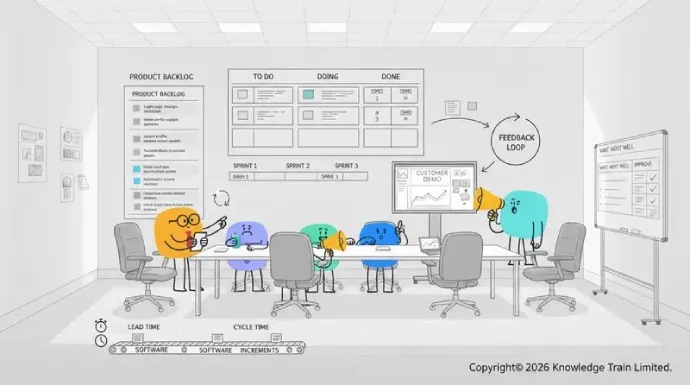
Definition of AgileGap analysis and feasibility studies:
Communicating with diverse stakeholders to ensure requirements are validated and aligned refers to a set of principles and practices that guide teams in developing software products through incremental delivery, adaptive planning, and continual improvement. Agile emphasises iterative development, close team collaboration, and frequent customer feedback to deliver high-quality solutions quickly and efficiently.Process mapping and
Agile methodology at a glancebusiness process modelling
| Aspect: | Description Visualising workflows for process improvement opportunities |
|---|---|
| PurposeSolution assessment and validation: | Deliver working software frequently, respond to change rapidly Reviewing proposals to ensure solutions address documented |
| Key valuesrequirements | Individuals and interactions, working software, customer collaboration, responding to change and deliver value |
| ApproachChange management | Iterative, adaptive, and incremental: |
| Popular frameworks Supporting the transition of solutions into the business and managing effects on people and processes | ScrumMain business analysis processes, Kanban, Extreme Programming (XP)Process |
| StakeholdersDescription | Customers, product owners, cross-functional teams, Scrum MastersRequirements elicitation |
Summary of the Agile Manifesto and Its valuesGathering information from stakeholders using interviews, workshops, observation, and document analysis
The Requirements documentationAgile ManifestoCapturing business and technical requirements in written formats, such as , published in 2001 by 17 software development experts, established the foundation for user storiesAgile methodologies, use cases, or requirement specifications. It promotes four core values and twelve underlying principles to guide teams toward continuous improvement and customer satisfaction.Requirements validation
Agile Manifesto: Four valuesEnsuring requirements are accurate, feasible, and aligned with business goals
- Individuals and interactions over processes and toolsStakeholder engagement
- Working software over comprehensive documentationBuilding relationships with all parties affected by the change to ensure their needs are met
- Customer collaboration over contract negotiationProcess improvement
- Responding to change over following a planAnalysing existing workflows and recommending enhancements for efficiency
Agile principlesSolution assessment
Agile is supported by twelve guiding principles, intended to help teams create successful products in an ever-changing environment. These principles inform day-to-day Agile practices.Evaluating potential solutions against requirements
- Satisfy the customer through early and continuous delivery of valuable softwareChange management
- Welcome changing requirements, even late in developmentSupporting successful adoption of new processes or systems
- Deliver working software frequently, from a couple of weeks to a couple of monthsCommon business analysis techniques
- Collaborate daily between business people and developersSWOT analysis
- Build :projects Identifying strengths, weaknesses, opportunities, and threats related to a business area or solution around motivated individuals and provide supportGap analysis:
- Convey information face-to-face whenever possible Comparing current and target states to identify improvement areas
- Working software is the primary measure of progressUse case modelling:
- Maintain a sustainable development pace Mapping user interactions with systems to define requirements
- Continuous attention to technical excellence and good designBusiness process modelling:
- Simplicity – the art of maximising the work not done – is essential Creating diagrams (such as BPMN) to visualise business processes
- Self-organising teams produce the best architectures, requirements, and designs
- Regularly reflect and adapt to improve effectivenessStakeholder analysis:
Historical origins and evolution of Agile Identifying stakeholder interests, influence, and engagement needs
The Agile approach originated in the late 1990s as software teams sought alternatives to rigid project management models like the User storiesWaterfall: model. In 2001, seventeen thought leaders signed Documenting concise functional requirements, typically in Agile projects
What is business analysis?Team collaboration and cross-functional teams
Agile emphasises collaboration between customers, stakeholders, and team members from diverse disciplines. Cross-functional teams are empowered to make decisions and deliver complete solutions within each iteration.