Introduction
Agile is based on 4 key values and 12 key principles. While the agile values provide project managers and developers with a very general overview of what it means to be ‘agile,’ and help guide the agile process, the 12 agile principles give examples of how agile should be implemented.What is Agile vs Scrum?
The 12 agile principles underpin every successful agile project and can inspire even non-agile teams. They form a core part of any agile project management course .What is Agile vs waterfall?
1. Early and continuous delivery of valuable software
When developing a product, speed and precision is key. Should development take too long, there is an increasing risk that the final product will no longer satisfy rapidly changing market demands and consumer needs.
Traditional methods may often develop a product in a vacuum, following a strict development plan with no deviation which results in delivering a final product that is already obsolete.What is an Agile way of working?
7. Working software19 Feb 2026
Replace ‘software’ with ‘products’ and you’ll find a fairly self-explanatory principles applicable to every project every developed. This principle came about in response to excessive documentation and procedures in the ITUnderstand how Agile principles revolutionize project delivery and quality. Read on to learn about their application in various industries. industry that slowed development.
In other industries, this principle might be summarized as such: “A working product is more valuable than a checklist.” Requirements analysis documents, models and mock-ups may be useful, but they aren’t very useful if you can’t convert this information into a working product.
Project managers and business owners alike need to focus on minimizing paperwork and maximizing productivity. Unfinished products are inventory and inventory is an expense that provides no value.
8. Stable work environmentsBenefits of Agile methodologies
Agile promotes the idea of sustainable development. In short, this means that with the correct implementation of agile methods, there should never be the need for developers to work ridiculous hours just to meet deadlines.
Agile requires stakeholders, customers and developers to act as one coherent team. When everyone involved feeds information into an agile framework, it becomes very easy to create accurate forecasts, budgets and timelines.Simon Buehring
Customers tell developers what they need, stakeholders understand how changes may affect development and teams can make informed decisions as to how progress is to be made. No one is left out of the loop and no one is taken by surprise by unexpected developments.
This helps reduce stress and avoids employee ‘burn out.’
9. Quality assurance
Many businesses prioritize speed or quantity over quality. In some cases, this makes a lot of sense. Sometimes customers don’t care as much for quality so whether or not a product works.
But, if development teams neglect quality for too long, their ability to adapt the product to suit current consumer demands diminishes and it becomes less agile.
10. SimplicityThe challenges with Agile
This principle is like number 7: working software. But while the focus of that principle was about removing unnecessary documentation, this principle focuses more on processes.
This principle can be achieved in several ways. Firstly, you can remove bloated processes that do not contribute to the overall quality or progress of a project. Secondly, you can rely on automation to complete repetitive or time-consuming tasks. Or thirdly, you might use pre-existing assets from past projects rather than creating ones from scratch each time you begin something new.Simon Buehring
This principle should be an ongoing effort. Agile teams need to recognize that there is always room for improvement. Technology provides us more varied, easier ways of doing things. Project management research helps managers and business continuously improve their practices to suit modern trends etc.
Being agile requires businesses hold weekly or even daily meetings. A large part of these should be dedicated towards finding new and better ways of accomplishing tasks.
11. Self-organizing teams
This principle is similar to number 5: autonomy and motivation. The difference here lies in the comparison between agile teams and traditional development teams. Traditional methods often compartmentalize their development teams. For example, ‘Team A’ completes one task, then passes it on to ‘Team B’ who layers their contribution on top of this etc.
Agile teams however, are comprised of multiple individuals, who share a wide variety of skills in several disciplines. Furthermore, agile development teams often include stakeholders, managers and consumers as core team-members. This allows them to work independently as a unit without the need to look to others for assistance.
This not only minimizes the need for upper management to micro-manage development but also ensures that processes such as quality assurance and adaptation are an inherent part of agile development and thus occur naturally and autonomously.Discover the variety of Agile methodologies and their unique implementations across sectors. Read more to see which fits your needs.
12. Reflection and adjustment
This final principle is almost a proof-of-concept principle that indicates whether or not agile methodologies have been adequately incorporated into business strategy. Reflection on past success or failures and responsibly changing approaches to compensate is what makes agile so successful.
Doing so requires communication, feedback, an understanding of agile methods and an environment that encourages both innovation and learning from mistakes.
No team acts perfectly but a mature, informed and responsible team can improve itself by taking both pro-active and reactive measures to improve development.Simon Buehring
Why agile principles matterExplore the evolution of Agile from a niche software development tool to a mainstream strategy. Read on to understand its significance.
Although the 12 agile principles were developed almost 2 decades ago, they are still relevant and will likely remain relevant for a long time to come.
That is because the key agile principles are anthropocentric . That is to say, they are based on human values and helps improve the quality of life in the workspace. Agile aims to improve the well-being of workers just as much as it aims to deliver high-quality products.
Better, smoother, more efficient development means happier, less stressed workers and more satisfied customers.
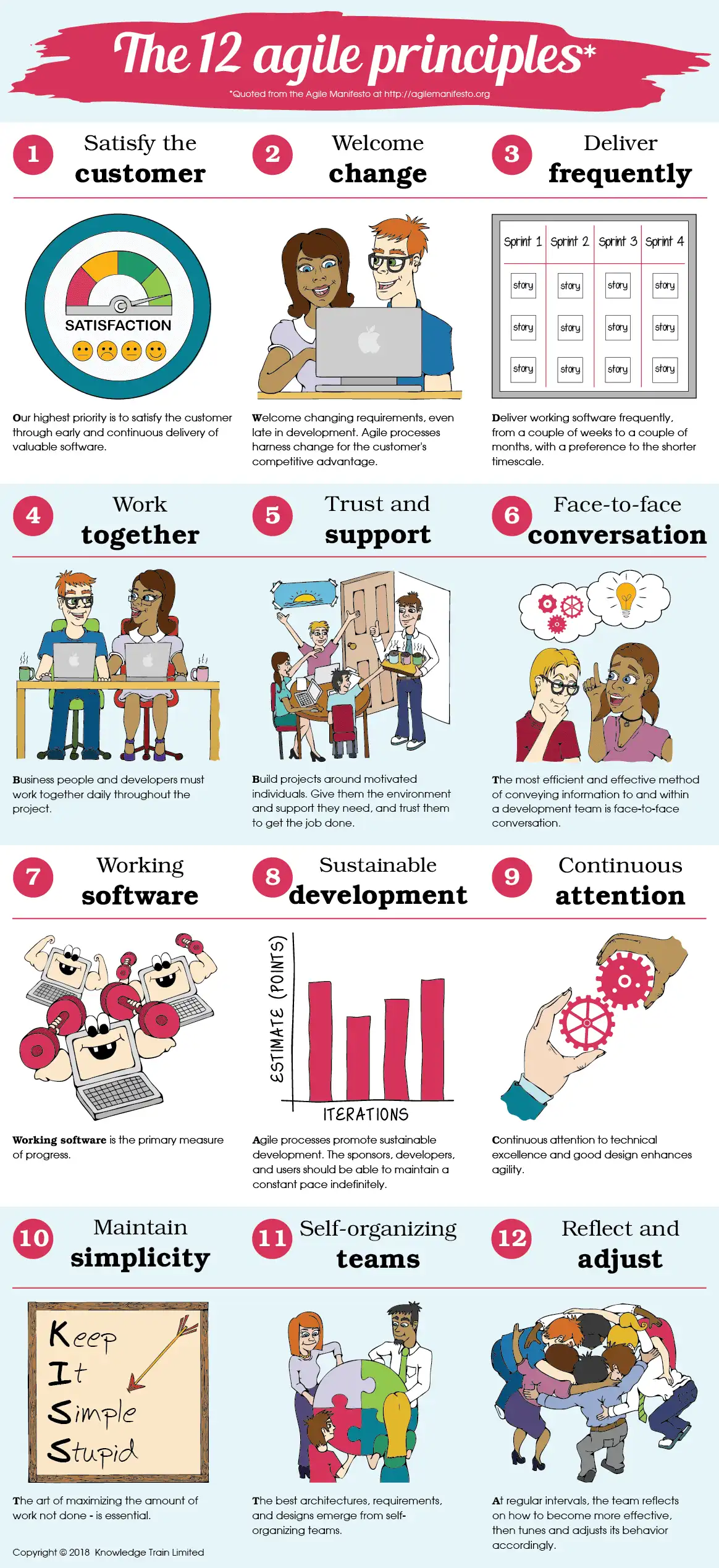
Infographic
Below is our beautifully illustrated infographic detailing the agile principles. Perfect for anyone working on agile projects!
Download and print your free poster hereThe top 15 Agile books you should read. Put it on the wall in your workplace to help your team learn the 12 agile principles.
Feel free to use either of these graphics on your website, but please link back to this page so others can enjoy our free resources.