2. Embrace changeProject management software can also be categorised based on its intended target audience and industry:
Project development is becoming increasingly unpredictable. Markets are becoming more complex and the number of diverse products available to consumers grows every day. It’s nearly impossible to predict what the final requirements of a project will be and as such, development projects are an increasingly risky.Industry-specific tools:
Most businesses don’t like risk, but what is even less desirable is wasting time and resources developing a product that’s no longer relevant by the time it’s finally completed. By welcoming change and actively seeking to make improvements through consumer feedback, businesses can gain a competitive edge – their products will satisfy the immediate needs of consumers and their products will be guaranteed to provide business value.Designed to cater to project management needs across various industries and sectors.
People change, times change, markets change. Trying to fight it is pointless. Traditional project management usually sees change as a problem to be solved, but agile embraces change and uses it to the customer’s advantage.Advantages: Flexibility, broader adoption and user base, often more cost-effective.
3. Frequent deliveryDisadvantages: May lack certain industry-specific functionalities or customisation options.
This principle may closely mirror the first, but while the first states that products should be delivered The choice between different types of project management software depends on factors like organisational requirements, budget constraints, industry regulations, and specific project needs. By considering these factors, teams can select the most suitable solution to effectively manage their projects and optimise efficiency.earlyEnhance your skills with our expert-led courses, this principle goes a little more into detail as to why products should be delivered continuously .
Smaller, more frequent releases mean less chance of error. Frequent releases give consumers more opportunity to provide feedback which, in turn, aids developers in correcting errors that might otherwise have derailed a project. If developers only receive feedback every few months, any errors made early in development may have since become much more difficult and costly to fix.
Many businesses apply this principle so that they deliver new iterations of software or products every few days. This just goes to show the importance of frequent delivery, which is arguably one of the most defining See all datesagile principles .
4. Cooperation
In traditional management, the work business owners and stakeholders is usually kept distinct from the work of developers. Analysist are put in place to ‘translate’ business needs into development plans and project managers simply help mediate the demands of owners in a way that doesn’t negatively affect product development.Instructor-led
Agile requires that stakeholders, customers and developers work in unison (often in the same room) to achieve project goals. This reduces the risk inherent to project development, by helping improve communication and cooperation. In addition, the more closely management is involved with development, the easier it is for them to understand the challenges faced by developers and the ramifications of changes made to development.See all dates
Scalable for complex, enterprise-level projectsWhy agile principles matter
Although the 12 agile principles were developed almost 2 decades ago, they are still relevant and will likely remain relevant for a long time to come.Strong data analysis and reporting capabilities.
That is because the key agile principles are ConsanthropocentricSteeper learning curve for users who are not familiar with spreadsheets. That is to say, they are based on human values and helps improve the quality of life in the workspace. Agile aims to improve the well-being of workers just as much as it aims to deliver high-quality products.Can be overwhelming due to its many features
Better, smoother, more efficient development means happier, less stressed workers and more satisfied customers.Higher price point compared to some competitors.
InfographicPricing
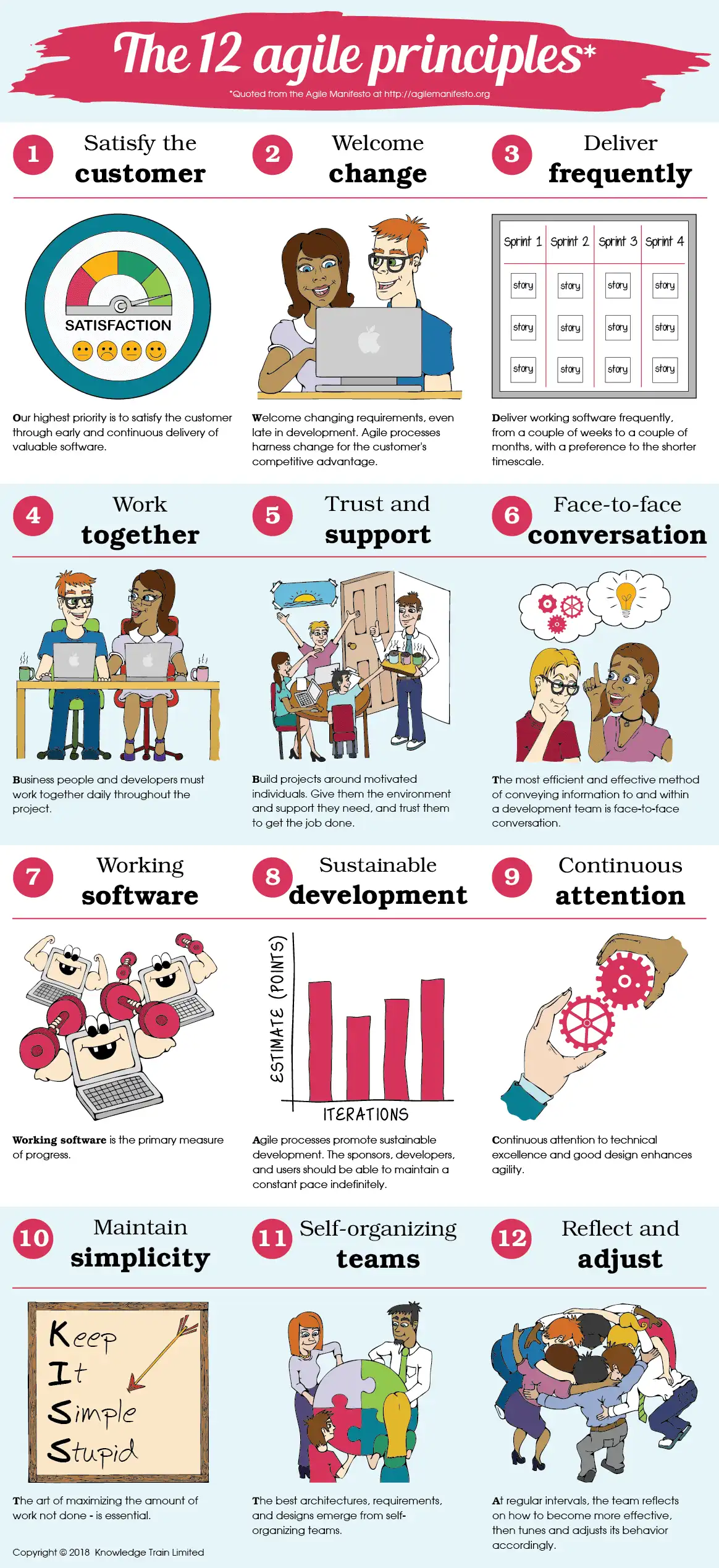
Below is our beautifully illustrated infographic detailing the agile principles. Perfect for anyone working on agile projects!Plans start at $7 per user per month (annual billing)
Download and print your free poster hereCeloxis. Put it on the wall in your workplace to help your team learn the 12 agile principles.Celoxis
Feel free to use either of these graphics on your website, but please link back to this page so others can enjoy our free resources. is a project management platform that is designed for mid-sized to large businesses. It offers a comprehensive set of features for project and portfolio management and can be deployed either as a cloud-based or on-premises solution.