Waterfall method

Key takeawaysLate feedback can increase the risk of building the wrong thing and discovering issues near the end.
Waterfall is a linear delivery model that suits stable, well-specified work but struggles when change is frequent.Regulated and high-compliance environments often prefer waterfall for traceability and control of change.
- Waterfall runs through fixed phases, and each phase is completed and documented before the next begins.Success depends on rigorous requirements capture, formal change control, and thorough testing and QA.
- It works best when requirements are clear, unlikely to change, and acceptance criteria can be agreed upfront.
- Strong documentation and upfront planning support predictable costs, resourcing, and stakeholder reporting.
- Late feedback can increase the risk of building the wrong thing and discovering issues near the end.
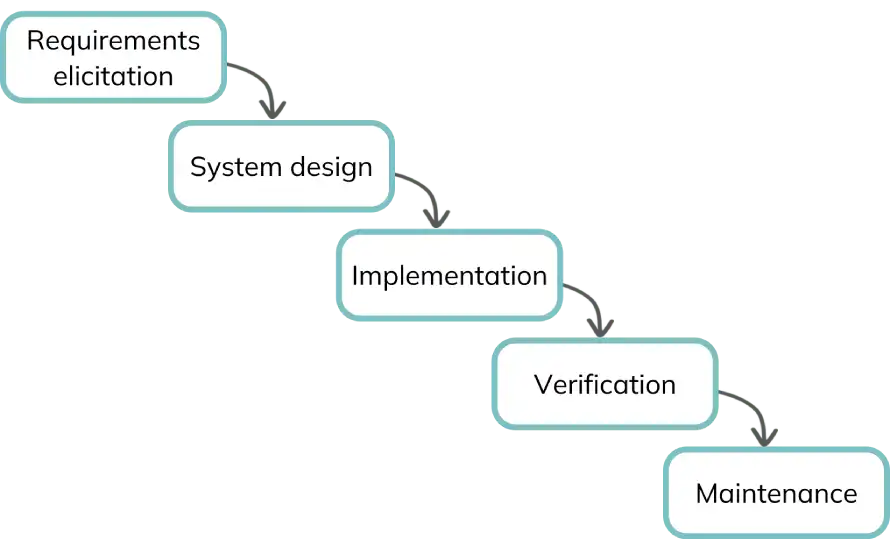
Requirements elicitation
WaterfallIn this phase, the team gathers and documents all project requirements. This includes defining the project scope and objectives, identifying stakeholders and their expectations, and creating a is a detailed specificationstructured document., sequential approach that includes distinct phases with each phase building on the output of the previous phase. In this subsection, we will cover the phases in a waterfall lifecycle.System design
Requirements elicitationBased on the requirements, the team designs the system architecture, user interface, database schemas, and detailed technical specifications.
In this phase, the team gathers and documents all project requirements. This includes defining the project scope and objectives, identifying stakeholders and their expectations, and creating a Implementationdetailed specificationDuring this phase, developers write code according to the design specifications, adhere to coding standards and best practices, and create unit tests for individual components. document.Verification
System designTesters rigorously evaluate the system by executing test cases based on requirements, performing integration and system testing, identifying and reporting bugs, and verifying bug fixes and retesting.
Based on the requirements, the team designs the system architecture, user interface, database schemas, and detailed technical specifications.After testing is complete, the team:
ImplementationPrepares the production environment
During this phase, developers write code according to the design specifications, adhere to coding standards and best practices, and create unit tests for individual components.Migrates data if needed
VerificationDeploys the system to users
Testers rigorously evaluate the system by executing test cases based on requirements, performing integration and system testing, identifying and reporting bugs, and verifying bug fixes and retesting.Provides user training and documentation.
After testing is complete, the team:
- Prepares the production environmentMaintenance and support
- Migrates data if neededAfter the system is deployed, ongoing activities include:
- Deploys the system to usersMonitoring system performance
- Provides user training and documentation.Addressing user-reported issues
Maintenance and supportImplementing minor enhancements
After the system is deployed, ongoing activities include:Providing technical support to users.
- Monitoring system performanceEach phase in the waterfall process must be completed before the next phase can begin. This approach ensures that all necessary documentation is created and minimises the risk of overlooking important requirements. It can be inflexible if requirements change mid-project. The
- Addressing user-reported issuessequential nature
- Implementing minor enhancements of waterfall requires meticulous planning and clear communication throughout the development lifecycle.
- Providing technical support to users.Benefits of the waterfall method
Each phase in the waterfall process must be completed before the next phase can begin. This approach ensures that all necessary documentation is created and minimises the risk of overlooking important requirements. It can be inflexible if requirements change mid-project. The Waterfall project management is a sequential and linear approach to executing tasks, and it has several advantages. Let’s discuss each one of them:sequential natureClear project structure and timeline of waterfall requires meticulous planning and clear communication throughout the development lifecycle.The
Benefits of the waterfall methodsequential nature
Waterfall project management is a sequential and linear approach to executing tasks, and it has several advantages. Let’s discuss each one of them: of waterfall provides:
Clear project structure and timelinePhases with clearly defined start and end points
The A planned structure with a timeline for when the work is to be completedsequential natureMilestones that are easily communicated to stakeholders. of waterfall provides:Comprehensive documentation
- Phases with clearly defined start and end pointsWaterfall methodology advocates comprehensive documentation, leading to well-defined project requirements and specifications, detailed design documents for future reference and valuable historical records for similar projects.
- A planned structure with a timeline for when the work is to be completedPredictable costs and resource allocation
- Milestones that are easily communicated to stakeholders.The upfront planning involved in the waterfall model allows for accurate budget estimation, efficient resource allocation throughout the project lifecycle and minimised unexpected expenses.
Comprehensive documentationEasier tracking and progress assessment
Waterfall methodology advocates comprehensive documentation, leading to well-defined project requirements and specifications, detailed design documents for future reference and valuable historical records for similar projects.Waterfall’s structured approach facilitates easy tracking of progress with clear indicators at each phase, simplified reporting to stakeholders and easy identification of bottlenecks or delays.
Predictable costs and resource allocationReduced risk through upfront planning
The upfront planning involved in the waterfall model allows for accurate budget estimation, efficient resource allocation throughout the project lifecycle and minimised unexpected expenses.Upfront planning in waterfall can help:
Easier tracking and progress assessmentIdentify potential risks early in the project
Waterfall’s structured approach facilitates easy tracking of progress with clear indicators at each phase, simplified reporting to stakeholders and easy identification of bottlenecks or delays.Develop mitigation strategies before the work commences
Reduced risk through upfront planningMinimise costly changes during the later stages of the project.
Upfront planning in waterfall can help:These strengths make waterfall ideal for projects with clearly defined requirements and relatively few changes expected. The methodology’s robustness is also very appropriate to the complexity of the work and the need for strict and complete control of change for medical device software development.
- Identify potential risks early in the projectEnhance your skills with our expert-led courses
- Develop mitigation strategies before the work commences
- Minimise costly changes during the later stages of the project.
These strengths make waterfall ideal for projects with clearly defined requirements and relatively few changes expected. The methodology’s robustness is also very appropriate to the complexity of the work and the need for strict and complete control of change for medical device software development.
Limitations of the waterfall methodLimited flexibility for changes
The waterfall method is a structured approach to The project managementstructured approach that follows a linear sequence of phases. However, it has some limitations. of waterfall can make changes challenging once a phase is completed. This rigidity can lead to difficulties in adapting to new requirements, costly revisions if requirements change mid-project and can inhibit creativity and innovation during the development process.
Limited flexibility for changesDelayed feedback and product validation
The The linear nature of the waterfall methodology means that user feedback and validation of the product often come late in the process. This delay can result in missed opportunities to address market needs, reduced chances of early validation of the product and increased risk of developing features that users don’t want.structured approachPotential for longer delivery times of waterfall can make changes challenging once a phase is completed. This rigidity can lead to difficulties in adapting to new requirements, costly revisions if requirements change mid-project and can inhibit creativity and innovation during the development process.Waterfall methodology can result in longer delivery times due to the extensive upfront planning. This approach can lead to delays in delivering working software to end-users and slower time-to-market compared to more iterative approaches.
Delayed feedback and product validationChallenges with customer collaboration
The linear nature of the waterfall methodology means that user feedback and validation of the product often come late in the process. This delay can result in missed opportunities to address market needs, reduced chances of early validation of the product and increased risk of developing features that users don’t want.Waterfall may present obstacles by restricting customer collaboration after the requirements phase. This can lead to limited stakeholder input and a potential mismatch between the final product and the evolving needs of the customer.
Potential for longer delivery timesRisk of late-stage issues and rework
Waterfall methodology can result in longer delivery times due to the extensive upfront planning. This approach can lead to delays in delivering working software to end-users and slower time-to-market compared to more iterative approaches.The
Challenges with customer collaborationlinear progression
Waterfall may present obstacles by restricting customer collaboration after the requirements phase. This can lead to limited stakeholder input and a potential mismatch between the final product and the evolving needs of the customer. may result in:
Risk of late-stage issues and reworkKey issues to be identified late in the development process
The The need for costly and time-consuming reworklinear progressionChallenges in addressing fundamental issues near the end of the project. may result in:These limitations of Waterfall reveal why it may not be appropriate for all types of projects, especially those with dynamic requirements or in rapidly changing markets. Identifying these drawbacks allows
- Key issues to be identified late in the development processproject managers
- The need for costly and time-consuming rework to make informed decisions on when to explore alternative approaches or adapt the waterfall model to mitigate these risks.
- Challenges in addressing fundamental issues near the end of the project.Waterfall vs Agile methods
These limitations of Waterfall reveal why it may not be appropriate for all types of projects, especially those with dynamic requirements or in rapidly changing markets. Identifying these drawbacks allows Waterfall and project managersAgile methods to make informed decisions on when to explore alternative approaches or adapt the waterfall model to mitigate these risks. are the most popular software development techniques. To decide which one is best for you, it’s important to understand their main differences. So, let’s compare two methods based on the most important aspects:
Waterfall vs Agile methodsKey differences in approach
Waterfall and Career path exampleAgile methods: are the most popular software development techniques. To decide which one is best for you, it’s important to understand their main differences. So, let’s compare two methods based on the most important aspects:Waterfall
Key differences in approachAgile
Career path exampleLinear, sequential:Iterative, incremental
| WaterfallFixed scope | AgileFlexible scope |
| Linear, sequentialLong-term planning | Iterative, incrementalShort-term planning |
| Fixed scopeComprehensive documentation | Flexible scopeMinimal documentation |
| Long-term planningFlexibility and adaptability | Short-term planningWaterfall |
| Comprehensive documentationRigid structure with defined phases | Minimal documentationDifficult to accommodate changes once a phase is complete |
Flexibility and adaptabilityBest for
Waterfallprojects
- Rigid structure with defined phases with stable requirements.
- Difficult to accommodate changes once a phase is completeAgile
- Best for Highly flexible, embracing change throughout the projectprojectsAdapts easily to evolving requirements with stable requirements.Suitable for projects in dynamic environments.
AgileCustomer involvement and feedback
- Highly flexible, embracing change throughout the projectWaterfall
- Adapts easily to evolving requirementsLimited customer involvement after initial requirements gathering
- Suitable for projects in dynamic environments.Feedback primarily at project completion.
Customer involvement and feedbackAgile
WaterfallContinuous customer collaboration throughout the project
- Limited customer involvement after initial requirements gatheringRegular feedback and adjustments based on customer input.
- Feedback primarily at project completion.Team structure and collaboration
AgileWaterfall
- Continuous customer collaboration throughout the projectHierarchical team structure
- Regular feedback and adjustments based on customer input.Specialised roles with limited cross-functional work.
Team structure and collaborationAgile
WaterfallSelf-organising, cross-functional teams
- Hierarchical team structureEmphasises collaboration and shared responsibility.
- Specialised roles with limited cross-functional work.Risk management and quality control
AgileWaterfall
- Self-organising, cross-functional teamsUpfront risk identification and mitigation planning
- Emphasises collaboration and shared responsibility.Quality control primarily at project end.
Risk management and quality controlAgile
WaterfallContinuous risk assessment and mitigation
- Upfront risk identification and mitigation planningOngoing quality control through regular testing and reviews.
- Quality control primarily at project end.Each has its advantages and disadvantages. Waterfall provides structure and predictability,
Agile
- Continuous risk assessment and mitigation
- Ongoing quality control through regular testing and reviews.
making it well-suited for projects with well-defined requirements and stable environments. AgileAgile offers flexibility and adaptability, making it ideal for projects with evolving requirements or uncertain outcomes. The decision to use offers flexibility and adaptability, making it ideal for projects with evolving requirements or uncertain outcomes. The decision to use waterfall or Agilewaterfall or Agile depends on several factors, such as project complexity, team dynamics, and organisational culture. depends on several factors, such as project complexity, team dynamics, and organisational culture.When to use the waterfall method
When to use the waterfall methodAgile methodologies
Agile methodologies have become popular in recent years, but the waterfall approach still has its place in certain situations. Let’s explore how and when waterfall can be successfully used. have become popular in recent years, but the waterfall approach still has its place in certain situations. Let’s explore how and when waterfall can be successfully used.Projects with well-defined requirements
Projects with well-defined requirementsThis methodology works best when:
This methodology works best when:Requirements are known and unlikely to change
- Requirements are known and unlikely to changeStakeholders have a clear vision of the desired outcome
- Stakeholders have a clear vision of the desired outcomeThe scope of the project is well-defined from the beginning.
- The scope of the project is well-defined from the beginning.Industries with strict regulatory compliance
Industries with strict regulatory complianceRegulated industries
Regulated industries such as healthcare and medical device development, aerospace and defence and financial services with strict compliance requirements often adopt the waterfall methodology. These fields often require extensive documentation and adherence to specific protocols. such as healthcare and medical device development, aerospace and defence and financial services with strict compliance requirements often adopt the waterfall methodology. These fields often require extensive documentation and adherence to specific protocols.Large-scale, complex projects with fixed timelines
Large-scale, complex projects with fixed timelinesWaterfall is often used for large projects that have many interconnected components, lengthy development cycles and strict deadlines and budget constraints. Infrastructure projects or large-scale enterprise-wide system implementations are examples of projects where waterfall is often used.
Waterfall is often used for large projects that have many interconnected components, lengthy development cycles and strict deadlines and budget constraints. Infrastructure projects or large-scale enterprise-wide system implementations are examples of projects where waterfall is often used.Projects with limited customer involvement during development
Projects with limited customer involvement during developmentProjects that don’t need much customer involvement during the project
Projects that don’t need much customer involvement during the projectWaterfall can be used when:
Waterfall can be used when:The only customer interaction is at the start and finish
- The only customer interaction is at the start and finishLittle or no user involvement is required in the development cycle
- Little or no user involvement is required in the development cycleThe needs of the user are clear and stable.
- The needs of the user are clear and stable.This method is effective when requirements are well understood upfront and do not change over time, as it follows a
This method is effective when requirements are well understood upfront and do not change over time, as it follows a linear approachlinear approach..Selecting waterfall for appropriate projects can lead to timely execution and successful project delivery. However, it’s important to carefully evaluate project characteristics and organisational requirements before adopting this methodology. When applied judiciously, waterfall offers a structured framework for managing complex projects with predictable outcomes.
Selecting waterfall for appropriate projects can lead to timely execution and successful project delivery. However, it’s important to carefully evaluate project characteristics and organisational requirements before adopting this methodology. When applied judiciously, waterfall offers a structured framework for managing complex projects with predictable outcomes.Enhance your skills with our expert-led courses
Waterfall best practicesTo enhance the success rate of waterfall project management, consider the following best practices:
To enhance the success rate of waterfall project management, consider the following best practices:Thorough requirements gathering and documentation
Thorough requirements gathering and documentationTo set a solid foundation for the project, gather and document all requirements comprehensively. This includes conducting detailed stakeholder interviews, creating a comprehensive functional specification, develop clear and measurable acceptance criteria and utilise formal sign-off processes for requirements documentation.
To set a solid foundation for the project, gather and document all requirements comprehensively. This includes conducting detailed stakeholder interviews, creating a comprehensive functional specification, develop clear and measurable acceptance criteria and utilise formal sign-off processes for requirements documentation.Effective communication and stakeholder management
Effective communication and stakeholder managementTo ensure a project stays on track, ensure clear and regular communication with all stakeholders. This includes establishing regular status meetings and progress reports, clearly define roles and responsibilities for team members, maintain open channels for stakeholder feedback and utilise visual tools like Gantt charts to communicate project timelines and milestones.
To ensure a project stays on track, ensure clear and regular communication with all stakeholders. This includes establishing regular status meetings and progress reports, clearly define roles and responsibilities for team members, maintain open channels for stakeholder feedback and utilise visual tools like Gantt charts to communicate project timelines and milestones.Rigorous testing and quality assurance
Rigorous testing and quality assuranceTo deliver a high-quality product, it is essential to implement a comprehensive testing strategy early in the project, conduct multiple levels of testing (unit, integration, system, user acceptance), allocate sufficient time and resources for thorough quality assurance activities and document and track all defects and their resolutions.
To deliver a high-quality product, it is essential to implement a comprehensive testing strategy early in the project, conduct multiple levels of testing (unit, integration, system, user acceptance), allocate sufficient time and resources for thorough quality assurance activities and document and track all defects and their resolutions.Change management and scope control
Change management and scope controlTo maintain project scope and control