Application securitySELF-PACED ONLINE TRAINING COURSES

- Statistics
- Name
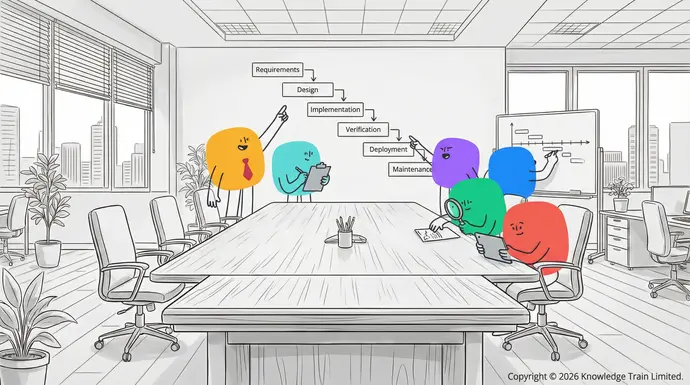
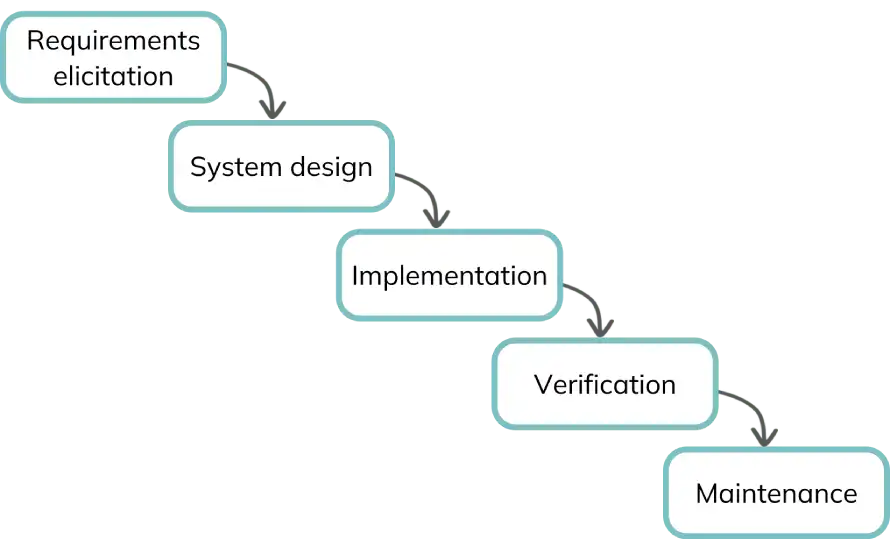
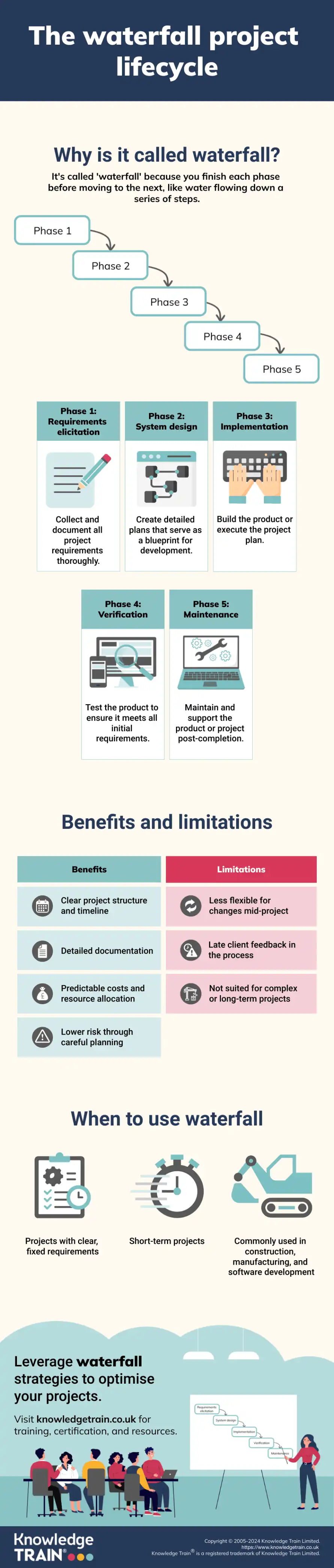
These strengths make waterfall ideal for projects with clearly defined requirements and relatively few changes expected. The methodology’s robustness is also very appropriate to the complexity of the work and the need for strict and complete control of change for medical device software development. Knowledge TrainWhat is cyber security?
Limitations of the waterfall method What’s the difference between a project communication plan and a stakeholder management plan?
The waterfall method is a structured approach to The communication plan centres on information distribution whereas stakeholder management plans create comprehensive engagement techniques. project management How can I ensure sensitive information is communicated securely within my project? that follows a linear sequence of phases. However, it has some limitations.Copied!Secure your data by utilising encryption methods together with secure digital platforms and by creating clear protocols for managing confidential information.
Limited flexibility for changesKey takeawaysWhat should I do if stakeholders aren’t following the communication plan?
The Strong delivery comes from choosing and combining techniques that fit your project’s uncertainty, scale, and stakeholders.Respond to individual stakeholder concerns while emphasising the plan’s necessity and adjust to satisfy their requirements. structured approachUse a Work Breakdown Structure to define scope clearly and create reliable estimates and ownership.How can I measure the effectiveness of my project communication plan? of waterfall can make changes challenging once a phase is completed. This rigidity can lead to difficulties in adapting to new requirements, costly revisions if requirements change mid-project and can inhibit creativity and innovation during the development process.Use Gantt charts and network diagrams to visualise sequencing, dependencies, and progress.Evaluate project communication effectiveness through surveys and feedback while monitoring response times and meeting attendance together with stakeholder satisfaction.
Delayed feedback and product validationApply CPM and PERT to identify critical work, quantify schedule risk, and test scenarios.Are there any industry-specific considerations for creating a communication plan?
The linear nature of the waterfall methodology means that user feedback and validation of the product often come late in the process. This delay can result in missed opportunities to address market needs, reduced chances of early validation of the product and increased risk of developing features that users don’t want.Use Kanban to manage flow, limit work in progress, and surface blockers early.Make sure your plan considers regulatory requirements along with industry-specific terminology and communication standards that exist in your field.
Potential for longer delivery timesPrioritise uncertainty with a risk matrix and stakeholder mapping to guide action and communication.How can I improve virtual communication in remote project teams?
Waterfall methodology can result in longer delivery times due to the extensive upfront planning. This approach can lead to delays in delivering working software to end-users and slower time-to-market compared to more iterative approaches.Track delivery health with EVM and cost-benefit analysis to support timely, evidence-based decisions.Use video conferencing tools while setting up explicit guidelines for virtual meetings and promote routine informal check-ins to sustain team unity.
Challenges with customer collaboration Infographic
Waterfall may present obstacles by restricting customer collaboration after the requirements phase. This can lead to limited stakeholder input and a potential mismatch between the final product and the evolving needs of the customer. Subscribe to our exclusive offers and promotions
Risk of late-stage issues and rework
The ContentsSubscribe now linear progression may result in:
- Key issues to be identified late in the development processContents{"@context":"https://schema.org","@type":"ImageObject","contentUrl":"https://www.knowledgetrain.co.uk/training-courses/project-communication-plan-infographic-v1.1.webp","description":"Project communication plan infographic","license":"https://www.knowledgetrain.co.uk/license","acquireLicensePage":"https://www.knowledgetrain.co.uk/license","creditText":"Knowledge Train","uploadDate":"2024-09-28T09:00:32.000Z","copyrightNotice":"© 2024 Knowledge Train Limited. All rights reserved.","creator":{"@type":"Organization","name":"Knowledge Train","url":"https://www.knowledgetrain.co.uk"}}
- The need for costly and time-consuming rework
- Challenges in addressing fundamental issues near the end of the project.Introduction to project management techniquesRelated articles
These limitations of Waterfall reveal why it may not be appropriate for all types of projects, especially those with dynamic requirements or in rapidly changing markets. Identifying these drawbacks allows project managersProject planning and visualisation to make informed decisions on when to explore alternative approaches or adapt the waterfall model to mitigate these risks.
Waterfall vs Agile methodsScheduling and time management
Waterfall and Agile methodsRisk and stakeholder management Give us a call are the most popular software development techniques. To decide which one is best for you, it’s important to understand their main differences. So, let’s compare two methods based on the most important aspects:
Key differences in approachFinancial and resource management
Career path example +44 (0)207 148 5985 :Conclusion
| Waterfall Or chat with us using the link at the bottom of the screen. | FAQs Contact us with questions about the courses on this page, or about which project management certification or training is best for you. |
| Finance FAQs | InfographicHow PRINCE2 qualifications can help your careerContact |
| Introduction to project management techniques Cookies | Project management techniques have become an essential aspect of modern businesses, allowing organisations to achieve their objectives, meet deadlines, and deliver value to their stakeholders. These techniques refer to the tools and methodologies that project managers and teams use to plan, execute, and control projects efficiently. Simon BuehringPrivacy |
| Project management techniques19 Feb 2026Terms | have been in existence for centuries, and they have evolved to meet the changing needs of businesses and the latest technological developments. Customer Support |
| The history of project management techniques dates to ancient times when large-scale projects such as the construction of the pyramids and the Great Wall of China were undertaken. However, modern project management started to emerge in the mid-20th century with the development of techniques such as the Gantt chart and the Critical Path Method (CPM). As businesses became more complex and globalised, new methodologies emerged to address the diverse project needs of different industries.PRINCE2 is a project management methodology used widely in the public, private, and third sectors. | Today, there are many project management techniques that project managers can use to achieve success. In this article, we will discuss 11 essential project management techniques that every [email protected] |
project manager Join Our Team
should know. Each technique has its benefits and is suitable for different types of projects and organisational cultures. Project managers need to understand the various project management techniques available and choose the ones that best fit their projects and organisational cultures. They should also be adaptable to change as
- project [email protected]
- needs and circumstances evolve. Copyright © 2005-2026 Knowledge Train Limited.
- Project planning and visualisation Registered in UK: 5566983. Work Breakdown Structure (WBS) Registered VAT: GB872413526.The Portfolios and portfolio management Knowledge Train
Work Breakdown Structure ®
- (WBS) is a project management technique that involves breaking down a project into smaller, more manageable components. It is a hierarchical decomposition of the total scope of work and provides a visual representation of all the tasks required to complete a project.Simon Buehring is a registered trademark of Knowledge Train Limited.
- The essence of a WBS is to break down the final deliverable into smaller, more manageable components called work packages. It starts with the final deliverable at the top and is subdivided in a tree structure, where each level of detail represents an increasingly granular level of the project components. These components are typically organised into phases, deliverables, and work packages. By definition, WBS becomes more detailed as you go deeper into the tree. In 19 Feb 2026 20 Old Bailey, London, EC4M 7AN, England, United Kingdom.
- project management Knowledge Train are experts in project management, PRINCE2, agile and change management training and certification. Choose from a full range of instructor-led and self-paced
, WBS is used to:Understand the strategic benefits of project portfolio management in aligning projects with organizational goals. Learn more by reading on.project management courses
Define and organise the total scope of a project , a
- Ensure all the work required is included, and nothing outside the scope is added PRINCE2 course
- Create a foundation for estimating costs, duration, and resources , or an
Assign responsibilities to team members agile project management course
- Develop a to boost your career.
- project schedule PRINCE2
and budget. ®
Developing a 12 websites for project management templates, MSP
- WBS ®
- typically requires input from the project team and stakeholders to ensure it is comprehensive and accurate. A WBS is usually presented as a tree diagram or outline, with each level representing an increased level of detail and each item on the same level representing a similar type of work. Note that the term ‘tree’ is used by many software systems and it is not necessarily drawn as a tree.Knowledge Train, ITIL
A WBS becomes the foundation for other 19 Feb 2026®
- project management processes , P3O
- , including risk assessment, task assignments, and progress tracking. It helps the project team to provide a common structure for the whole project, and other details and activities are based on the work breakdown structure.Listicle of best websites to find project management templates to help you stay organised. Scroll down to read more.®
Gantt charts , PRINCE2
Gantt charts
- are one of the most widely used and recognised project management techniques. They provide a visual timeline for the project and can display the relationships and dependencies between different tasks or activities. Gantt charts have a long history, with their use dating back to the early 1900s when they were popularised by Henry Gantt, a mechanical engineer and management consultant. In recent years, Gantt charts have transitioned from physical, hand-drawn charts to digital project management tools.
- A Gantt chart typically consists of a horizontal bar chart with the project tasks listed on the vertical axis on the left side and the time periods spread across the top. The project tasks are then represented by horizontal bars spanning the time periods in which they are scheduled to be performed. The length of the bar indicates the duration of each task. This format allows
project managers
- and team members to:
- Clearly visualise the project timeline and the duration of each task
Track progress against the planned scheduleAllocate resources to tasksCommunicate the project timelines to stakeholders.Some modern Gantt chart software provides additional features such as colour-coding of tasks, milestone markers, and linking of dependent tasks. Some tools also allow for resource allocation and workload management directly from the Gantt view.Gantt charts are most useful when you want to provide an overview of the entire project. However, for large and complex projects, they may become cluttered and difficult to read. Despite this, Gantt charts remain a popular tool for project managers because of their intuitive design and ability to communicate complex scheduling information quickly and clearly.
Project network diagrams
Project Network Diagrams, as the name implies, are graphical representations of a project’s tasks and their relationships, showing how the project activities are sequenced and interrelated. These diagrams provide a visual depiction of the project flow and are commonly used in project management methodologies that include Critical Path Method (CPM) and Program Evaluation and Review Technique (PERT).
Network diagrams typically use nodes to represent tasks or activities and arrows to indicate dependencies between these tasks. They allow for a clear visualisation of task sequences and can help project managers identify potential bottlenecks or critical paths in the
project schedule
- .
- Key takeaways
- Visual representation of task dependencies
Identify critical path and potential schedule risks
Facilitate resource allocation and schedule optimisation.Quick tips
Begin with a clear list of all project tasks and their dependencies.
Use software tools for easy creation and updating of network diagrams.
Regularly review and update the diagram as the project progresses.
Utilise color-coding to highlight critical paths or high-risk activities.
Common pitfalls
- Overlooking important task dependencies.
- Creating overly complex diagrams that are difficult to understand.
- Failing to update the diagram as project scope or timelines change.
Neglecting to consider resource constraints when analysing the network.By learning project network diagrams, managers can enhance their ability to plan, schedule, and control complex projects effectively.Enhance your skills with our expert-led courses
Functional project management courses Always active , a
PRINCE2 course
, or an
agile project management course
to boost your career.
PRINCE2
®
The technical storage or access is strictly necessary for the legitimate purpose of enabling the use of a specific service explicitly requested by the subscriber or user, or for the sole purpose of carrying out the transmission of a communication over an electronic communications network., MSP
®
Help prioritise stakeholders based on their influence and interest in the project.