Waterfall method

Key takeaways
Waterfall is a linear delivery model that suits stable, well-specified work but struggles when change is frequent.
- Waterfall runs through fixed phases, and each phase is completed and documented before the next begins.
- It works best when requirements are clear, unlikely to change, and acceptance criteria can be agreed upfront.
- Strong documentation and upfront planning support predictable costs, resourcing, and stakeholder reporting.
- Late feedback can increase the risk of building the wrong thing and discovering issues near the end.
- Regulated and high-compliance environments often prefer waterfall for traceability and control of change.
- Success depends on rigorous requirements capture, formal change control, and thorough testing and QA.
Introduction to the waterfall method
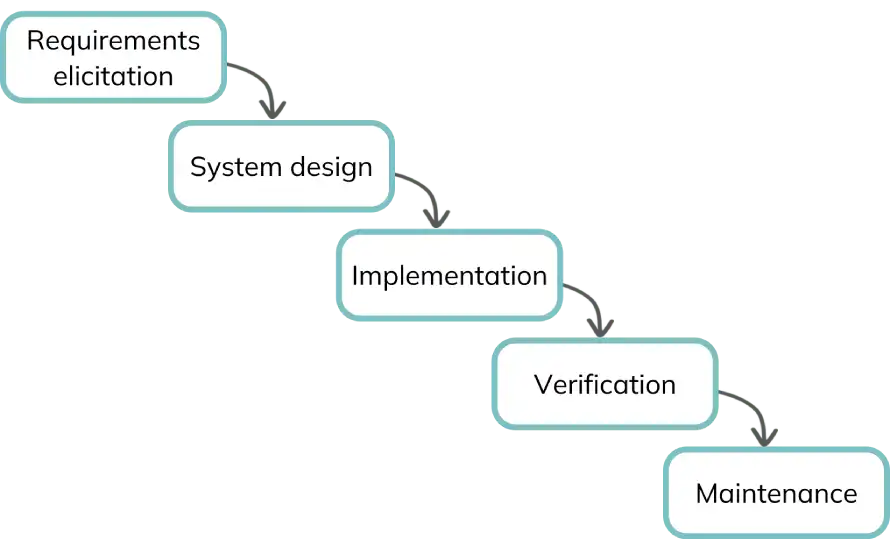
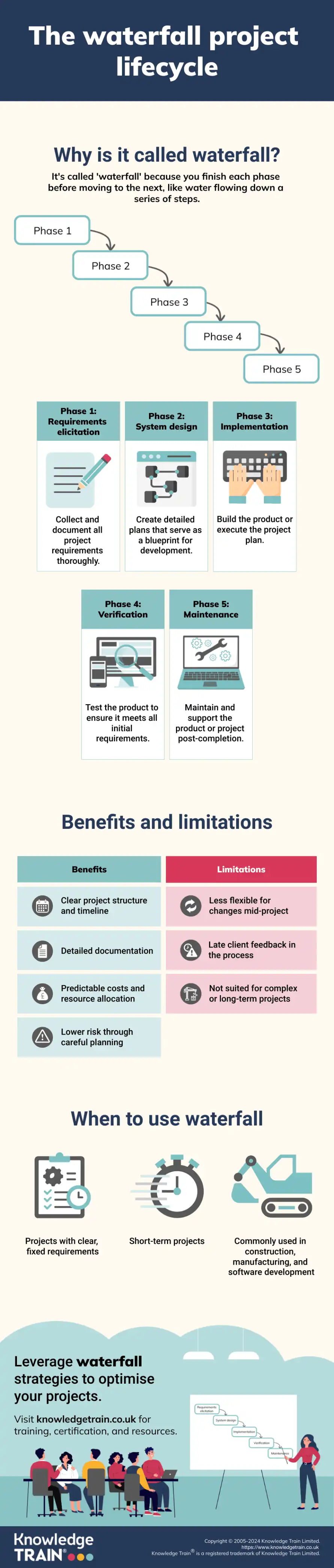
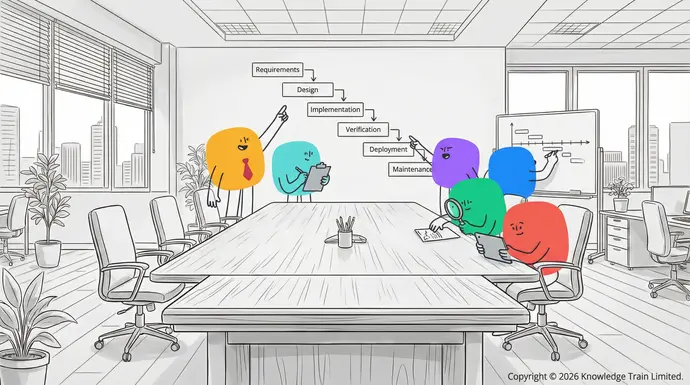
The waterfall method of project management is a sequential approach to a project. The phases of this methodology are completed one after another in the following order:
- Requirements elicitation
- Design
- Implementation
- Verification
- Maintenance.
Each of these steps should be completed and fully documented before the next step is taken. This linear approach is most known for the following characteristics:
- Rigid structure
- Comprehensive documentation
- Clear milestones
- Predictable timelines.
Waterfall method is the opposite of the Agile approach. It is less flexible and works on a fixed scope. Traditional waterfall method was not designed to be iterative like the Agile methodology. Waterfall project is best for software products and projects that have well-defined requirements that will not change much. It is good for software with certain endpoints and certain regulatory compliance checks needed for the software to function.
Waterfall phases
Waterfall is a structured, sequential approach that includes distinct phases with each phase building on the output of the previous phase. In this subsection, we will cover the phases in a waterfall lifecycle.
Requirements elicitation
detailed specification document.
System design
Based on the requirements, the team designs the system architecture, user interface, database schemas, and detailed technical specifications.
Implementation
During this phase, developers write code according to the design specifications, adhere to coding standards and best practices, and create unit tests for individual components.
Verification
Testers rigorously evaluate the system by executing test cases based on requirements, performing integration and system testing, identifying and reporting bugs, and verifying bug fixes and retesting.
After testing is complete, the team:
- Prepares the production environment
- Migrates data if needed
- Deploys the system to users
- Provides user training and documentation.
Maintenance and support
After the system is deployed, ongoing activities include:
- Monitoring system performance
- Addressing user-reported issues
- Implementing minor enhancements
- Providing technical support to users.
Each phase in the waterfall process must be completed before the next phase can begin. This approach ensures that all necessary documentation is created and minimises the risk of overlooking important requirements. It can be inflexible if requirements change mid-project. The sequential nature of waterfall requires meticulous planning and clear communication throughout the development lifecycle.
Benefits of the waterfall method
Waterfall project management is a sequential and linear approach to executing tasks, and it has several advantages. Let’s discuss each one of them:
Clear project structure and timeline
The sequential nature of waterfall provides:
- Phases with clearly defined start and end points
- Adapts easily to evolving requirements
- Suitable for projects in dynamic environments.
Customer involvement and feedback
Waterfall
- Limited customer involvement after initial requirements gathering
- Feedback primarily at project completion.
Agile
- Continuous customer collaboration throughout the project
- Regular feedback and adjustments based on customer input.
Team structure and collaboration
Waterfall
- Hierarchical team structure
- Specialised roles with limited cross-functional work.
Agile
- Self-organising, cross-functional teams
- Emphasises collaboration and shared responsibility.
Risk management and quality control
Waterfall
- Upfront risk identification and mitigation planning
- Quality control primarily at project end.
Agile
- Continuous risk assessment and mitigation
- Ongoing quality control through regular testing and reviews.
making it well-suited for projects with well-defined requirements and stable environments. Agile offers flexibility and adaptability, making it ideal for projects with evolving requirements or uncertain outcomes. The decision to use waterfall or Agile depends on several factors, such as project complexity, team dynamics, and organisational culture.
When to use the waterfall method
Agile methodologies have become popular in recent years, but the waterfall approach still has its place in certain situations. Let’s explore how and when waterfall can be successfully used.
Projects with well-defined requirements
This methodology works best when:
- Requirements are known and unlikely to change
- Stakeholders have a clear vision of the desired outcome
- The scope of the project is well-defined from the beginning.
Industries with strict regulatory compliance
Regulated industries such as healthcare and medical device development, aerospace and defence and financial services with strict compliance requirements often adopt the waterfall methodology. These fields often require extensive documentation and adherence to specific protocols.
Large-scale, complex projects with fixed timelines
Waterfall is often used for large projects that have many interconnected components, lengthy development cycles and strict deadlines and budget constraints. Infrastructure projects or large-scale enterprise-wide system implementations are examples of projects where waterfall is often used.
Projects with limited customer involvement during development
Projects that don’t need much customer involvement during the project
Waterfall can be used when:
- The only customer interaction is at the start and finish
- Little or no user involvement is required in the development cycle
- The needs of the user are clear and stable.
This method is effective when requirements are well understood upfront and do not change over time, as it follows a linear approach .
Selecting waterfall for appropriate projects can lead to timely execution and successful project delivery. However, it’s important to carefully evaluate project characteristics and organisational requirements before adopting this methodology. When applied judiciously, waterfall offers a structured framework for managing complex projects with predictable outcomes.
Waterfall best practices
To enhance the success rate of waterfall project management, consider the following best practices:
Thorough requirements gathering and documentation
To set a solid foundation for the project, gather and document all requirements comprehensively. This includes conducting detailed stakeholder interviews, creating a comprehensive functional specification, develop clear and measurable acceptance criteria and utilise formal sign-off processes for requirements documentation.
Effective communication and stakeholder management
To ensure a project stays on track, ensure clear and regular communication with all stakeholders. This includes establishing regular status meetings and progress reports, clearly define roles and responsibilities for team members, maintain open channels for stakeholder feedback and utilise visual tools like Gantt charts to communicate project timelines and milestones.
Rigorous testing and quality assurance
To deliver a high-quality product, it is essential to implement a comprehensive testing strategy early in the project, conduct multiple levels of testing (unit, integration, system, user acceptance), allocate sufficient time and resources for thorough quality assurance activities and document and track all defects and their resolutions.
Change management and scope control
To maintain project scope and control changes , implement a formal change request process, assess the impact of proposed changes on the timeline, budget, and resources, maintain a change log to track all approved changes and communicate changes and their impacts to all stakeholders.
Continuous monitoring and reporting
- Regularly track progress against the project plan
- Use earned value management to assess project performance
- Conduct periodic risk assessments and mitigation planning
- Provide timely and accurate reports to stakeholders.
Following these best practices and tips will ensure greater chances of successful project delivery through the waterfall model. Adhering to these tips will assist you to keep your project organised and executed, excellent communication with stakeholders, as well as quality of deliverables.
Waterfall tools and techniques
Waterfall projects benefit from a range of specific tools and techniques to support effective project management and execution:
Gantt charts and project timelines
- Visual representation of project phases, dependencies, and timelines
- Tracking of progress against planned schedules and milestones
- Well-defined and fixed requirements
- Strict regulatory compliance
- Large and complex projects with rigid timeline.
Acknowledging both its strengths and weaknesses, project managers can decide when to use waterfall methodology. With a proper context and mindset, waterfall remains a valuable approach to successfully delivering projects .
FAQs
What are the main differences between waterfall and agile methodologies? +44 (0)207 148 5985
Waterfall is a linear and sequential approach, while CoursesAgilePROJECT MANAGEMENT is iterative and flexible. Waterfall emphasises upfront planning, while Agile embraces change and feedback throughout the development process.PRINCE2
Can waterfall and agile methodologies be combined?®
Yes, hybrid approaches exist that blend elements of both methodologies to suit specific project requirements and team preferences.Foundation
How long does a typical waterfall project take?Learn the fundamentals of the PRINCE2 method.
Project duration can vary widely, from a few months to several years, depending on the scope, complexity, and resources available.Practitioner
What are the biggest challenges in waterfall project management?Includes Foundation & Practitioner combined option.
Challenges include handling changes and late-stage issues, maintaining stakeholder engagement, and ensuring that requirements are accurately captured and understood from the outset.Association for Project Management (APM)
Is waterfall still relevant in today’s fast-paced software development environment?Project Fundamentals Qualification (PFQ)
Yes, for projects with well-defined requirements, strict regulatory requirements, or where changes are expensive or impractical, waterfall remains a viable approach.Start your APM project management career.
InfographicProject Management Qualification (PMQ)