Introduction to the waterfall methodUnderstand what defines projects within organizations and why they are crucial for business success. Learn about future trends in project management by reading further.
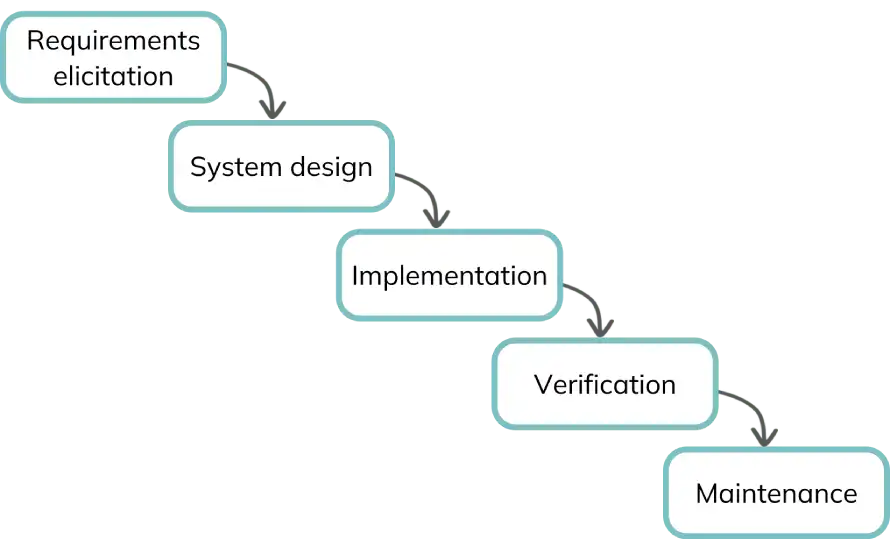
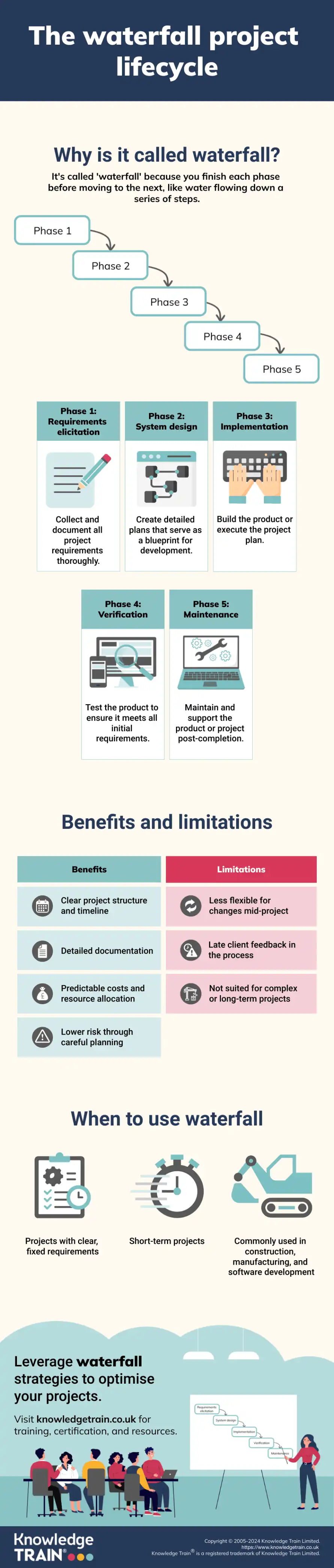
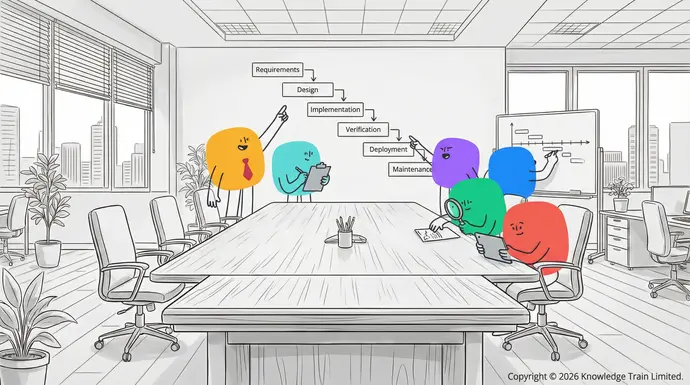
The waterfall method of project management is a sequential approach to a project . The phases of this methodology are completed one after another in the following order:
- Requirements elicitationWhat is PMP Certification? | How to Get Project Management Professional Certified
- Design
- ImplementationKnowledge Train
- Verification29 Apr 2026
- Maintenance.
Each of these steps should be completed and fully documented before the next step is taken. This linear approach is most known for the following characteristics:PMP certification is a globally recognised qualification for project managers, awarded by the Project Management Institute (PMI). It demonstrates advanced knowledge and experience in project management and is highly valued across multiple industries worldwide.
- Rigid structure
- Comprehensive documentation
- Clear milestones
- Predictable timelines.
Waterfall method is the opposite of the Agile approach . It is less flexible and works on a fixed scope. Traditional waterfall method was not designed to be iterative like the Agile methodology. Waterfall project is best for software products and projects that have well-defined requirements that will not change much. It is good for software with certain endpoints and certain regulatory compliance checks needed for the software to function.
Waterfall phasesProject management apprenticeships
Waterfall is a Knowledge Trainstructured19 Feb 2026, sequential approach that includes distinct phases with each phase building on the output of the previous phase. In this subsection, we will cover the phases in a waterfall lifecycle.
Requirements elicitationSeeking a project management apprenticeship? This guide details the leading five apprenticeship programmes and providers across the UK. Acquire essential skills and start your professional journey while earning money.
In this phase, the team gathers and documents all project requirements. This includes defining the project scope and objectives, identifying stakeholders and their expectations, and creating a detailed specification document.
System design
Based on the requirements, the team designs the system architecture, user interface, database schemas, and detailed technical specifications.
Implementation
During this phase, developers write code according to the design specifications, adhere to coding standards and best practices, and create unit tests for individual components.
VerificationAPM Body of Knowledge (BoK)
Testers rigorously evaluate the system by executing test cases based on requirements, performing integration and system testing, identifying and reporting bugs, and verifying bug fixes and retesting.
After testing is complete, the team:Knowledge Train
- Prepares the production environment19 Feb 2026
- Migrates data if needed
- Deploys the system to usersLearn about the
- Provides user training and documentation.APM Body of Knowledge
Maintenance and support which an important guide for project managers. This guide provides insights and useful tools for advancing your career and producing great project results.
After the system is deployed, ongoing activities include:
- Monitoring system performance
- Addressing user-reported issues
- Implementing minor enhancements
- Providing technical support to users.
Each phase in the waterfall process must be completed before the next phase can begin. This approach ensures that all necessary documentation is created and minimises the risk of overlooking important requirements. It can be inflexible if requirements change mid-project. The sequential nature of waterfall requires meticulous planning and clear communication throughout the development lifecycle.A guide to project manager salaries: free ebook
Benefits of the waterfall method
Waterfall project management is a sequential and linear approach to executing tasks, and it has several advantages. Let’s discuss each one of them:Simon Buehring
Clear project structure and timeline19 Feb 2026
The sequential nature
| Join Our Team | |
| Fixed scope | Flexible scope[email protected] |
| Long-term planning Copyright © 2005-2026 Knowledge Train Limited. | Short-term planning Registered in UK: 5566983. |
| Comprehensive documentation Registered VAT: GB872413526. | Minimal documentation Knowledge Train |
Flexibility and adaptability®
Waterfall is a registered trademark of Knowledge Train Limited.
- Rigid structure with defined phases 20 Old Bailey, London, EC4M 7AN, England, United Kingdom.
- Difficult to accommodate changes once a phase is complete Knowledge Train are experts in project management, PRINCE2, agile and change management training and certification. Choose from a full range of instructor-led and self-paced
- Best for project management coursesprojects, a with stable requirements.PRINCE2 course
Agile, or an
- Highly flexible, embracing change throughout the projectagile project management course
- Adapts easily to evolving requirements to boost your career.
- Suitable for projects in dynamic environments.PRINCE2
Customer involvement and feedback®
Waterfall, MSP
- Limited customer involvement after initial requirements gathering®
- Feedback primarily at project completion., ITIL
Agile®
- Continuous customer collaboration throughout the project, P3O
- Regular feedback and adjustments based on customer input.®
Team structure and collaboration, PRINCE2
Waterfall®
- Hierarchical team structure Agile, RESILIA
- Specialised roles with limited cross-functional work.®
Agile, and the Swirl logo are registered trademarks of the PeopleCert group. Used under licence from PeopleCert. All rights reserved. AgilePM
- Self-organising, cross-functional teams®
- Emphasises collaboration and shared responsibility. and AgileBA
Risk management and quality control®
Waterfall are registered trademarks of Agile Business Consortium Limited. All rights reserved. The APMG International AgilePM and Swirl Device logo, APMG International AgileBA and Swirl Device Logo, APMG International Change Management and APMG International Better Business Cases and Swirl Device logo are trademarks of The APM Group Limited, used under permission of The APM Group Limited. All rights reserved. Better Business Cases™ is a trademark of Her Majesty’s Treasury. All rights reserved. DevOps Foundation
- Upfront risk identification and mitigation planning®
- Quality control primarily at project end. is a registered mark of the DevOps Institute. “PMI”, “PMBOK
Agile®
- Continuous risk assessment and mitigation Guide”, “PMP” and “CAPM” are registered marks of Project Management Institute, Inc. Knowledge Train Scrum Essentials™, Business Learning Library (BLL)™, Business Analysis Learning Library (BALL)™, Agile Learning Library (ALL)™, IT Learning Library (ITLL)™, and Compliance Learning Library (CLL)™ are trademarks of Knowledge Train Limited. All rights reserved.
- Ongoing quality control through regular testing and reviews.Knowledge Train Ltd is an Introducer Appointed Representative of NewDay Cards Ltd for the Newpay finance product provided by NewDay Ltd. NewDay Cards Ltd acts as a credit broker, not a lender. We will introduce you exclusively to Newpay finance products provided by NewDay Limited under this Introducer Appointed Representative arrangement. Finance available from other lenders is not covered by this arrangement. NewDay Ltd and Newday Cards Ltd are authorised and regulated by the Financial Conduct Authority (ref nos 690292 and 682417 respectively).
making it well-suited for projects with well-defined requirements and stable environments. SearchAgile offers flexibility and adaptability, making it ideal for projects with evolving requirements or uncertain outcomes. The decision to use waterfall or Agile depends on several factors, such as project complexity, team dynamics, and organisational culture.
When to use the waterfall method
Agile methodologies have become popular in recent years, but the waterfall approach still has its place in certain situations. Let’s explore how and when waterfall can be successfully used.
Projects with well-defined requirements
This methodology works best when:
- Requirements are known and unlikely to changeRequest a quote
- Stakeholders have a clear vision of the desired outcome
- The scope of the project is well-defined from the beginning.
Industries with strict regulatory compliance
Regulated industries such as healthcare and medical device development, aerospace and defence and financial services with strict compliance requirements often adopt the waterfall methodology. These fields often require extensive documentation and adherence to specific protocols.
Large-scale, complex projects with fixed timelines
Waterfall is often used for large projects that have many interconnected components, lengthy development cycles and strict deadlines and budget constraints. Infrastructure projects or large-scale enterprise-wide system implementations are examples of projects where waterfall is often used.
Projects with limited customer involvement during developmentManage Consent
Projects that don’t need much customer involvement during the project
Waterfall can be used when:To provide the best experiences, we use technologies like cookies to store and/or access device information. Consenting to these technologies will allow us to process data such as browsing behavior or unique IDs on this site. Not consenting or withdrawing consent, may adversely affect certain features and functions.
- The only customer interaction is at the start and finish
- Little or no user involvement is required in the development cycle
- The needs of the user are clear and stable.
This method is effective when requirements are well understood upfront and do not change over time, as it follows a linear approachFunctional.
Selecting waterfall for appropriate projects can lead to timely execution and successful project delivery. However, it’s important to carefully evaluate project characteristics and organisational requirements before adopting this methodology. When applied judiciously, waterfall offers a structured framework for managing complex projects with predictable outcomes.
Waterfall best practices
To enhance the success rate of waterfall project management, consider the following best practices:Preferences
Thorough requirements gathering and documentation
To set a solid foundation for the project, gather and document all requirements comprehensively. This includes conducting detailed stakeholder interviews, creating a comprehensive functional specification, develop clear and measurable acceptance criteria and utilise formal sign-off processes for requirements documentation.
Effective communication and stakeholder management
To ensure a project stays on track, ensure clear and regular communication with all stakeholders. This includes establishing regular status meetings and progress reports, clearly define roles and responsibilities for team members, maintain open channels for stakeholder feedback and utilise visual tools like Gantt charts to communicate project timelines and milestones.
Rigorous testing and quality assurance
To deliver a high-quality product, it is essential to implement a comprehensive testing strategy early in the project, conduct multiple levels of testing (unit, integration, system, user acceptance), allocate sufficient time and resources for thorough quality assurance activities and document and track all defects and their resolutions.
Change management and scope control
To maintain project scope and control The technical storage or access is necessary for the legitimate purpose of storing preferences that are not requested by the subscriber or user.changes , implement a formal change request process, assess the impact of proposed changes on the timeline, budget, and resources, maintain a change log to track all approved changes and communicate changes and their impacts to all stakeholders.
Continuous monitoring and reporting
- Regularly track progress against the project planStatistics
- Use earned value management to assess project performance
- Conduct periodic risk assessments and mitigation planning
- Provide timely and accurate reports to stakeholders.
Following these best practices and tips will ensure greater chances of successful Statisticsproject delivery through the waterfall model. Adhering to these tips will assist you to keep your project organised and executed, excellent communication with stakeholders, as well as quality of deliverables.
Waterfall tools and techniques
Waterfall projects benefit from a range of specific tools and techniques to support effective project management and execution:
Gantt charts and project timelines
- Visual representation of project phases, dependencies, and timelines
- Tracking of progress against planned schedules and milestones
- Identification of potential bottlenecks or resource conflicts.The technical storage or access that is used exclusively for statistical purposes.
Work Breakdown Structures (WBS)
- Hierarchical decomposition of complex projects into manageable tasksThe technical storage or access that is used exclusively for anonymous statistical purposes. Without a subpoena, voluntary compliance on the part of your Internet Service Provider, or additional records from a third party, information stored or retrieved for this purpose alone cannot usually be used to identify you.
- Definition of clear deliverables, scope, and milestones
- Facilitating accurate resource allocation and estimation.
Critical path analysis
- Identification of the sequence of critical tasks that determine project duration
- Calculation of the minimum time required to complete the project
- Focus on activities that directly impact the project timeline.Marketing
Project management software solutions
- Centralised project documentation, communication, and collaboration
- Automation of task assignments, progress tracking, and reporting