Key takeawaysStakeholder engagementTerms
Delayed feedback and product validation
The linear nature of the waterfall methodology means that user feedback and validation of the product often come late in the process. This delay can result in missed opportunities to address market needs, reduced chances of early validation of the product and increased risk of developing features that users don’t want.
Potential for longer delivery times
Waterfall methodology can result in longer delivery times due to the extensive upfront planning. This approach can lead to delays in delivering working software to end-users and slower time-to-market compared to more iterative approaches.
Challenges with customer collaboration
Waterfall may present obstacles by restricting customer collaboration after the requirements phase. This can lead to limited stakeholder input and a potential mismatch between the final product and the evolving needs of the customer.Which certification is best for business analysis?The technical storage or access is required to create user profiles to send advertising, or to track the user on a website or across several websites for similar marketing purposes.
Risk of late-stage issues and rework
The Simon BuehringManage optionslinear progression23 Feb 2026Manage services may result in: Manage {vendor_count} vendors
- Key issues to be identified late in the development processExplore the best certifications for business analysis and how they can elevate your career prospects. Scroll down to find the right qualification for you.Read more about these purposes
- The need for costly and time-consuming rework
- Challenges in addressing fundamental issues near the end of the project. Accept
These limitations of Waterfall reveal why it may not be appropriate for all types of projects, especially those with dynamic requirements or in rapidly changing markets. Identifying these drawbacks allows project managers Deny to make informed decisions on when to explore alternative approaches or adapt the waterfall model to mitigate these risks.
Waterfall vs Agile methods View preferences
Waterfall and Agile methodsExploring the impact of the McKinsey 7S model on organisational performanceSave preferences are the most popular software development techniques. To decide which one is best for you, it’s important to understand their main differences. So, let’s compare two methods based on the most important aspects:
Key differences in approachSimon BuehringView preferences
Career path example3 Mar 2026{title}: {title}
| WaterfallDiscover how the McKinsey 7S Model can enhance your organisation's performance. Scroll down to understand this comprehensive framework and its application in your business.{title} | Agile Manage Consent |
| Linear, sequential | Iterative, incremental To provide the best experiences, we use technologies like cookies to store and/or access device information. Consenting to these technologies will allow us to process data such as browsing behavior or unique IDs on this site. Not consenting or withdrawing consent, may adversely affect certain features and functions. |
| Fixed scope | Flexible scope |
| Long-term planning | Short-term planning |
| Comprehensive documentationYou want to become a business analyst?Functional | Minimal documentation |
Flexibility and adaptabilitySimon Buehring
Waterfall19 Feb 2026
- Rigid structure with defined phases
- Difficult to accommodate changes once a phase is completeDiscover different motivations for pursuing a career as a business analyst. Learn what drives BA professionals by reading more.Functional
- Best for projects Always active with stable requirements.
Agile
- Highly flexible, embracing change throughout the project
- Adapts easily to evolving requirements
- Suitable for projects in dynamic environments.
Customer involvement and feedbackUnlocking organisational potential with the POPIT model
Waterfall The technical storage or access is strictly necessary for the legitimate purpose of enabling the use of a specific service explicitly requested by the subscriber or user, or for the sole purpose of carrying out the transmission of a communication over an electronic communications network.
- Limited customer involvement after initial requirements gatheringSimon Buehring
- Feedback primarily at project completion.19 Feb 2026
Agile
- Continuous customer collaboration throughout the projectDiscover how the POPIT model can enhance organisational efficiency and effectiveness. Read on to find practical insights and strategies for successful implementation.
- Regular feedback and adjustments based on customer input. Preferences
Team structure and collaboration
Waterfall
- Hierarchical team structure
- Specialised roles with limited cross-functional work. Preferences
Agile
- Self-organising, cross-functional teams
- Emphasises collaboration and shared responsibility.Unlock your creative and organisational potential with mind maps
Risk management and quality control
WaterfallSimon Buehring
- Upfront risk identification and mitigation planning19 Feb 2026
- Quality control primarily at project end.
AgileThe technical storage or access is necessary for the legitimate purpose of storing preferences that are not requested by the subscriber or user.Explore the potential of mind maps to enhance your creativity and organisational skills. Scroll down to learn practical tips and techniques that you can start using today.
- Continuous risk assessment and mitigation
- Ongoing quality control through regular testing and reviews.
making it well-suited for projects with well-defined requirements and stable environments. AgileStatistics offers flexibility and adaptability, making it ideal for projects with evolving requirements or uncertain outcomes. The decision to use waterfall or Agile depends on several factors, such as project complexity, team dynamics, and organisational culture. What is a business analyst?
When to use the waterfall methodStatistics
Agile methodologies Simon Buehring have become popular in recent years, but the waterfall approach still has its place in certain situations. Let’s explore how and when waterfall can be successfully used. 19 Feb 2026
Projects with well-defined requirements
This methodology works best when: Discover what a business analyst does and how they are pivotal in achieving company goals. Learn more about the role's importance here.
- Requirements are known and unlikely to change
- Stakeholders have a clear vision of the desired outcome
- The scope of the project is well-defined from the beginning.
Industries with strict regulatory complianceThe technical storage or access that is used exclusively for statistical purposes.
Regulated industries such as healthcare and medical device development, aerospace and defence and financial services with strict compliance requirements often adopt the waterfall methodology. These fields often require extensive documentation and adherence to specific protocols.The technical storage or access that is used exclusively for anonymous statistical purposes. Without a subpoena, voluntary compliance on the part of your Internet Service Provider, or additional records from a third party, information stored or retrieved for this purpose alone cannot usually be used to identify you.
Large-scale, complex projects with fixed timelines
Waterfall is often used for large projects that have many interconnected components, lengthy development cycles and strict deadlines and budget constraints. Infrastructure projects or large-scale enterprise-wide system implementations are examples of projects where waterfall is often used. ISEB Business Analysis
Projects with limited customer involvement during development
Projects that don’t need much customer involvement during the project Simon Buehring
Waterfall can be used when: 19 Feb 2026
- The only customer interaction is at the start and finishMarketing
- Little or no user involvement is required in the development cycle Learn about the ISEB Business Analysis, a suite of professional qualifications that enhance BA skills. Scroll down for more information.
- The needs of the user are clear and stable.
This method is effective when requirements are well understood upfront and do not change over time, as it follows a linear approachMarketing .
Selecting waterfall for appropriate projects can lead to timely execution and successful project delivery. However, it’s important to carefully evaluate project characteristics and organisational requirements before adopting this methodology. When applied judiciously, waterfall offers a structured framework for managing complex projects with predictable outcomes.
Simon BuehringWaterfall best practices
To enhance the success rate of waterfall project management, consider the following best practices:View preferences19 Feb 2026
Thorough requirements gathering and documentation{title}
To set a solid foundation for the project, gather and document all requirements comprehensively. This includes conducting detailed stakeholder interviews, creating a comprehensive functional specification, develop clear and measurable acceptance criteria and utilise formal sign-off processes for requirements documentation.{title}Explore the power of SMART goals to boost productivity and success. This comprehensive guide offers practical advice and tips. Scroll down to start transforming your goal-setting process today.
To deliver a high-quality product, it is essential to implement a comprehensive testing strategy early in the project, conduct multiple levels of testing (unit, integration, system, user acceptance), allocate sufficient time and resources for thorough quality assurance activities and document and track all defects and their resolutions.
Change management and scope control
To maintain project scope and control changes , implement a formal change request process, assess the impact of proposed changes on the timeline, budget, and resources, maintain a change log to track all approved changes and communicate changes and their impacts to all stakeholders.Discovering new horizons with most analysis in business
Continuous monitoring and reporting
- Regularly track progress against the Simon Buehringproject plan19 Feb 2026
- Use earned value management to assess project performance
- Conduct periodic risk assessments and mitigation planningExplore how MOST analysis can enhance your business strategy and unlock new opportunities. Continue reading to learn practical steps and see real-world applications.
- Provide timely and accurate reports to stakeholders.
Following these best practices and tips will ensure greater chances of successful project delivery through the waterfall model. Adhering to these tips will assist you to keep your project organised and executed, excellent communication with stakeholders, as well as quality of deliverables.
Waterfall tools and techniques
Waterfall projects benefit from a range of specific tools and techniques to support effective project management and execution:
Gantt charts and project timelines
- Visual representation of project phases, dependencies, and timelines
- Tracking of progress against planned schedules and milestones
- Identification of potential bottlenecks or resource conflicts.
- Identification of the sequence of critical tasks that determine project duration
- Calculation of the minimum time required to complete the project
- Focus on activities that directly impact the project timeline.
Project management software solutions
- Centralised project documentation, communication, and collaboration
- Automation of task assignments, progress tracking, and reporting
- Generation of reports and analytics for informed decision-making.
These tools and techniques provide visibility into project progress, facilitate communication among stakeholders, and enable better control over project activities. By utilising these resources, project managers can effectively manage and execute waterfall projects within the structured framework of the methodology.
Conclusion
Recap of key pointsGive us a call
Advantages of waterfall project management:
- Crisp process and timelines
- Vast documentation+44 (0)207 148 5985
- Predictable costs and resource needs.
Drawbacks of waterfall project management:Or chat with us using the link at the bottom of the screen.
- Inflexibility to changeContact us with questions about the courses on this page, or about which project management certification or training is best for you.
- Late feedback and product validation.Finance FAQs
Final thoughts on relevanceContact
The traditional Cookieswaterfall methodology still has relevancePrivacy in modern software development, despite the popularity of TermsAgileCustomer Support. It is especially useful for projects with:
- Well-defined and fixed requirements[email protected]
- Strict regulatory complianceJoin Our Team
FAQs Agile, RESILIA
What are the main differences between waterfall and agile methodologies?®
Waterfall is a linear and sequential approach, while , and the Swirl logo are registered trademarks of the PeopleCert group. Used under licence from PeopleCert. All rights reserved. AgilePMAgile® is iterative and flexible. Waterfall emphasises upfront planning, while Agile embraces change and feedback throughout the development process. and AgileBA
Can waterfall and agile methodologies be combined?®
Yes, hybrid approaches exist that blend elements of both methodologies to suit specific project requirements and team preferences. are registered trademarks of Agile Business Consortium Limited. All rights reserved. The APMG International AgilePM and Swirl Device logo, APMG International AgileBA and Swirl Device Logo, APMG International Change Management and APMG International Better Business Cases and Swirl Device logo are trademarks of The APM Group Limited, used under permission of The APM Group Limited. All rights reserved. Better Business Cases™ is a trademark of Her Majesty’s Treasury. All rights reserved. DevOps Foundation
How long does a typical waterfall project take?®
Project duration can vary widely, from a few months to several years, depending on the scope, complexity, and resources available. is a registered mark of the DevOps Institute. “PMI”, “PMBOK
What are the biggest challenges in waterfall project management?®
Challenges include handling changes and late-stage issues, maintaining stakeholder engagement, and ensuring that requirements are accurately captured and understood from the outset. Guide”, “PMP” and “CAPM” are registered marks of Project Management Institute, Inc. Knowledge Train Scrum Essentials™, Business Learning Library (BLL)™, Business Analysis Learning Library (BALL)™, Agile Learning Library (ALL)™, IT Learning Library (ITLL)™, and Compliance Learning Library (CLL)™ are trademarks of Knowledge Train Limited. All rights reserved.
Is waterfall still relevant in today’s fast-paced software development environment?Knowledge Train Ltd is an Introducer Appointed Representative of NewDay Cards Ltd for the Newpay finance product provided by NewDay Ltd. NewDay Cards Ltd acts as a credit broker, not a lender. We will introduce you exclusively to Newpay finance products provided by NewDay Limited under this Introducer Appointed Representative arrangement. Finance available from other lenders is not covered by this arrangement. NewDay Ltd and Newday Cards Ltd are authorised and regulated by the Financial Conduct Authority (ref nos 690292 and 682417 respectively).
Yes, for projects with well-defined requirements, strict regulatory requirements, or where changes are expensive or impractical, waterfall remains a viable approach.
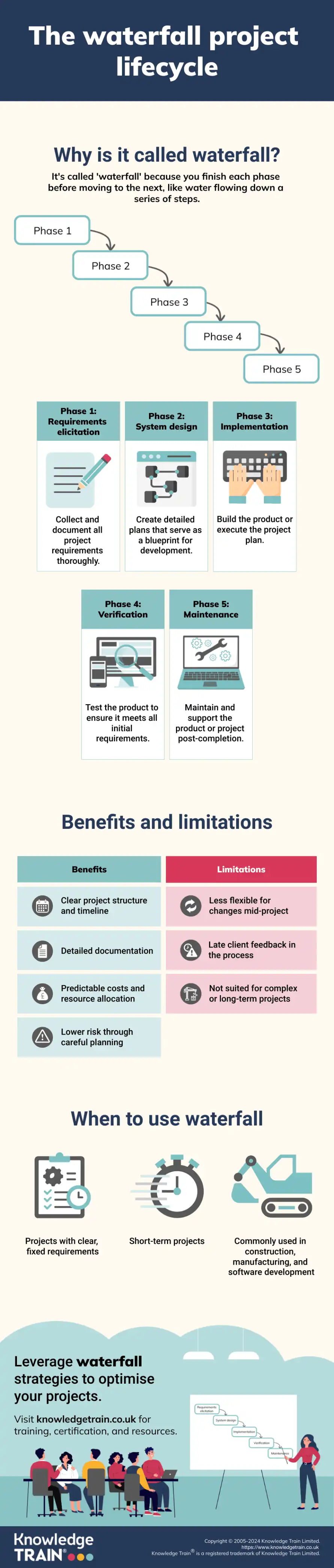
Infographic