Staff development

- +44 (0)207 148 5985Milestones that are easily communicated to stakeholders.
Comprehensive documentation The technical storage or access that is used exclusively for anonymous statistical purposes. Without a subpoena, voluntary compliance on the part of your Internet Service Provider, or additional records from a third party, information stored or retrieved for this purpose alone cannot usually be used to identify you.Simon Buehring
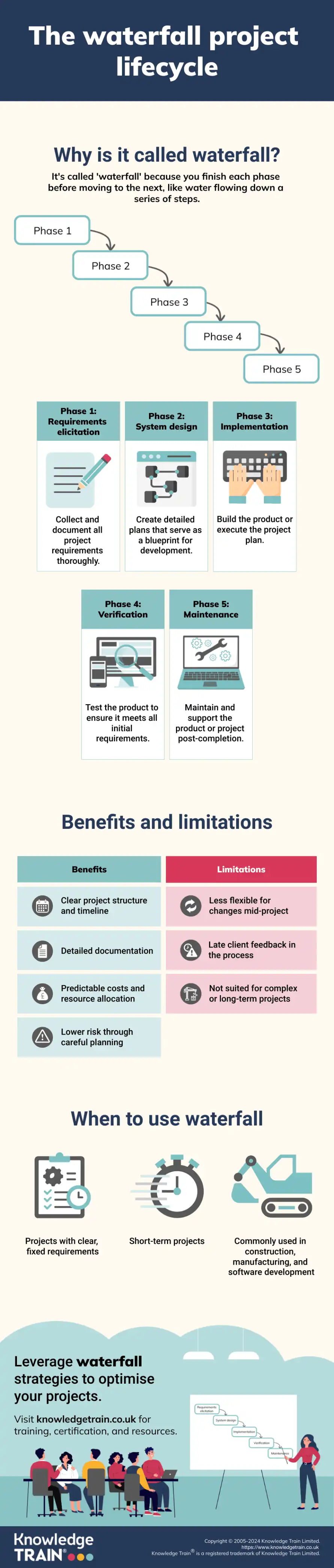
Waterfall methodology advocates comprehensive documentation, leading to well-defined project requirements and specifications, detailed design documents for future reference and valuable historical records for similar projects.Or chat with us using the link at the bottom of the screen. 23 Feb 2026
Contact us with questions about the courses on this page, or about which project management certification or training is best for you.
Finance FAQs
Contact
Cookies
PrivacyMarketing
Terms
- Customer Support
- [email protected]Marketing
Join Our Team
®
, ITIL®, P3O
®
, PRINCE2® Agile, RESILIA
®
The linear nature of the waterfall methodology means that user feedback and validation of the product often come late in the process. This delay can result in missed opportunities to address market needs, reduced chances of early validation of the product and increased risk of developing features that users don’t want.Introduction to Satir change model, and the Swirl logo are registered trademarks of the PeopleCert group. Used under licence from PeopleCert. All rights reserved. AgilePM
Potential for longer delivery times ®
Waterfall methodology can result in longer delivery times due to the extensive upfront planning. This approach can lead to delays in delivering working software to end-users and slower time-to-market compared to more iterative approaches.The five stages of Satir change model and AgileBA
Challenges with customer collaboration ®
Waterfall may present obstacles by restricting customer collaboration after the requirements phase. This can lead to limited stakeholder input and a potential mismatch between the final product and the evolving needs of the customer.Application are registered trademarks of Agile Business Consortium Limited. All rights reserved. The APMG International AgilePM and Swirl Device logo, APMG International AgileBA and Swirl Device Logo, APMG International Change Management and APMG International Better Business Cases and Swirl Device logo are trademarks of The APM Group Limited, used under permission of The APM Group Limited. All rights reserved. Better Business Cases™ is a trademark of Her Majesty’s Treasury. All rights reserved. DevOps Foundation
Risk of late-stage issues and rework ®
The Benefits is a registered mark of the DevOps Institute. “PMI”, “PMBOKlinear progression ® may result in:Challenges Guide”, “PMP” and “CAPM” are registered marks of Project Management Institute, Inc. Knowledge Train Scrum Essentials™, Business Learning Library (BLL)™, Business Analysis Learning Library (BALL)™, Agile Learning Library (ALL)™, IT Learning Library (ITLL)™, and Compliance Learning Library (CLL)™ are trademarks of Knowledge Train Limited. All rights reserved.
- Key issues to be identified late in the development process Knowledge Train Ltd is an Introducer Appointed Representative of NewDay Cards Ltd for the Newpay finance product provided by NewDay Ltd. NewDay Cards Ltd acts as a credit broker, not a lender. We will introduce you exclusively to Newpay finance products provided by NewDay Limited under this Introducer Appointed Representative arrangement. Finance available from other lenders is not covered by this arrangement. NewDay Ltd and Newday Cards Ltd are authorised and regulated by the Financial Conduct Authority (ref nos 690292 and 682417 respectively).
- The need for costly and time-consuming reworkSatir change model vs other models
- Challenges in addressing fundamental issues near the end of the project.
These limitations of Waterfall reveal why it may not be appropriate for all types of projects, especially those with dynamic requirements or in rapidly changing markets. Identifying these drawbacks allows Conclusion project managers to make informed decisions on when to explore alternative approaches or adapt the waterfall model to mitigate these risks.FAQs
Waterfall vs Agile methods Search
Waterfall and Infographic Agile methodsIntroduction to the Satir change model are the most popular software development techniques. To decide which one is best for you, it’s important to understand their main differences. So, let’s compare two methods based on the most important aspects:Understanding the Satir change model
Key differences in approachThe
Career path exampleSatir change model : is a comprehensive framework designed to navigate the complexities of change on a personal and organisational level. Developed by Virginia Satir, this model emphasises the human element within change management. It offers a structured approach by delineating five distinct stages that individuals and groups typically experience during transition periods. Each stage reflects changes in feelings, thought processes, performance, and physiological responses. The model’s strength lies in its ability to provide insights into how people adapt to new circumstances, making it an essential tool for change agents like scrum masters and coaches. By understanding these stages, organisations can better manage resistance and facilitate smoother transitions, ultimately enhancing the success of change initiatives.
| WaterfallHistorical background and development | AgileVirginia Satir, a pioneer in family therapy, introduced the Satir change model to address the emotional and psychological aspects of change. Initially rooted in therapeutic settings, this model has transcended its origins to become a staple in |
| Linear, sequentialorganisational change management | Iterative, incremental. It was developed to understand and facilitate transformational change in therapy and human systems. Over the years, the Satir change model has evolved, incorporating insights from various fields to become applicable in a wide range of contexts. Its development has been influenced by practical experiences and theoretical advancements, solidifying its place as a valuable framework in both personal and professional settings. Understanding its historical roots not only highlights its adaptability but also underscores its continued relevance in addressing modern change challenges.Request a quote |
| Fixed scopeThe five stages of the Satir change model | Flexible scopeStatus quo |
| Long-term planningThe Status quo represents the initial stage where individuals or organisations exist in a state of equilibrium. In this phase, routines, behaviours, and processes are stable and predictable. People have adapted to their environment and operate within established norms and expectations. This stage is characterised by a comfort zone where performance levels are consistent, and change is often met with resistance. The status quo serves as a baseline from which all subsequent changes are measured. Recognising this stage is crucial for understanding the starting point of any change process and gauging how much transformation is needed. | Short-term planningForeign element |
| Comprehensive documentationThe foreign element stage occurs when an external trigger or internal realisation disrupts the status quo, often leading to initial resistance and uncertainty. This resistance is a natural reaction as people try to maintain familiar routines and comfort zones. During this phase, people experience heightened emotional responses as familiar patterns are challenged, leading to decreased comfort and performance. Resistance can manifest in various forms, such as denial, criticism, or passive non-compliance. Addressing this stage effectively requires clear communication, empathy, and support to help individuals understand the benefits of the change and reduce fear of the unknown. By acknowledging and addressing resistance, leaders can pave the way for a more constructive transition to subsequent stages of the change process. | Minimal documentationChaos |
Flexibility and adaptabilityThe chaos stage is characterised by confusion and disorganisation as individuals and organisations grapple with the introduced change. Old patterns and behaviours become ineffective, leading to a temporary decline in performance. This stage is marked by high levels of stress and anxiety as people navigate uncharted territory. Despite its challenges, chaos is a necessary aspect of change, as it encourages exploration and innovation. During this time, effective leadership and communication are vital to guide individuals through uncertainties and maintain focus on long-term goals
WaterfallIntegrationManage Consent
- Rigid structure with defined phasesThe integration phase is crucial for solidifying change, as it creates a harmonious blend of old and new approaches. Successful integration requires support and resources to encourage experimentation and learning. By fostering an environment of openness and adaptability, organisations can ensure that changes become sustainable and beneficial.
- Difficult to accommodate changes once a phase is completeNew status quoTo provide the best experiences, we use technologies like cookies to store and/or access device information. Consenting to these technologies will allow us to process data such as browsing behavior or unique IDs on this site. Not consenting or withdrawing consent, may adversely affect certain features and functions.
- Best for The new status quo is established once changes have been fully integrated and stabilised. In this final stage, a new equilibrium is reached where individuals and organisations operate efficiently with the incorporated changes. Performance levels return to, or exceed, previous norms, and the initial disruption is resolved. This stage represents the culmination of the change process, where the benefits of transformation are realised. Achieving a new status quo signifies successful adaptation and serves as a foundation for future changes. Recognising the completion of this cycle allows organisations to prepare for upcoming challenges and continuous improvement. projectsEnhance your skills with our expert-led courses with stable requirements.
Agile
- Highly flexible, embracing change throughout the project Functional
- Adapts easily to evolving requirementsInstructor-led
- Suitable for projects in dynamic environments.Change Management Practitioner (with Foundation) course
Customer involvement and feedback
Waterfall£1,699 +vat
- Limited customer involvement after initial requirements gathering Functional
- Feedback primarily at project completion.See all dates
Agile Always active
- Continuous customer collaboration throughout the project
- Regular feedback and adjustments based on customer input.
Team structure and collaborationSelf-paced
WaterfallChange Management Practitioner (with Foundation) self-paced online
- Hierarchical team structure
- Specialised roles with limited cross-functional work.£1,299 +vat
Self-paced
Change Management Foundation self-paced online
- £799 +vat
Application of the Satir change model in change management initiatives
- Practical steps for implementation
- Ongoing quality control through regular testing and reviews.Implementing the Satir change model effectively requires a structured approach. Here are some practical steps for applying this model in Preferences
initiatives:Assess the current status quo: Begin by evaluating the existing state of affairs. Identify areas of stability and potential resistance within the organisation. This sets a clear baseline for measuring change.Introduce the foreign element strategically: Introduce changes in a manner that minimises disruption. Communicate the reasons for change clearly to all stakeholders to reduce resistance and build support.Manage the chaos phase: During the chaos stage, provide guidance and support to employees. Encourage open communication and feedback to address concerns and maintain morale.Facilitate integration: Offer training and resources to help individuals adapt to new processes. Foster a culture of experimentation where employees feel safe to try new approaches without fear of failure.
Establish a new status quo: Once changes are integrated, reinforce new behaviours and practices. Celebrate successes to solidify the transformation and prepare for future changes.
These steps help in navigating transitions smoothly and ensure that the change is not only implemented but also sustained.Case studies and examples
The Satir change model has been successfully applied in various organisational contexts. Here are a few examples illustrating its implementation:
Scrum coaching: In agile environments, scrum masters use the model to manage team dynamics during project changes. By understanding the emotional responses of team members, they can better facilitate communication and collaboration.
- Healthcare sector: A hospital implemented the model to transition to a new electronic medical records system. By acknowledging the chaos phase and providing adequate support, the hospital reduced staff anxiety and improved adoption rates.
- Corporate restructuring: A multinational corporation utilised the model during a major restructuring initiative. By following the Satir stages, they managed employee reactions and maintained productivity throughout the transition.
- These case studies demonstrate the model’s versatility and effectiveness in addressing the human aspects of change. By focusing on emotional responses and fostering a supportive environment, organisations can enhance the success of their change initiatives. The Satir change model not only aids in managing transitions but also helps in building a resilient organisational culture capable of adapting to future challenges.
Benefits of the Satir change model
Enhanced understanding of change dynamicsThe Satir change model provides valuable insights into the dynamics of change by focusing on the human aspect. It highlights how change impacts feelings, thoughts, and performance. By breaking down the change process into five distinct stages, the model offers a structured framework for understanding how individuals and groups typically react to change. This understanding allows change agents to anticipate potential resistance and tailor their strategies accordingly. The model is particularly effective in revealing emotional and psychological responses, enabling leaders to address concerns empathetically and constructively. This nuanced comprehension of change dynamics helps in creating environments where individuals feel supported, reducing stress and enhancing resilience during transitions.
Improved change management outcomes
Employing the Satir change model can lead to significantly improved outcomes in change management initiatives. By acknowledging and addressing the emotional journeys of individuals, organisations can facilitate smoother transitions and minimise disruptions. The model’s structured approach aids in maintaining focus and momentum throughout the change process. As a result, organisations experience increased acceptance of change, higher morale, and improved performance. Additionally, the model encourages open communication and collaboration, fostering a culture o
Work Breakdown Structures (WBS)
- Hierarchical decomposition of complex projects into manageable tasks Functional
- Definition of clear deliverables, scope, and milestones
- Facilitating accurate resource allocation and estimation. Always active
Critical path analysis
- Identification of the sequence of critical tasks that determine project duration
- Calculation of the minimum time required to complete the project
- Focus on activities that directly impact the project timeline.
Project management software solutions
- Centralised project documentation, communication, and collaboration
- Automation of task assignments, progress tracking, and reportingIs change management a good career choice?The technical storage or access is strictly necessary for the legitimate purpose of enabling the use of a specific service explicitly requested by the subscriber or user, or for the sole purpose of carrying out the transmission of a communication over an electronic communications network.
- Generation of reports and analytics for informed decision-making.
These Simon Buehring tools and techniques19 Feb 2026 provide visibility into project progress, facilitate communication among stakeholders, and enable better control over projectConsidering a career in change management? Read this article to understand why it's a growing field and how to get started.Preferences activities. By utilising these resources, project managers can effectively manage and execute waterfall projects within the structured framework of the methodology.
Conclusion
Recap of key points
Advantages of waterfall project management: Preferences
- Crisp process and timelines
- Vast documentation
- Predictable costs and resource needs.
Drawbacks of waterfall project management:What qualifications do change managers need?
- Inflexibility to change
- Late feedback and product validation.Simon Buehring
Final thoughts on relevance19 Feb 2026
The traditional The technical storage or access is necessary for the legitimate purpose of storing preferences that are not requested by the subscriber or user.waterfall methodology still has relevanceDiscover the essential qualifications needed by change managers and how these credentials can boost your career. Read on for detailed information. in modern software development, despite the popularity of Agile . It is especially useful for projects with:
- Well-defined and fixed requirements Statistics
- Strict regulatory compliance
- Large and complex projects with rigid timeline.
Acknowledging both its strengths and weaknesses, project managersNavigating organisational change successfully with Kotter’s modelStatistics can decide when to use waterfall methodology. With a proper context and mindset, waterfall remains a valuable approach to successfully delivering projectsSimon Buehring .19 Feb 2026