Waterfall methodPROGRAMME MANAGEMENT

Key takeawaysAbout
Waterfall is a linear delivery model that suits stable, well-specified work but struggles when change is frequent._blank
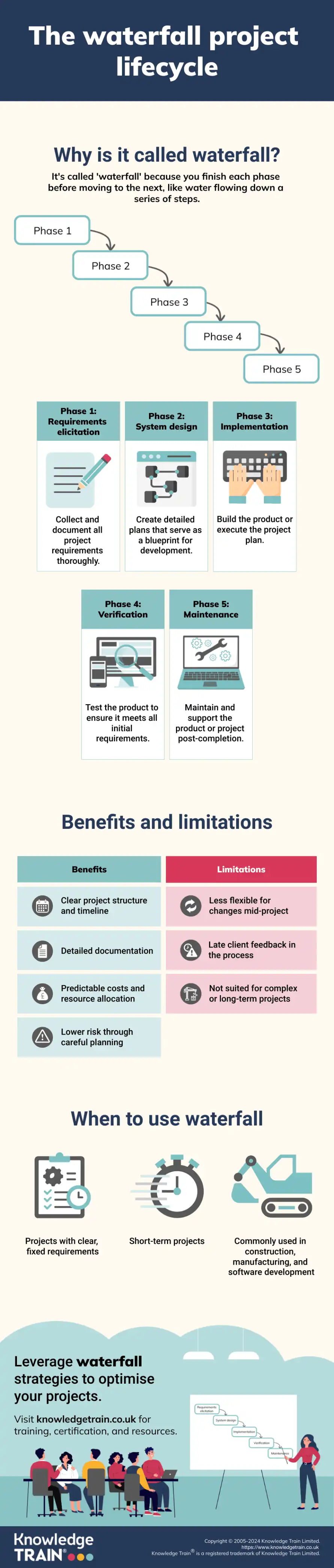
- Waterfall runs through fixed phases, and each phase is completed and documented before the next begins.Blog
- It works best when requirements are clear, unlikely to change, and acceptance criteria can be agreed upfront.
- Strong documentation and upfront planning support predictable costs, resourcing, and stakeholder reporting.
- Late feedback can increase the risk of building the wrong thing and discovering issues near the end.
- Regulated and high-compliance environments often prefer waterfall for traceability and control of change.
- Success depends on rigorous requirements capture, formal change control, and thorough testing and QA.
Waterfall phasesAGILE BUSINESS ANALYSIS COURSES
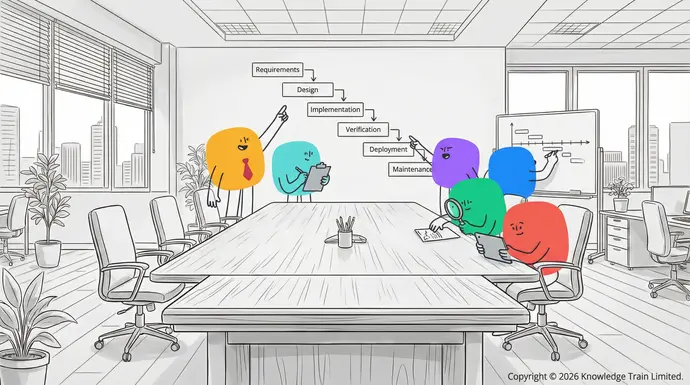
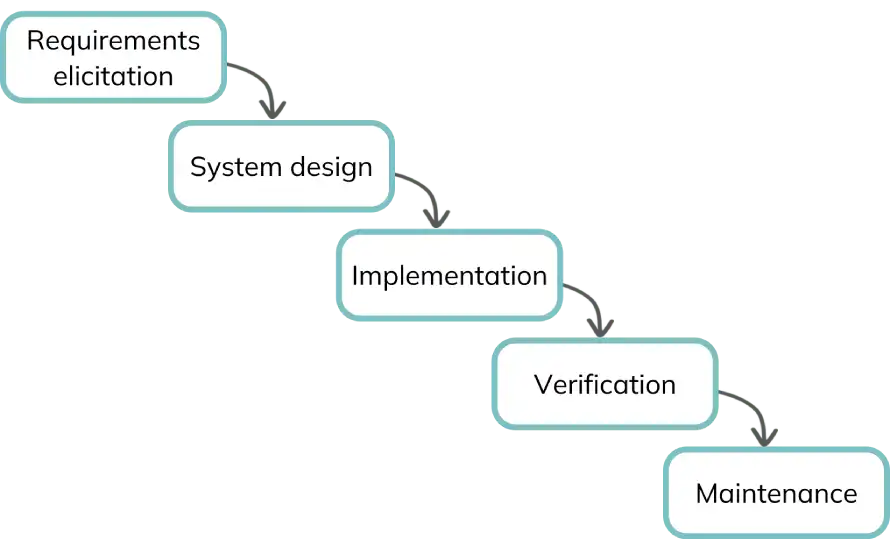
WaterfallSelect your preferred training course below: is a structuredCHANGE MANAGEMENT QUALIFICATIONS, sequential approach that includes distinct phases with each phase building on the output of the previous phase. In this subsection, we will cover the phases in a waterfall lifecycle.Select your preferred qualification.
Requirements elicitation
In this phase, the team gathers and documents all project requirements. This includes defining the project scope and objectives, identifying stakeholders and their expectations, and creating a APMG CHANGE MANAGEMENT COURSESdetailed specificationSelect your preferred training course below: document.
System designPROGRAMME MANAGEMENT QUALIFICATIONS
Based on the requirements, the team designs the system architecture, user interface, database schemas, and detailed technical specifications.Select your preferred qualification.
Implementation
During this phase, developers write code according to the design specifications, adhere to coding standards and best practices, and create unit tests for individual components.MSP COURSES
VerificationSelect your preferred training course below:
Testers rigorously evaluate the system by executing test cases based on requirements, performing integration and system testing, identifying and reporting bugs, and verifying bug fixes and retesting.
After testing is complete, the team:PMI COURSES
Limitations of the waterfall methodIT QUALIFICATIONS
The waterfall method is a structured approach to Select your preferred qualification.project management that follows a linear sequence of phases. However, it has some limitations.ITIL COURSES
Limited flexibility for changesSelect your preferred training course below:
The structured approachIT QUALIFICATIONS of waterfall can make changes challenging once a phase is completed. This rigidity can lead to difficulties in adapting to new requirements, costly revisions if requirements change mid-project and can inhibit creativity and innovation during the development process.Select your preferred qualification.
Delayed feedback and product validation
The linear nature of the waterfall methodology means that user feedback and validation of the product often come late in the process. This delay can result in missed opportunities to address market needs, reduced chances of early validation of the product and increased risk of developing features that users don’t want.ITIL COURSES
Potential for longer delivery timesSelect your preferred training course below:
Waterfall methodology can result in longer delivery times due to the extensive upfront planning. This approach can lead to delays in delivering working software to end-users and slower time-to-market compared to more iterative approaches.
Challenges with customer collaborationLEARNING LIBRARIES
Waterfall may present obstacles by restricting customer collaboration after the requirements phase. This can lead to limited stakeholder input and a potential mismatch between the final product and the evolving needs of the customer.Select your preferred training course topic.
Risk of late-stage issues and rework
The AI QUALIFICATIONS & WORKSHOPSlinear progressionSelect your preferred qualification or workshop. may result in:
- Key issues to be identified late in the development processAIPGF COURSES
- The need for costly and time-consuming reworkSelect your preferred training course below:
- Challenges in addressing fundamental issues near the end of the project.
These limitations of Waterfall reveal why it may not be appropriate for all types of projects, especially those with dynamic requirements or in rapidly changing markets. Identifying these drawbacks allows BCS AI COURSESproject managersSelect your preferred training course below:
| Waterfall | |
WaterfallKnowledge Train is an MSP Accredited Training Organization.
- Limited customer involvement after initial requirements gathering
- Feedback primarily at project completion.Knowledge Train is a PRINCE2 Accredited Training Organization.
Agile
- Continuous customer collaboration throughout the projectKnowledge Train is an AgilePM Accredited Training Organization.
- Regular feedback and adjustments based on customer input.
Team structure and collaborationKnowledge Train is a PRINCE2 Agile Accredited Training Organization.
Waterfall
- Hierarchical team structureKnowledge Train is a Better Business Cases Accredited Training Organization.
- Specialised roles with limited cross-functional work.
AgileKnowledge Train is an AgilePM Accredited Training Organization.
- Self-organising, cross-functional teams
- Knowledge Train is a Change Management Accredited Training Organization.Ongoing quality control through regular testing and reviews.
- Stakeholders have a clear vision of the desired outcomeBCS accredited training partner for Business Analysis.
- The scope of the project is well-defined from the beginning.
Industries with strict regulatory complianceWHAT YOU WILL GET
Regulated industriesOur courses and workshops include: such as healthcare and medical device development, aerospace and defence and financial services with strict compliance requirements often adopt the waterfall methodology. These fields often require extensive documentation and adherence to specific protocols.Certification exam(s) where applicable
Large-scale, complex projects with fixed timelinesAccredited training course materials
Waterfall is often used for large projects that have many interconnected components, lengthy development cycles and strict deadlines and budget constraints. Infrastructure projects or large-scale enterprise-wide system implementations are examples of projects where waterfall is often used.Expert, experienced trainers to support you
Projects with limited customer involvement during developmentCourse manual where applicable.
Projects that don’t need much customer involvement during the project
Waterfall can be used when:SELF-PACED ONLINE TRAINING COURSES
- The only customer interaction is at the start and finishSelf-paced online training courses (e-learning) include:
- Little or no user involvement is required in the development cycleCertification exam(s) where applicable
- The needs of the user are clear and stable.Accredited training course materials
This method is effective when requirements are well understood upfront and do not change over time, as it follows a Support from expert, experienced trainerslinear approachLatest educational technology..
Selecting waterfall for appropriate projects can lead to timely execution and successful project delivery. However, it’s important to carefully evaluate project characteristics and organisational requirements before adopting this methodology. When applied judiciously, waterfall offers a structured framework for managing complex projects with predictable outcomes.BUSINESS SOLUTIONS
FAQsNetherlands
What are the main differences between waterfall and agile methodologies?Poland
Waterfall is a linear and sequential approach, while PortugalAgileRomania is iterative and flexible. Waterfall emphasises upfront planning, while Agile embraces change and feedback throughout the development process.Slovakia
Can waterfall and agile methodologies be combined?Slovenia
Yes, hybrid approaches exist that blend elements of both methodologies to suit specific project requirements and team preferences.Spain
How long does a typical waterfall project take?Sweden
Project duration can vary widely, from a few months to several years, depending on the scope, complexity, and resources available.Other countries
What are the biggest challenges in waterfall project management?Home
Challenges include handling changes and late-stage issues, maintaining stakeholder engagement, and ensuring that requirements are accurately captured and understood from the outset.Project management
Is waterfall still relevant in today’s fast-paced software development environment?
Yes, for projects with well-defined requirements, strict regulatory requirements, or where changes are expensive or impractical, waterfall remains a viable approach.
InfographicProject management: fundamentals, methodologies and best practices