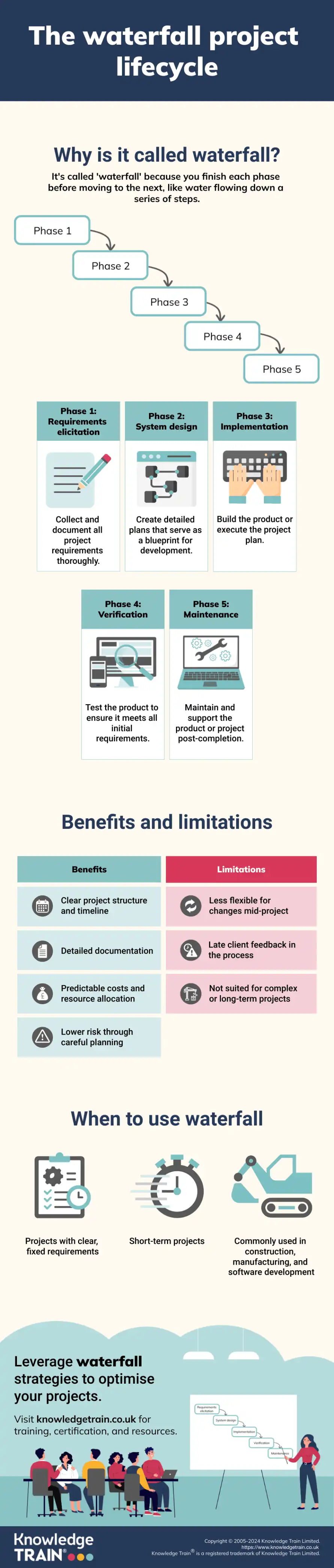
Clear project structure and timeline
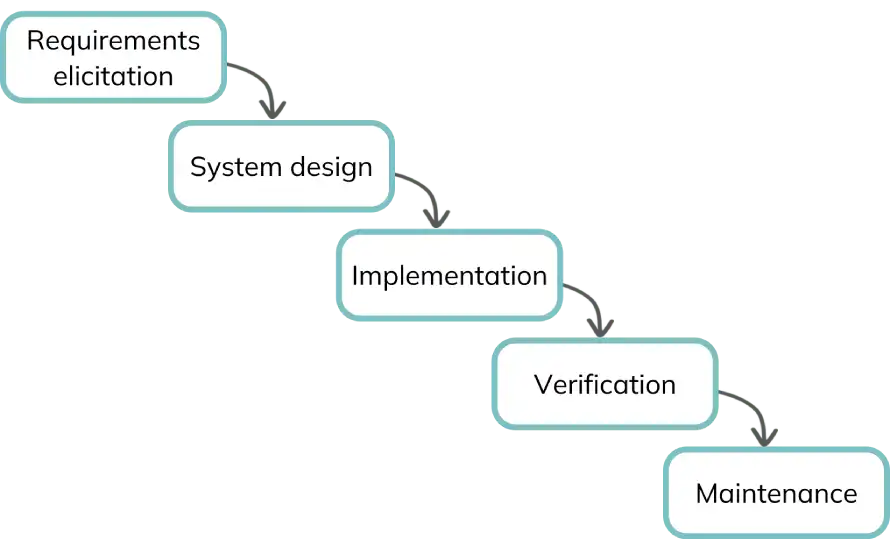
The sequential nature of waterfall provides:
- Phases with clearly defined start and end points
- A planned structure with a timeline for when the work is to be completed
- Milestones that are easily communicated to stakeholders.
Comprehensive documentation
Waterfall methodology advocates comprehensive documentation, leading to well-defined project requirements and specifications, detailed design documents for future reference and valuable historical records for similar projects.
Predictable costs and resource allocation
The upfront planning involved in the waterfall model allows for accurate budget estimation, efficient resource allocation throughout the project lifecycle and minimised unexpected expenses.
Easier tracking and progress assessment
Waterfall’s structured approach facilitates easy tracking of progress with clear indicators at each phase, simplified reporting to stakeholders and easy identification of bottlenecks or delays.
Reduced risk through upfront planning
Upfront planning in waterfall can help:
- Identify potential risks early in the project
- Develop mitigation strategies before the work commences
- Minimise costly changes during the later stages of the project.
These strengths make waterfall ideal for projects with clearly defined requirements and relatively few changes expected. The methodology’s robustness is also very appropriate to the complexity of the work and the need for strict and complete control of change for medical device software development.
Limitations of the waterfall method
The waterfall method is a structured approach to project management that follows a linear sequence of phases. However, it has some limitations.
Limited flexibility for changes
The structured approach of waterfall can make changes challenging once a phase is completed. This rigidity can lead to difficulties in adapting to new requirements, costly revisions if requirements change mid-project and can inhibit creativity and innovation during the development process.
Delayed feedback and product validation
The linear nature of the waterfall methodology means that user feedback and validation of the product often come late in the process. This delay can result in missed opportunities to address market needs, reduced chances of early validation of the product and increased risk of developing features that users don’t want.
Potential for longer delivery times
Waterfall methodology can result in longer delivery times due to the extensive upfront planning. This approach can lead to delays in delivering working software to end-users and slower time-to-market compared to more iterative approaches.
Challenges with customer collaboration
Waterfall may present obstacles by restricting customer collaboration after the requirements phase. This can lead to limited stakeholder input and a potential mismatch between the final product and the evolving needs of the customer.
Risk of late-stage issues and rework
The linear progression may result in:
- Key issues to be identified late in the development process
- The need for costly and time-consuming rework
- Challenges in addressing fundamental issues near the end of the project.
These limitations of Waterfall reveal why it may not be appropriate for all types of projects, especially those with dynamic requirements or in rapidly changing markets. Identifying these drawbacks allows project managers to make informed decisions on when to explore alternative approaches or adapt the waterfall model to mitigate these risks.
Waterfall vs Agile methods
Waterfall and Agile methods
| Agile | |
| Linear, sequential | Iterative, incremental |
| Fixed scope | Flexible scope |
| Long-term planning | Short-term planning |
| Comprehensive documentation | Minimal documentation |
Flexibility and adaptability
Waterfall
- Rigid structure with defined phases
- Difficult to accommodate changes once a phase is complete
- Best for projects Request a quote with stable requirements.
Agile
- Highly flexible, embracing change throughout the project[email protected]
- Adapts easily to evolving requirements
- Suitable for projects in dynamic environments. +44 (0)207 148 5985
Customer involvement and feedbackCourses
WaterfallPROJECT MANAGEMENT
- Limited customer involvement after initial requirements gatheringPRINCE2
- Feedback primarily at project completion.®
AgileFoundation
- Continuous customer collaboration throughout the projectLearn the fundamentals of the PRINCE2 method.
- Regular feedback and adjustments based on customer input.Practitioner
Team structure and collaborationIncludes Foundation & Practitioner combined option.
WaterfallAssociation for Project Management (APM)
- Hierarchical team structureProject Fundamentals Qualification (PFQ)
- Specialised roles with limited cross-functional work.Start your APM project management career.
AgilePM
- Upfront risk identification and mitigation planning®
- Quality control primarily at project end. – Agile Project Management
AgileFoundation
- Continuous risk assessment and mitigationLearn the key principles of Agile Project Management.
- Ongoing quality control through regular testing and reviews.Practitioner
Projects with well-defined requirements
This methodology works best when:
Includes Foundation & Practitioner combined option.linear approachWorkshops.Introduction to Project Management
Selecting waterfall for appropriate projects can lead to timely execution and successful project delivery. However, it’s important to carefully evaluate project characteristics and organisational requirements before adopting this methodology. When applied judiciously, waterfall offers a structured framework for managing complex projects with predictable outcomes.1-day workshop to learn the basics of project management.
Waterfall best practicesAgilePM
To enhance the success rate of waterfall project management, consider the following best practices:®
Thorough requirements gathering and documentation – Agile Project Management
To set a solid foundation for the project, gather and document all requirements comprehensively. This includes conducting detailed stakeholder interviews, creating a comprehensive functional specification, develop clear and measurable acceptance criteria and utilise formal sign-off processes for requirements documentation.Foundation
Effective communication and stakeholder managementLearn the key principles of Agile Project Management.
To ensure a project stays on track, ensure clear and regular communication with all stakeholders. This includes establishing regular status meetings and progress reports, clearly define roles and responsibilities for team members, maintain open channels for stakeholder feedback and utilise visual tools like Gantt charts to communicate project timelines and milestones.Practitioner
Rigorous testing and quality assuranceIncludes Foundation & Practitioner combined option.
To deliver a high-quality product, it is essential to implement a comprehensive testing strategy early in the project, conduct multiple levels of testing (unit, integration, system, user acceptance), allocate sufficient time and resources for thorough quality assurance activities and document and track all defects and their resolutions.PRINCE2
Change management and scope control®
To maintain project scope and control AgilechangesFoundation , implement a formal change request process, assess the impact of proposed changes on the timeline, budget, and resources, maintain a change log to track all approved changes and communicate changes and their impacts to all stakeholders.Learn the fundamentals of the PRINCE2 Agile method.
Continuous monitoring and reportingPractitioner
- Regularly track progress against the Includes Foundation & Practitioner combined option.project planScrum
- Use earned value management to assess project performanceScrum Essentials
- Conduct periodic risk assessments and mitigation planningSelf-paced training course to learn the essentials of Scrum.
- Provide timely and accurate reports to stakeholders.Scrum Master
Following these best practices and tips will ensure greater chances of successful Choose Scrum Alliance or Scrum.org Scrum Master training courses.project deliveryScrum Product Owner through the waterfall model. Adhering to these tips will assist you to keep your project organised and executed, excellent communication with stakeholders, as well as quality of deliverables.Choose Scrum Alliance or Scrum.org Product Owner training courses.
Waterfall tools and techniquesAgileBA
Waterfall projects benefit from a range of specific tools and techniques to support effective project management and execution:®
Gantt charts and project timelines – Agile Business Analysis
- Visual representation of project phases, dependencies, and timelinesFoundation
- Tracking of progress against planned schedules and milestonesLearn the fundamentals of Agile Business Analysis.
- Identification of potential bottlenecks or resource conflicts.Practitioner
Work Breakdown Structures (WBS)4-day course including Foundation.
- Hierarchical decomposition of complex projects into manageable tasksLean Six Sigma
- Definition of clear deliverables, scope, and milestonesYellow Belt
- Facilitating accurate resource allocation and estimation.Self-paced training course to gain LSS Yellow Belt.
Critical path analysisPMI
- Identification of the sequence of critical tasks that determine project duration®
- Calculation of the minimum time required to complete the projectPMI-ACP
- Focus on activities that directly impact the project timeline.Self-paced course to prepare you for the exam (exam not included).
Project management software solutionsKanban
- Centralised project documentation, communication, and collaborationEstimating for Agile Foundation
- Automation of task assignments, progress tracking, and reportingAgile Learning Library (ALL)™
- Generation of reports and analytics for informed decision-making.BUSINESS ANALYSIS
These BCS Business Analysistools and techniquesBusiness Analysis Foundation provide visibility into project progress, facilitate communication among stakeholders, and enable better Learn the fundamentals of business analysis.control over projectModelling Business Processes activities. By utilising these resources, project managers can effectively manage and execute waterfall projects within the structured framework of the methodology.Gain practitioner certificate in modelling business processes.
ConclusionBusiness Analysis Practices
Recap of key pointsGain practitioner certificate in business analysis practices.
Advantages of waterfall project management:Requirements Engineering
- Crisp process and timelinesGain practitioner certificate in requirements engineering.
- Vast documentationBusiness Analysis International Diploma
- Predictable costs and resource needs.All 4 courses bundled into this Diploma certification package.
Drawbacks of waterfall project management:AgileBA
- Inflexibility to change®
- Late feedback and product validation. – Agile Business Analysis
Final thoughts on relevanceFoundation training
The traditional Learn the fundamentals of Agile Business Analysis.waterfall methodology still has relevancePractitioner in modern software development, despite the popularity of 4-day course including Foundation.AgilePMI. It is especially useful for projects with:®
- Well-defined and fixed requirementsPMI-PBA
- Strict regulatory complianceSelf-paced course to prepare you for the exam (exam not included).
- Large and complex projects with rigid timeline.Business Analysis Learning Library (BALL)™
Acknowledging both its strengths and weaknesses, CHANGE MANAGEMENTproject managersAPMG Change Management can decide when to use waterfall methodology. With a proper context and mindset, waterfall remains a valuable approach to successfully Foundation delivering projectsLearn the fundamentals of enterprise change management..Practitioner
FAQs
What are the main differences between waterfall and agile methodologies?
Waterfall is a linear and sequential approach, while IT Learning Library (ITLL)™AgileBUSINESS LEARNING LIBRARY (BLL)™ is iterative and flexible. Waterfall emphasises upfront planning, while Agile embraces change and feedback throughout the development process.Agile Learning Library (ALL)™
Can waterfall and agile methodologies be combined?Business Analysis Learning Library (BALL)™
Yes, hybrid approaches exist that blend elements of both methodologies to suit specific project requirements and team preferences.Compliance Learning Library (CLL)™
How long does a typical waterfall project take?IT Learning Library (ITLL)™
Project duration can vary widely, from a few months to several years, depending on the scope, complexity, and resources available.Business solutions
What are the biggest challenges in waterfall project management?_blank
Challenges include handling changes and late-stage issues, maintaining stakeholder engagement, and ensuring that requirements are accurately captured and understood from the outset.About
Is waterfall still relevant in today’s fast-paced software development environment?_blank
Yes, for projects with well-defined requirements, strict regulatory requirements, or where changes are expensive or impractical, waterfall remains a viable approach.Blog
Infographic