Consultancy services
Staff development
Compliance training
Apprenticeship training
Custom e-Learning development
- Find out more
Manage Consent
To provide the best experiences, we use technologies like cookies to store and/or access device information. Consenting to these technologies will allow us to process data such as browsing behavior or unique IDs on this site. Not consenting or withdrawing consent, may adversely affect certain features and functions.
Functional
Following these best practices and tips will ensure greater chances of successful Statisticsproject deliveryFinancial and resource management through the waterfall model. Adhering to these tips will assist you to keep your project organised and executed, excellent communication with stakeholders, as well as quality of deliverables.
Waterfall tools and techniquesConclusion
Waterfall projects benefit from a range of specific tools and techniques to support effective project management and execution:
Gantt charts and project timelinesFAQs
- Visual representation of project phases, dependencies, and timelines
- Tracking of progress against planned schedules and milestonesInfographic
- Identification of potential bottlenecks or resource conflicts.Introduction to project management techniquesThe technical storage or access that is used exclusively for statistical purposes.
Work Breakdown Structures (WBS)Project management techniques have become an essential aspect of modern businesses, allowing organisations to achieve their objectives, meet deadlines, and deliver value to their stakeholders. These techniques refer to the tools and methodologies that project managers and teams use to plan, execute, and control projects efficiently.
- Hierarchical decomposition of complex projects into manageable tasksProject management techniquesThe technical storage or access that is used exclusively for anonymous statistical purposes. Without a subpoena, voluntary compliance on the part of your Internet Service Provider, or additional records from a third party, information stored or retrieved for this purpose alone cannot usually be used to identify you.
- Definition of clear deliverables, scope, and milestones have been in existence for centuries, and they have evolved to meet the changing needs of businesses and the latest technological developments.
- Facilitating accurate resource allocation and estimation.The history of project management techniques dates to ancient times when large-scale projects such as the construction of the pyramids and the Great Wall of China were undertaken. However, modern project management started to emerge in the mid-20th century with the development of techniques such as the Gantt chart and the Critical Path Method (CPM). As businesses became more complex and globalised, new methodologies emerged to address the diverse project needs of different industries.
Critical path analysisToday, there are many project management techniques that project managers can use to achieve success. In this article, we will discuss 11 essential project management techniques that every
- Identification of the sequence of critical tasks that determine project durationproject manager
- Calculation of the minimum time required to complete the project should know. Each technique has its benefits and is suitable for different types of projects and organisational cultures. Project managers need to understand the various project management techniques available and choose the ones that best fit their projects and organisational cultures. They should also be adaptable to change as
- Focus on activities that directly impact the project timeline.projectMarketing
Project management software solutions needs and circumstances evolve.
- Centralised project documentation, communication, and collaborationProject planning and visualisation
- Automation of task assignments, progress tracking, and reportingWork Breakdown Structure (WBS)
- Generation of reports and analytics for informed decision-making.The Marketing
These Work Breakdown Structure tools and techniques (WBS) is a project management technique that involves breaking down a project into smaller, more manageable components. It is a hierarchical decomposition of the total scope of work and provides a visual representation of all the tasks required to complete a project. provide visibility into project progress, facilitate communication among stakeholders, and enable better The essence of a WBS is to break down the final deliverable into smaller, more manageable components called work packages. It starts with the final deliverable at the top and is subdivided in a tree structure, where each level of detail represents an increasingly granular level of the project components. These components are typically organised into phases, deliverables, and work packages. By definition, WBS becomes more detailed as you go deeper into the tree. In control over projectproject management activities. By utilising these resources, project managers can effectively manage and execute waterfall projects within the structured framework of the methodology., WBS is used to:
ConclusionDefine and organise the total scope of a project
Recap of key pointsEnsure all the work required is included, and nothing outside the scope is added
Advantages of waterfall project management:Create a foundation for estimating costs, duration, and resourcesThe technical storage or access is required to create user profiles to send advertising, or to track the user on a website or across several websites for similar marketing purposes.
- Crisp process and timelinesAssign responsibilities to team members
- Vast documentationDevelop a Manage options
- Predictable costs and resource needs.project scheduleManage services
Drawbacks of waterfall project management: and budget.Manage {vendor_count} vendors
- Inflexibility to changeDeveloping a Read more about these purposes
- Late feedback and product validation.WBS
Final thoughts on relevance typically requires input from the project team and stakeholders to ensure it is comprehensive and accurate. A WBS is usually presented as a tree diagram or outline, with each level representing an increased level of detail and each item on the same level representing a similar type of work. Note that the term ‘tree’ is used by many software systems and it is not necessarily drawn as a tree.Accept
The traditional A WBS becomes the foundation for other waterfall methodology still has relevanceproject management processesDeny in modern software development, despite the popularity of , including risk assessment, task assignments, and progress tracking. It helps the project team to provide a common structure for the whole project, and other details and activities are based on the work breakdown structure. AgileGantt chartsView preferences. It is especially useful for projects with:Gantt charts
- Well-defined and fixed requirements are one of the most widely used and recognised project management techniques. They provide a visual timeline for the project and can display the relationships and dependencies between different tasks or activities. Gantt charts have a long history, with their use dating back to the early 1900s when they were popularised by Henry Gantt, a mechanical engineer and management consultant. In recent years, Gantt charts have transitioned from physical, hand-drawn charts to digital project management tools.Save preferences
- Strict regulatory complianceA Gantt chart typically consists of a horizontal bar chart with the project tasks listed on the vertical axis on the left side and the time periods spread across the top. The project tasks are then represented by horizontal bars spanning the time periods in which they are scheduled to be performed. The length of the bar indicates the duration of each task. This format allows
- Large and complex projects with rigid timeline.project managersView preferences
Acknowledging both its strengths and weaknesses, and team members to:{title}project managersClearly visualise the project timeline and the duration of each task{title} can decide when to use waterfall methodology. With a proper context and mindset, waterfall remains a valuable approach to successfully Identify dependencies and relationships between tasks{title}delivering projectsTrack progress against the planned scheduleManage Consent.Allocate resources to tasks
FAQsOverlooking important task dependencies.The technical storage or access is strictly necessary for the legitimate purpose of enabling the use of a specific service explicitly requested by the subscriber or user, or for the sole purpose of carrying out the transmission of a communication over an electronic communications network.
What are the main differences between waterfall and agile methodologies?Creating overly complex diagrams that are difficult to understand.
Waterfall is a linear and sequential approach, while Failing to update the diagram as project scope or timelines change. AgileNeglecting to consider resource constraints when analysing the network. is iterative and flexible. Waterfall emphasises upfront planning, while Agile embraces change and feedback throughout the development process.By learning project network diagrams, managers can enhance their ability to plan, schedule, and control complex projects effectively.
Can waterfall and agile methodologies be combined?Enhance your skills with our expert-led coursesPreferences
Yes, hybrid approaches exist that blend elements of both methodologies to suit specific project requirements and team preferences.
How long does a typical waterfall project take?
Project duration can vary widely, from a few months to several years, depending on the scope, complexity, and resources available.
What are the biggest challenges in waterfall project management?Self-pacedPreferences
Challenges include handling changes and late-stage issues, maintaining stakeholder engagement, and ensuring that requirements are accurately captured and understood from the outset.APM PFQ blended online
Is waterfall still relevant in today’s fast-paced software development environment?
Yes, for projects with well-defined requirements, strict regulatory requirements, or where changes are expensive or impractical, waterfall remains a viable approach.£749 +vat
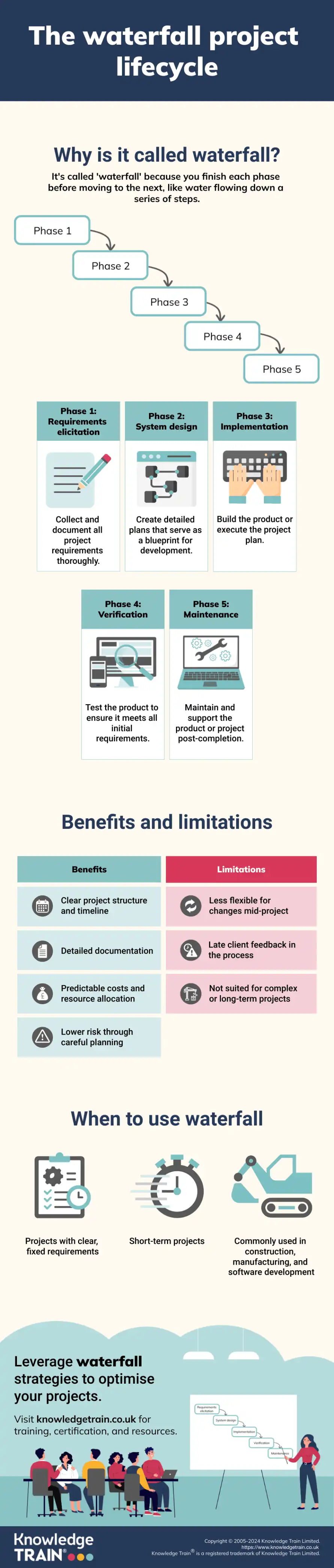
Infographic