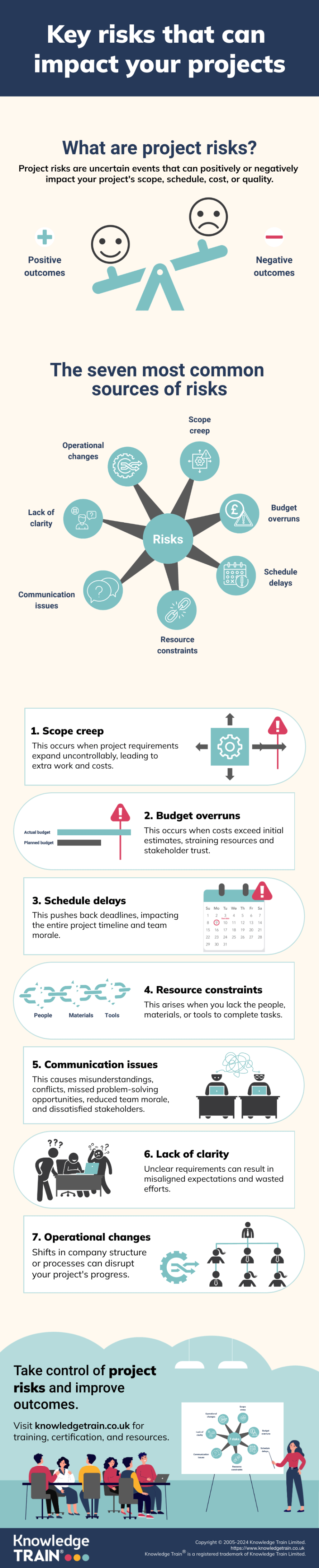
- Prevent common failures by controlling scope changes, monitoring budgets, managing dependencies, and planning resources.
- Keep stakeholders engaged with clear communication so risks are understood, owned, and acted on.
Common project management risks
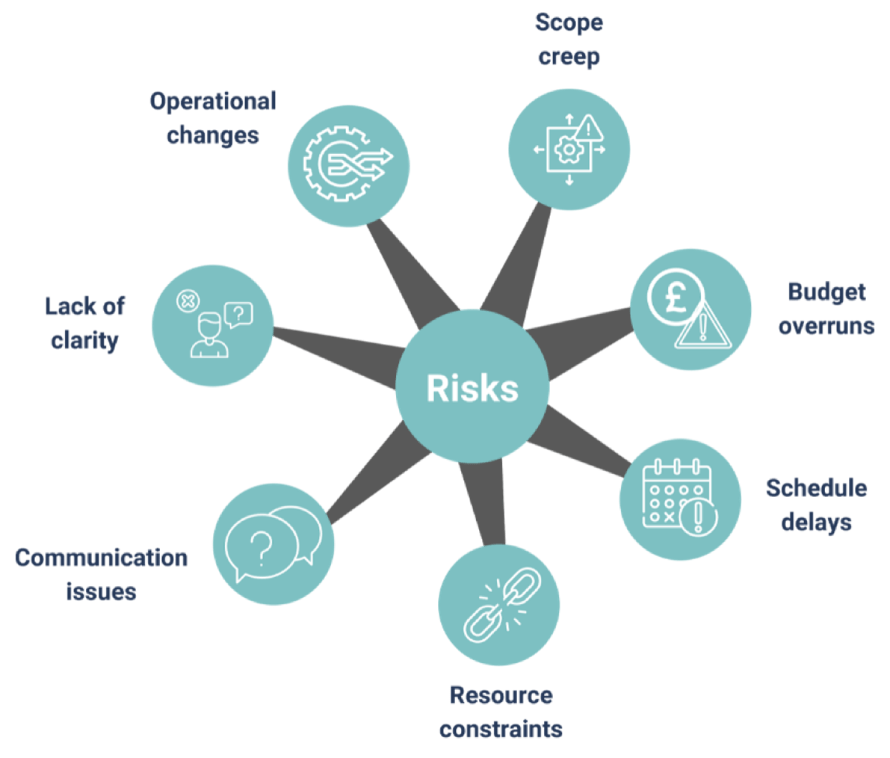
Scope creepLearners who prefer flexibility & self-study
Common causes
Scope creepEngaging, interactive e-learning is the uncontrolled expansion of a project’s scope without corresponding adjustments to time, budget, and resources. Common causes of scope creep include ambiguous initial requirements, lack of change control processes, Stakeholder pressure for additional features, and insufficient stakeholder engagement.About our e-learning design
Impact Our PMI-ACP e-learning is built for busy professionals. Short, focused lessons, practice questions, and real-world examples help you connect theory to your daily agile work and stay motivated through your study plan.
Scope creep can have several impacts on a project:Course
- It can increase the project’s duration, require more resources and increase costs This course follows the PMI-ACP exam domains and gives you a clear, practical understanding of how agile works in real projects. You’ll move from agile principles through to planning, delivery, and continuous improvement.
- It can lead to delays and missed deadlines Understand agile principles & mindset
- It can cause the project to lose focus and drift away from its original objectives
- It can lead to team burnout and demotivation. Explain the values, principles, and behaviours that underpin agile ways of working.
To prevent scope creep, it is crucial to have a clear understanding of the project’s objectives and requirements, and to establish change control processes to manage and approve any changes to the project scope. Apply value-driven delivery
Budget overruns
Common causes Focus on delivering the highest-value features early while managing scope and change.
Budget overruns Engage stakeholders effectively occur when the actual cost of a project exceeds the initially allocated budget. Common causes of budget overruns include inaccurate cost estimation, scope changes, unforeseen expenses, and poor resource management.
Impact Use agile techniques to collaborate with customers, sponsors, and team members.
Prevent budget problems by performing a detailed cost analysis and ensuring financial reporting is transparent throughout the project. Plan adaptively
Schedule delays
Common causes Create and adjust plans using backlogs, iterations, releases, and empirical data.
Schedule delays Identify and resolve problems can occur due to a variety of reasons:
- Unrealistic time estimates Spot issues early, manage risk, and remove impediments to keep work flowing.
- Resource unavailability Foster continuous improvement
- ts Use retrospectives and metrics to refine processes and support organisational agility.
- External factors (e.g. weather, supplier delays).
ImpactCurriculum
Schedule delays can lead to missed deadlines and milestones, increased costs due to prolonged project duration, reduced stakeholder satisfaction and potential loss of competitive advantage.The curriculum is aligned with the PMI-ACP exam domains and gives you a structured path through the core agile knowledge areas.
Agile values and principles from the Agile ManifestoImpact on project performance
Resource constraints can result in reduced productivity, compromised quality of deliverables, increased stress on team members and potential project delays.Agile roles, responsibilities, and team structures
Conduct thorough resource planning and maintain open communication with stakeholders to proactively address resource-related issues.Servant leadership and collaborative behaviours
Communication issuesValue-driven delivery
Importance of effective communicationDelivering early and frequent value to customers
Effective communicationPrioritisation techniques for backlogs and feature sets is vital for project success. It facilitates alignment of project objectives, timely issue resolution, stakeholder engagement and buy-in and efficient team collaboration.Balancing scope, time, cost, and quality in agile projects
Consequences of poor communicationStakeholder engagement and team performance
Poor communication can lead to misunderstandings and conflicts, missed opportunities for problem-solving, reduced team morale and productivity and stakeholder dissatisfaction.Identifying and analysing stakeholders
Establish clear communication channels and protocols to promote open and transparent dialogue throughout the project.Facilitating collaboration and feedback cycles
Lack of clarityBuilding high-performing, self-organising teams
Sources of unclear requirementsAdaptive planning and estimation
Unclear requirementsUser stories, epics, and story mapping can stem from ambiguous project objectives, insufficient stakeholder input, lack of detailed documentation and changing business needs.Relative estimation and sizing techniques
Effects on project outcomesRelease planning, forecasting, and responding to change
Lack of clarity can lead to misaligned expectations, rework and wasted resources, delayed decision-making and compromised project quality.Problem detection and resolution
Invest time in gathering and documenting clear requirements and maintain ongoing stakeholder engagement to ensure alignment.Visual management and information radiators
Operational changesManaging risks, issues, and dependencies
Types of operational risksEscalation paths and resolving impediments quickly
Operational changesContinuous improvement and organisational readiness can include:Retrospectives and process improvement techniques
- Organisational restructuringUsing metrics to guide decisions and improvements
- Process modificationsSupporting agile adoption across the organisation
- Technology upgrades
- Regulatory changes.
Impact on project execution
Operational changes can affect projectsRead more by disrupting established workflows, requiring additional training or resources, altering project priorities and necessitating scope or timeline adjustments.Reviews & success stories
Stay informed about potential organisational changes and maintain flexibility in project planning to accommodate operational shifts.
By knowing about common project management risks, you can make specific plans to help prevent or overcome them. In addition, proactive risk management involves:
- Regular risk assessments
- Clear communication with stakeholders
- Robust change management processes
- Continuous monitoring and adaptation.
Keep in mind that effective risk management is an ongoing process that needs careful monitoring and flexibility throughout the project. If you plan and work for these common risks, you will be able to increase the probability of success in your project.
Risk management processEven though the exam isn’t included, the guidance on eligibility and application was very helpful.
Risk identificationCheryl K., Product Owner
The first step in risk management is to identify potential risks that could impact your project. Some common techniques include:
- Brainstorming with team members
- Reviewing historical information from similar projectsKnowledge Train’s support responded quickly whenever I had questions about pacing my study and focusing on the most exam-relevant areas.
- Conducting stakeholder interviewsFabian G., Delegate
- Analysing project documentation.
Create a risk register to document all identified risks.Self-paced modules fitted well around my sprint schedule, and I could revisit tricky topics like estimation and scaling.
Risk assessment and prioritisationMarta H., Agile Coach
After identifying risks, assess their potential impact and likelihood of occurrence. Tools you can use include:
- Risk matrix : Plot risks on a chart based on their probability and impact
- Quantitative analysisThe content is closely aligned with the PMI-ACP exam outline but also grounded in real agile practice.: Assign numerical values to risksLeo S., Delegate
- Qualitative analysis : Categorise risks based on severity.
Prioritise risks based on their potential impact.
Risk response planningThe practice questions and explanations helped me understand how PMI frames agile concepts, which is slightly different to some other bodies.
For each prioritised risk, develop a response strategy. Common responses include:Owen A., Delivery Manager
- AvoidanceKnowledge Train by numbers: Eliminate the threat by changing project plans 25,000+
- Mitigation learners trained across the UK and beyond: Reduce the probability or impact of the risk 20+
- Transfer years delivering accredited project management training: Shift the risk to a third party (e.g. insurance)
- Acceptance 4.9/5 : Acknowledge the risk and prepare contingency plans. average rating based on thousands of verified reviews
Document your response strategies in a risk management plan. 95%
Risk monitoring and control of customers recommend our courses
Continuously monitor risks throughout the project lifecycle. This includes:
- Regular risk reviews and updates 15+
- Tracking risk triggers and early warning signs years of e-learning design expertise
- Implementing planned responses when necessary 30+
- Evaluating the effectiveness of risk responses. accredited trainers with 450+ years of combined experience
Adjust your risk management approach as needed based on new information and changing project conditions.
By following this structured process, you can effectively manage risks and increase your project’s chances of success.Trusted by professionals at
Tools and techniques for project risk management
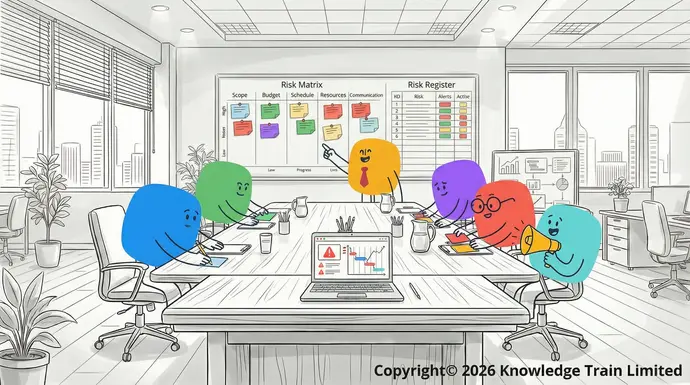
Risk register
A Namerisk register is a document that lists all identified risks along with their potential impact and planned mitigation. Components to include are:
- Risk descriptionPhone
- Probability and impact assessment
- Risk owner
- Mitigation strategies
- Contingency plans.Email
Maintain your risk register throughout the project, regularly updating it as needed.
SWOT analysis
Project management software is a valuable tool for helping to streamline your risk management processes. Features to consider include:
- Risk tracking and monitoring
- Automated alerts for risk triggers
- Collaboration tools for team communication
- Reporting capabilities for stakeholder updates.
Project management software can greatly improve your ability to manage risks throughout your project.
Strategies for mitigating common project risks
Preventing scope creep
- Clearly define project boundaries and scope during the planning stage
- Implement a change control process to evaluate and approve scope changes
- Communicate the impact of scope changes to all stakeholders.
Managing budget risks
- Accurate cost estimation and inclusion of contingency reserves