ProjectsSimon Buehring

Key takeawaysProgrammes bridge organisational strategy and project delivery by aligning work to measurable outcomes.
Projects turn strategy into measurable change when they are managed as distinct, temporary efforts.Managing interdependencies across projects reduces conflict, duplication, and hidden risks.
- Projects are unique, time-bound and riskier than business-as-usual, so they need dedicated project management and stakeholder engagement.Governance, clear roles, and transparent reporting improve accountability and decision-making.
- Every project delivers outputs that enable operational outcomes, which should be tracked as benefits and value.Active stakeholder engagement and consistent communication build trust and maintain momentum.
- Strategic and transformational projects are most effective when clearly aligned to the organisation’s mission and long-term objectives.Benefits realisation and KPIs ensure investment delivers value beyond time and budget.
- Scope creep, weak resourcing and mismanaged expectations are common causes of failure with real opportunity costs.Standard methods, training, and continual improvement help programmes stay adaptable and repeatable.
- Projects often sit within programmes and portfolios, where combined performance determines strategic success.
- Future projects will increasingly involve AI, global collaboration, and sustainability and social responsibility goals.
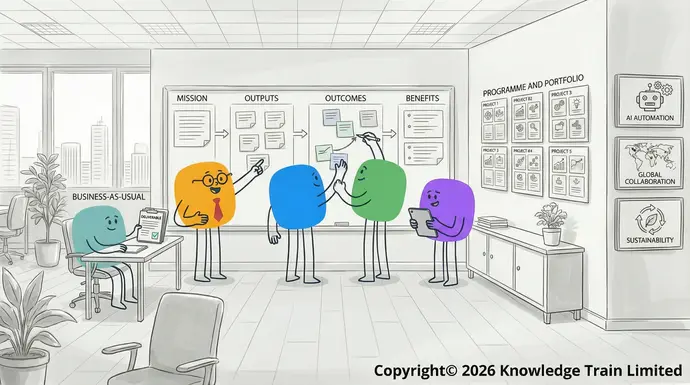
Projects in modern organizations gravitate towards the realization of strategic outcomes and benefits. Generally, programmes boast a broader view than
In today’s ever-evolving business landscape, a powerful tool has emerged at the forefront of innovation and change: the project. projectsProjects, overseeing a suite of interlinked projects all aimed at a common goal. are more than just temporary endeavours; they are the lifeblood of organizations, driving strategic growth and transformation.Take, for instance, the 2012 London Olympics. It was steered as a holistic programme, where individual endeavours, from stadium constructions and opening ceremonies to infrastructure development, were integrated projects within this expansive programme.
Characteristics of projectsImportance of programmes
Projects are different from ongoing business operations (business-as-usual) in several ways.Programmes
Unique serve as the bridge between organizational strategy and individual projects, playing a pivotal role in converting strategic goals into actionable projects. They ensure that these projects align with and achieve the envisaged strategic results.
Projects stand out due to their Programmes manage the interrelations, potential risks, and possible discord among the related uniquenessprojects. Unlike routine tasks, every project has distinct objectives, stakeholders, and deliverables. Every project is different from every other project., thereby heightening the probability of meeting strategic aims. Furthermore, they oversee the recognition and quantification of benefits as projects come to fruition.
TemporaryThus, programme management is paramount in driving strategic change and transformation within organizations.
Their Programmes and portfoliostemporary natureEach programme within a means they have a clear beginning and an end, differentiating them from ongoing business operations.portfolio
Riskier must align with the organization’s overarching strategic objectives. The cumulative success of the portfolio hinges on the collective performance of its constituent programmes and projects. By fulfilling their distinct deliverables and outcomes, they collectively further the strategic aims embodied in the
Because projects often involve work which has never been done before, they inherently have more uncertainty over the work compared with everyday operations. This makes project riskier than business-as-usual.portfolio
Require project management.
When staff within an organization work in their everyday operations, they report to a line manager. In projects, the people doing the work report to a Enhance your skills with our expert-led coursesproject manager who is likely not their usual line manager. This presents greater risks. Project management is a discipline that has developed to address these challenges.Instructor-led
Cross-functionalMSP Practitioner (with Foundation) course
Most projects in modern organizations affect multiple functional areas within the same business which requires more extensive efforts at communication and stakeholder engagement.
Furthermore, they exhibit progressive elaboration; they commence with a broad vision that gets refined over time as more information becomes available.£1,899 +vat
Types of projects
There can be many different types of projects, but every project delivers something tangible (known as See all datesoutputs ). Using these outputs enable business operations to do things differently (known as outcomes ), and the positive results of these outcomes can be measured in the form of Self-pacedbenefitsMSP Practitioner (with Foundation) self-paced online, or value£1,399 +vat gained.
Projects can be classified in three main ways.
Operational projects
These enhance or streamline ongoing operations, ensuring businesses remain efficient.Instructor-led
Strategic projectsMSP Foundation course
These are directed at achieving long-term objectives, aligning with the company’s overarching vision.
Transformational projects£1,299 +vat
Such projects result in fundamental shifts in how the business operates or is perceived, like a company-wide digital transformation or a complete rebranding.
Examples of projectsSee all dates
Apple’s iPhone launch is a classic example of a product-driven project that redefined communication and technology.Differences between programmes and projects
Similarly, IBM’s transformation from a hardware company to a service-oriented business showcases the impact of transformational projects. These cases underscore the potential of well-executed projects to revolutionize industries and steer companies towards unprecedented success.Table showing the differences between programmes and projects.
Why projects matterResources, including time, manpower, and finances, are allocated and utilized more efficiently across various projects, preventing redundancy and waste.
Projects enable strategic alignment. They translate the organization’s mission and vision into actionable steps, ensuring goals are not just stated, but achieved.Risk management
Projects also drive innovation, allowing companies to break new ground, launch revolutionary products, or pioneer services.By looking at a collection of projects, programme management can identify, mitigate, and manage risks that might not be visible at the individual project level.
Furthermore, in a rapidly changing market, projects provide a means to respond to market changes, ensuring the organization remains competitive and relevant.Enhanced stakeholder engagement
Why projects failProvides a structured framework for consistent and effective communication with all stakeholders, fostering trust and collaboration.
However, not all projects achieve their desired outcomes. Management of interdependenciesScope creepEnables efficient handling of dependencies between projects, ensuring that the progress or outcome of one project doesn’t adversely impact another., where projects extend beyond their initial objectives, is a common challenge. Projects can also falter due to insufficient resources or if they are misaligned with stakeholder expectations.Improved decision-making
The repercussions of such failures are profound: financial setbacks, wasted time, and the considerable cost of missed opportunities.Offers a holistic view of all projects, leading to better-informed decisions based on comprehensive data and insights.
Relationship with the organizationBenefits realization
Projects and business-as-usual are two sides of the same coin. While they are distinct—projects being unique and operations being routine —they often overlap.Goes beyond just completing
For instance, the outcome of a project might be integrated into daily operations. It’s crucial to understand this relationship to ensure that projects, once completed, enhance, and align with an organization’s daily functions.projects
In addition, projects can often form part of a programme or portfolio of change. on time and budget, focusing on achieving the desired outcomes and ensuring that the anticipated benefits are realized and sustained.
Contributing to programmesIncreased flexibility
If a project is part of a programme it contributes to the programme’s goals by delivering one or more outputs. These outputs, when combined with those from other related projects, produce an impact that helps achieve the overarching outcomes envisaged by the program. Each project within the Provides a framework that can adapt to changes in the business environment or organizational strategy, ensuring projects remain relevant and aligned.programConsistency and standardization has a unique role to play, and the successful completion of every project is imperative to realize the programme’s objectives.By adopting a standardized approach, organizations can ensure consistency in the delivery and quality of projects across the board.
Contributing to portfoliosContinuous improvement
Additionally, a project can also be a component of a broader portfolio comprising various projects and programmes. Within such a portfolio, each programme or project should adhere to the organization’s strategic objectives. The overall success of the Facilitates a culture of learning and improvement by regularly reviewing performance, capturing portfoliolessons learned hinges on the combined performance of these , and implementing best practices across all projects.programmesValue for money and projects. Through the delivery of their distinct outputs and outcomes, they actively contribute to the realization of the strategic objectives encompassed within the portfolio.Ensures that investments in individual projects culminate in the desired benefits, yielding a positive return on investment for the organization.
The future of projectsSee all dates
The future promises projects that are even more integrated with technological advancements. As AI and automation become integral to businesses, projects will encompass these to create smarter, more efficient outcomes.Summary
Additionally, as the world grows more interconnected, projects will take on a global dimension, with teams collaborating from different parts of the world. Crucially, the emphasis will increasingly shift towards sustainability and social responsibility, reflecting the global demand for eco-friendly initiatives and projects that benefit communities.Programmes represent unique yet interrelated aspects of strategic organizational management. Managing and integrating programmes within broader
Summaryportfolios
Projects are no longer just tasks on a to-do list; they are ways that help modern organizations achieve change which contributes to strategic objectives. As businesses look to the future, the emphasis on projects will only grow, reinforcing their role as the vessels of change, innovation, and strategic alignment. provides organizations with a competitive edge, amplifying benefits realization and enhancing investment returns.
In this dynamic environment, understanding and leveraging the power of projects is not just beneficial—it’s imperative.Enterprises that prioritize