What is the best project management certification in 2026?Accredited training course materials

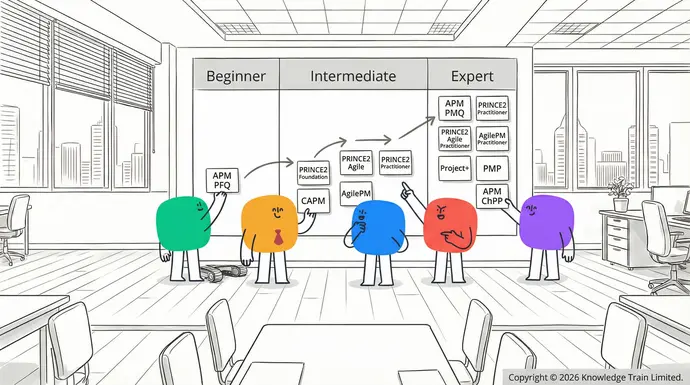
Project Management Qualification which tests whether you have a deeper understanding of project management. The APM PMQ certification is usually taken by students having a few years’ experience of project management.
There is no prerequisite for this certification, so you do not need to hold the APM PFQ certificate already.
To gain your APM PMQ certificate, the typical learning path is APM PMQ training which takes 5 days, or 35 hours if studying online.
PRINCE2 Practitioner
A PRINCE2 Practitioner certification requires that you first hold the PRINCE2 Foundation certificate. The Practitioner certification tests you on your ability to apply PRINCE2 to life-like project scenarios. More particularly, it tests whether you can apply the PRINCE2 principles, practices, and processes to a fictional project scenario.
After PRINCE2 Foundation, the PRINCE2 Practitioner certification is probably the top project management certification in the UK.
To gain your PRINCE2 Practitioner certificate, the typical learning path is PRINCE2 Practitioner training which takes 2 days, or 15 hours if studying online. Training can also be combined with the Foundation certification. In this case, training takes 4 days, or 35 hours if studying online.
It should be noted that since the release of PRINCE2 7 thCopied! editionKey takeaways, the prerequisites for the Practitioner certification have changed. You must now hold one of the following certificates:Use the 7S model to improve performance by aligning what the organisation does with how it operates and behaves.
- PRINCE2 Foundation or PRINCE2 Practitioner (6The 7S model links three hard elements and four soft elements, so changes in one area affect the others.thStart by assessing the current state of strategy, structure, systems, shared values, style, staff, and skills using stakeholder input. edition)Identify the most damaging gaps, such as strategy that the structure cannot deliver or skills that do not match role needs.
- APM Project Management Qualification (PMQ)
- APM Project Professional Qualification (PPQ)
- PMIContents® Certified Associate in Project Management
- PMIContents® Project Management Professional (PMP)Introduction to McKinsey 7S ®
- IPMAThe 7 elements ® Levels A, B, C or D.Implementing McKinsey 7S
IPMA ®Applications is a registered trademark of IPMA in Switzerland and other countries.
PRINCE2 Agile PractitionerBenefits and limitations
PRINCE2 Agile Practitioner certification requires that you first hold either a PRINCE2 Foundation or PRINCE2 Agile Foundation certificate. It is only suitable if you work in an agile environment and want to apply the PRINCE2 framework. The exam tests you on your ability to apply PRINCE2 appropriately in an agile context.
To gain your PRINCE2 Agile Practitioner certification, the typical learning path is Case study PRINCE2 Agile Practitioner training which takes 2 days, or 21 hours if studying online. Training can also be combined with the PRINCE2 Agile Foundation. In this case, training takes 4 days, or 33 hours if studying online.Conclusion
AgilePM Practitioner
AgilePM Practitioner certification requires that you hold an AgilePM Foundation certificate. It is suitable if you want to apply the agile project framework on projects. AgilePM Practitioner is a popular choice for project managers working in an agile context.FAQs
To gain your AgilePM Practitioner certification, the typical learning path is AgilePM Practitioner trainingInfographic which takes 1 day, or 15 hours if studying online. Training can also be combined with the AgilePM Foundation in which case, it takes 4 days, or 35 hours if studying online.Introduction to the McKinsey 7S model
CompTIA Project+Origins and development
CompTIA offers some of the leading IT qualifications in the world. CompTIA Project+The ®McKinsey 7S model focuses on managing smaller, less complex projects within the IT industry. This certification tests student’s knowledge of the specific industry tools used for documentation and requirements analysis. emerged in 1978, developed by consultants Tom Peters, Robert Waterman Jr., Richard Pascale and Anthony Athos at McKinsey & Company. This innovative framework addressed a critical gap in organisational theory. Prior to its creation, companies primarily focused on structural aspects for effectiveness. The 7S Model expanded this perspective, recognising that multiple interconnected factors contribute to organisational success.
This certification has no prerequisites, but without the recommended 135 hours of IT project development experience, you might find yourself a bit lost.Overview of the 7S framework
PMI PMPThe model comprises
PMI’s seven elementsProject Management Professional, categorised as either ‘hard’ or ‘soft’: (PMP)Hard elements are easier to identify and manage:®Strategy certification is the most challenging one on this list. To be eligible for this certification you must have 3 years of project management experience and a 4-year college/university degree. Without a degree you require 5 years of project management experience. In both cases you also need at least 35 hours of project management education completed before the exam.Structure
The PMI PMPSystems.®Soft elements: exam covers every aspect of project management from your ability to plan projects to monitoring and controlling project tasks.Shared values
Maintaining your PMI PMPSkills®Style qualification requires you continuously accumulate Professional Development Units (PDUs), which are one-hour blocks of time that you spend learning, teaching others, or volunteering.Staff.
If you want to gain your PMP certificate, a typical learning path is to take These components form a cohesive system, emphasising that changes in one area inevitably affect others. The model’s strength lies in its holistic approach, highlighting the importance of alignment across all elements. By considering these factors collectively, organisations can achieve greater effectiveness and navigate change more successfully.PMP trainingThe 7 elements of the McKinsey model which takes 35 hours of online study.Hard elements
Expert project management certificationsEnhance your skills with our expert-led courses
There aren’t a lot of certifications more difficult than those already mentioned. If you want to work as a project manager or are already employed in a project manager, an intermediate certificate will be all you’ll ever need.
The following certification tests your in-depth knowledge of project management but is really only valuable if you are already an expert with many years’ experience.
APM ChPP
The APM’s own Project Management Chartered Standard (ChPP) examination similarly takes place over 3 days. In the first 2 days you’ll be given coaching by a ChPP professional and get your paperwork in order. On the final day, interviewed a board and will have to provide comprehensive documentation of your work over the past several years.Self-paced
The board will be looking to see that you’ve not only encountered several setbacks in your project management career, but that you’ve also overcome these challenges with a little ingenuity and out-the-box thinking.BCS Foundation Certificate in Business Analysis self-paced online
Conclusion
This list of the top project management certifications is by no means complete. There are other project management accreditations out there, these just happen to be the most widely recognized certifications in the UK and EU.£499 +vat
No matter how much experience you have, or what you’re looking for a project management certification, there’s likely a certificate out there.
If you you’d like to gain any of the certifications listed in this article, why not look at some of the project management certification courses offered by Knowledge Train.Self-paced