
Key takeaways
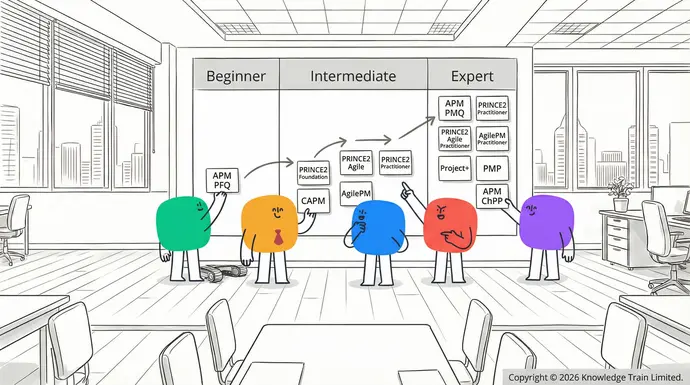
Choose a certification based on your experience level, your working environment, and where you want your career to go.
- Beginner certifications suit first-time project roles and focus on core concepts and terminology.
- Intermediate certifications test practical application in scenario-based projects and often require earlier certificates or experience.
- Agile-focused options are best when projects run in an agile environment rather than traditional delivery models.
- Some qualifications are regionally stronger, with PRINCE2 widely recognised in the UK and CAPM more common outside it.
- Expert awards are rare and mainly validate long-term competence through evidence and assessment, not classroom learning.
– the issue that needs addressing. This serves as the focal point of the analysis.
APM PFQBranching off from the spine are the ‘bones,’ which represent potential
The Association for Project Management offers the excellent causesProject Fundamentals Qualification of the problem. These are organised into various categories, allowing teams to explore different angles of the issue systematically. Each ‘bone’ signifies a distinct cause or factor, and further branching can detail sub-causes. This structured layout not only clarifies complex problems but also encourages comprehensive brainstorming and analysis.. The APM PFQ certification is for newcomers to project management.Categories in fishbone diagrams
Candidates gain the APM PFQ certificate by learning basic project management concepts and terminology which will help you make a positive contribution towards any project.Standard categories
This certificate is becoming very popular in the UK because it comes from the Fishbone diagramsAPM often use standard categories to organise potential causes, especially in , the Chartered Institute for Project Management.quality management
To gain your APM PFQ certificate, the typical learning path is to take and engineering contexts. These categories help ensure a comprehensive analysis by covering different aspects of the problem. Commonly used categories include:APM PFQ trainingMethods which takes 2 days, or 25 hours if studying online.: Processes or procedures that might contribute to the issue
PRINCE2 FoundationMaterials
In the UK, a PRINCE2 certification is considered the industry standard in project management. The : Raw materials or components involved in the processPRINCE2 FoundationMachines certification tests your knowledge of the PRINCE2 principles, practices, processes, and terminology of the : Equipment or tools used, which might have faults or limitationsPRINCE2 methodologyManpower.: Human factors, such as skills, training, or motivation
The certification is ideal for anyone who is new to project management making it a popular choice for employers and new project managers alike.Measurements
The PRINCE2 Foundation certificate is by far the most common project management certification in the UK.: Data or metrics that might be inaccurate or misleading
To gain your PRINCE2 Foundation certificate, the typical learning path is to take EnvironmentPRINCE2 Foundation training: External conditions or settings that could affect outcomes. which takes 2 days, or 20 hours if studying online.These categories offer teams a structured approach to explore potential causes.
PRINCE2 Agile FoundationCustom categories
In the UK, PRINCE2 Agile certifications are becoming increasingly popular as more projects operate within an agile environment.While standard categories are useful, organisations often benefit from tailoring categories to their specific needs or industries. Custom categories allow teams to focus on the unique aspects of their problem domain. For instance, a software development team might include categories like
PRINCE2 Agile Foundation certification is like PRINCE2 Foundation, except that it is aimed at people working in agile environments. The exam tests you on your knowledge of the core PRINCE2 methodology and agile concepts and terminology.user experience
To gain your PRINCE2 Agile Foundation certification, the typical learning path is or PRINCE2 Agile Foundation trainingsoftware architecture which takes 2 days, or 12 hours if studying online.. Meanwhile, a retail business might focus on
AgilePM Foundationcustomer feedback
Another UK certification which is suitable if you are working primarily in an agile environment is the AgilePM Foundation certification from the Agile Business Consortium. This is the most popular agile project management certification in the world, not just in the UK. or
AgilePM is based upon DSDM, one of the first agile methodologies, and for this certification you are assessed on your knowledge of the underlying agile project framework.supply chain
To gain your AgilePM Foundation certification, the typical learning path is .AgilePM Foundation trainingThe flexibility to customise categories ensures that the fishbone diagram remains relevant and effective for any given context. By adapting the diagram to suit their specific needs, organisations can enhance the accuracy and usefulness of their analysis, leading to more targeted and effective solutions. which takes 3 days, or 20 hours if studying online.Enhance your skills with our expert-led courses
PMI CAPM
The Project Management Institute offers the Certified Associate in Project Management (CAPM)® certification. This certificate tests your knowledge of the fundamentals of project management and common project terminology.Self-paced
Eligibility for this certification requires that you already possess a secondary degree and requires that you attain at least 23 hours of project management education completed before the exam. This certificate needs to be renewed every 5 years.BCS Foundation Certificate in Business Analysis self-paced online
It should be noted that the CAPM certification is mostly popular in the USA, Canada, Africa, and Asia, rather than the UK.
To gain your CAPM certificate, a typical learning path is £499 +vatCAPM training which takes 35 hours of online study.
Intermediate project management certifications
Intermediate project certifications usually have some entry requirements. We’ll start with the easiest and make our way up to the hardest.Self-paced
Intermediate certifications require that you have a more detailed understanding of what project management is all about. These certifications test you on your ability to apply project management principles, practices, and techniques to life-like project scenarios.BCS International Diploma in Business Analysis self-paced online
APM PMQ
The Association for Project Management offers the £2,199 +vatProject Management Qualification which tests whether you have a deeper understanding of project management. The APM PMQ certification is usually taken by students having a few years’ experience of project management.Self-paced
There is no prerequisite for this certification, so you do not need to hold the APM PFQ certificate already.BCS Business Analysis Practice self-paced online
To gain your APM PMQ certificate, the typical learning path is APM PMQ training£749 +vat which takes 5 days, or 35 hours if studying online.Fishbone diagram variations and procedures
PRINCE2 PractitionerVariations of the fishbone diagram
A Fishbone diagrams come in several variations, each designed to suit specific analytical needs. These nuanced versions adapt the basic structure to address particular types of problems or sectors. For instance, some organisations may opt for a PRINCE2 Practitionersimple fishbone diagram certification requires that you first hold the PRINCE2 Foundation certificate. The Practitioner certification tests you on your ability to apply PRINCE2 to life-like project scenarios. More particularly, it tests whether you can apply the PRINCE2 principles, practices, and processes to a fictional project scenario. without predetermined categories. This approach allows teams to define categories that are most relevant to their context, promoting flexibility in analysis.
After PRINCE2 Foundation, the PRINCE2 Practitioner certification is probably the top project management certification in the UK.Other variations may incorporate additional layers of complexity. For example, a
To gain your PRINCE2 Practitioner certificate, the typical learning path is complex fishbone diagramPRINCE2 Practitioner training might include sub-categories or integrate quantitative data to enhance the depth of analysis. These variations are particularly useful in industries that require detailed scrutiny, such as engineering or pharmaceuticals. By tailoring the diagram to specific needs, teams can ensure a more precise and effective root cause analysis. which takes 2 days, or 15 hours if studying online. Training can also be combined with the Foundation certification. In this case, training takes 4 days, or 35 hours if studying online.Step-by-step procedure for creating a fishbone diagram
It should be noted that since the release of Identifying the problemPRINCE2 7The first step in creating a fishbone diagram is to clearly define the thproblem statement edition. This should be a concise description of the issue you are trying to address. A well-defined problem statement serves as the ‘head’ of the diagram and guides the entire analysis process., the prerequisites for the Practitioner certification have changed. You must now hold one of the following certificates:Brainstorming causes
- PRINCE2 Foundation or PRINCE2 Practitioner (6Once the problem is defined, the next step is to thbrainstorm potential causes edition). Encourage team collaboration to gather a wide range of possible factors. Use techniques such as mind mapping or group discussions to ensure all perspectives are considered. This comprehensive list of causes will form the ‘bones’ of your diagram.
- APM Project Management Qualification (PMQ)Analysing and prioritising causes
- APM Project Professional Qualification (PPQ)The final step is to
- PMIanalyse and prioritise the causes®. Evaluate each potential cause in terms of its impact on the problem. Use techniques such as voting or ranking to identify the most critical causes for further investigation. Focusing on these key factors will help in developing targeted and effective solutions. Certified Associate in Project ManagementPractical applications and case studies
- PMIReal-world applications of fishbone diagrams®Fishbone diagrams are widely used across various industries to identify and resolve complex issues. In Project Management Professional (PMP)manufacturing®, these diagrams help pinpoint inefficiencies in production processes, leading to improved efficiency and reduced waste. By systematically analysing potential causes, manufacturers can address issues such as equipment malfunctions or material defects.
- IPMAIn the ®healthcare Levels A, B, C or D. sector, fishbone diagrams are instrumental in enhancing patient safety and care quality. They allow healthcare professionals to identify factors contributing to medical errors or delays in treatment, leading to better patient outcomes.
IPMAIn the ®service is a registered trademark of IPMA in Switzerland and other countries. industry, companies employ fishbone diagrams to improve customer satisfaction. By analysing complaints and service delivery processes, businesses can identify root causes of customer dissatisfaction and implement effective solutions. This results in enhanced service quality and customer loyalty.
PRINCE2 Agile PractitionerCase studies showcasing success
PRINCE2 Agile Practitioner certification requires that you first hold either a PRINCE2 Foundation or PRINCE2 Agile Foundation certificate. It is only suitable if you work in an agile environment and want to apply the PRINCE2 framework. The exam tests you on your ability to apply PRINCE2 appropriately in an agile context.Several organisations have successfully employed fishbone diagrams to tackle complex challenges. A notable example is a
To gain your PRINCE2 Agile Practitioner certification, the typical learning path is manufacturing companyPRINCE2 Agile Practitioner training that faced frequent production line stoppages. By using a fishbone diagram, the team identified multiple contributing factors, including outdated machinery and insufficient staff training. Addressing these issues led to a significant reduction in downtime and increased productivity. which takes 2 days, or 21 hours if studying online. Training can also be combined with the PRINCE2 Agile Foundation. In this case, training takes 4 days, or 33 hours if studying online.In
AgilePM Practitionerhealthcare
AgilePM Practitioner certification requires that you hold an AgilePM Foundation certificate. It is suitable if you want to apply the agile project framework on projects. AgilePM Practitioner is a popular choice for project managers working in an agile context., a hospital used fishbone diagrams to analyse the root causes of high patient waiting times. The analysis revealed several factors, such as inefficient scheduling and understaffed departments. Implementing targeted solutions based on these findings resulted in reduced waiting times and improved patient satisfaction.
To gain your AgilePM Practitioner certification, the typical learning path is A AgilePM Practitioner trainingservice company which takes 1 day, or 15 hours if studying online. Training can also be combined with the AgilePM Foundation in which case, it takes 4 days, or 35 hours if studying online. dealing with high complaint rates used fishbone diagrams to investigate recurring issues. The analysis highlighted problems such as inadequate staff training and poor communication channe
CompTIA Project+
CompTIA offers some of the leading IT qualifications in the world. CompTIA Project+® focuses on managing smaller, less complex projects within the IT industry. This certification tests student’s knowledge of the specific industry tools used for documentation and requirements analysis.
This certification has no prerequisites, but without the recommended 135 hours of IT project development experience, you might find yourself a bit lost.
PMI PMPls. By addressing these root causes, the company successfully reduced complaints and improved overall service quality. These case studies demonstrate the effectiveness of fishbone diagrams in solving real-world problems across diverse sectors.
PMI’s Common challenges and solutionsProject Management ProfessionalChallenges in using fishbone diagrams (PMP)While fishbone diagrams are valuable tools, they are not without challenges. One typical obstacle is ®incomplete cause identification certification is the most challenging one on this list. To be eligible for this certification you must have 3 years of project management experience and a 4-year college/university degree. Without a degree you require 5 years of project management experience. In both cases you also need at least 35 hours of project management education completed before the exam.. Teams may overlook significant factors due to limited brainstorming or narrow focus areas. Another common issue is
The PMI PMPcategory overlap®, where causes are placed in multiple categories, leading to confusion and redundancy. These challenges can hinder the effectiveness of the diagram and compromise the analysis. exam covers every aspect of project management from your ability to plan projects to monitoring and controlling project tasks.Solutions and best practices
Maintaining your PMI PMPTo overcome these challenges, teams should employ several strategies. For ®comprehensive cause identification qualification requires you continuously accumulate Professional Development Units (PDUs), which are one-hour blocks of time that you spend learning, teaching others, or volunteering., include team members from different departments in the brainstorming process. This ensures a broad range of perspectives and reduces the likelihood of missing critical causes. To address
If you want to gain your PMP certificate, a typical learning path is to take category overlapPMP training, establish clear definitions for each category before starting the analysis. This clarity helps in appropriately categorising causes and minimises redundancy. Additionally, regular reviews of the diagram during the analysis process can help identify and rectify any overlaps or omissions, enhancing the diagram’s overall effectiveness. which takes 35 hours of online study.FAQs
Expert project management certificationsRelated articles
There aren’t a lot of certifications more difficult than those already mentioned. If you want to work as a project manager or are already employed in a project manager, an intermediate certificate will be all you’ll ever need.
The following certification tests your in-depth knowledge of project management but is really only valuable if you are already an expert with many years’ experience.
APM ChPP
The APM’s own Project Management Chartered Standard (ChPP) examination similarly takes place over 3 days. In the first 2 days you’ll be given coaching by a ChPP professional and get your paperwork in order. On the final day, interviewed a board and will have to provide comprehensive documentation of your work over the past several years.
The board will be looking to see that you’ve not only encountered several setbacks in your project management career, but that you’ve also overcome these challenges with a little ingenuity and out-the-box thinking.
Conclusion
This list of the top project management certifications is by no means complete. There are other project management accreditations out there, these just happen to be the most widely recognized certifications in the UK and EU.
No matter how much experience you have, or what you’re looking for a project management certification, there’s likely a certificate out there.
If you you’d like to gain any of the certifications listed in this article, why not look at some of the project management certification courses offered by Knowledge Train.