Key takeawaysAustria
Project controls turn project data into decisions that protect time, cost, and outcomes.Belgium
- Use baselines for scope, schedule, and budget to measure progress consistently.Bulgaria
- Track milestones, KPIs, and Earned Value to spot deviation early and act quickly.Croatia
- Manage cost through realistic estimates, regular variance analysis, and clear reporting.Cyprus
- Reduce disruption with disciplined scope control and documented change requests.Czech Republic
- Identify and prioritise risks, then apply practical mitigation plans owned by clear roles.Denmark
- Choose tools that fit your workflow, train users, and standardise data inputs for accuracy.Estonia
Introduction
Project controls are a crucial part of ITIL v3 certificationproject management . They help project teams know and steer the time and cost that go into a project. Simon BuehringProject controls6 Mar 2026 can help you:
- Stay on scope
- Avoid budget overruns
- Meet deadlines.
In this article, we will look at the definition and importance of project controls. We will examine some techniques and implementation approaches. We will see how controls can be beneficial and what their impact is on the success of a project. We will also discuss the tools, software and career opportunities in this field. By the end of this article, you will know how project controls can improve your project management practices.
Understanding project controls
Comprehensive definition
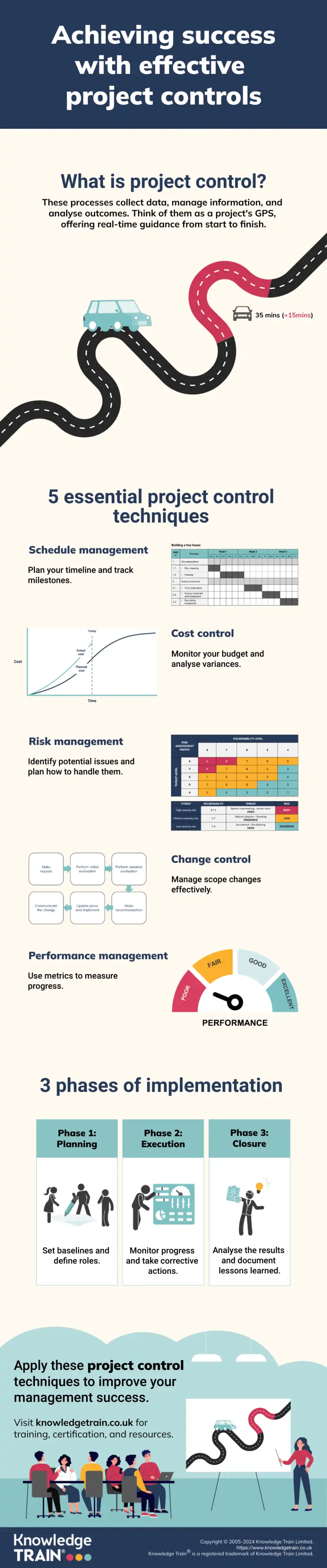
Project controls are methods and processes that help you collect data, process it and analyse results. They help you predict, understand and positively influence time and cost aspects of a project . They provide valuable information to make decisions throughout the project lifecycle.
Role within project management
Project controls are the navigational system in project management. They help project managers :
- Know project status at any time
- Forecast outcomes
- Spot deviations from the plan
- Recommend actions to correct the course.
Key components of project controls
These are the main components of project controls:
- Planning and schedulingCopied!
- Cost estimation and controlKey takeaways
- Risk assessment and managementITIL v3 certification progresses through staged exams and credit points, with options to bridge into ITIL 4.
- Change controlStart with ITIL v3 Foundation, which introduces service management and the ITIL lifecycle and awards 2 credits.
- Performance monitoring and reporting.ITIL Practitioner focuses on applying ITIL and CSI, is open book, and awards 3 credits.
Differences between project controls and project managementIntermediate modules build specialist knowledge and help you accumulate credits towards Expert level.
While ITIL Expert requires 22 credits and passing the MALC exam to prove integrated, real-world capability.project managementITIL Master is experience-based, requires Expert plus five years in senior ITSM roles, and is assessed via practical assignments. is the top level of the project, project controls focus on:
- Time and cost aspects
- Data processing and reporting
- Performance measurementContents
- Predictive modelling.
Project controls provide project managersContents with valuable insights and recommendations. This allows project managersIntroduction to make informed decisions and steer projects towards successful completion.
Essential project control techniques£1,599 +vat
Schedule management
Timeline developmentSee all dates
timeline development means creating a project schedule. This involves identifying tasks, estimating durations and developing dependencies. Use a Gantt chart to visualise the project timelineInstructor-led and the critical path.ITIL 4 Strategist Direct, Plan & Improve (DPI)
Milestone tracking
Track£1,799 +vat milestonesSee all dates to see how your project progresses towards its objectives. Review and update milestones regularly to see how your project is progressing. Milestones give you an easy-to-read indicator of the health of your project.Studying for ITIL v3
Cost controlYou can study for
Budget planningITIL v3 certification
Competence and training.They can enrol in a classroom or online course. To gain
ITIL Foundation certification
they must pass the ITIL Foundation exam.
If you become ITIL certified at Foundation level, you can then consider pursuing higher ITIL certifications.
ITIL Foundation is worth 2 credit points.
2. ITIL v3 Practitioner certificationITIL Practitioner certification teaches you how to apply the ITIL framework. It does it by:Explaining the Continual Service Improvement (CSI) approach to structure improvement initiatives;
Earned Value Management (EVM)Covering three key areas crucial for improvement initiatives:
Apply Organizational Earned Value ManagementChange Management (EVM) techniques to measure project performance objectively. This method integrates scope, schedule and cost metrics to provide an overview of project status.;
Implementing project controlsMeasurement and Metrics;
Project planning phaseCommunication.
Establishing baselinesITIL v3 Foundation or an ITIL 4 Foundation certificate is a perquisite for the ITIL Practitioner exam. ITIL Practitioner is not a prerequisite for the ITIL v3 Intermediate level certifications.
Start with establishing The ITIL Practitioner examination is open book and consists of multiple-choice questions based on a scenario. projectITIL Practitioner is worth 3 credit points. 3. ITIL v3 Intermediate certificationsbaselines Intermediate levels come in two sets of modules: for scope, schedule and budget. These are the starting points of the project. They will be used to measure progress throughout the project lifecycle. Ensure that all stakeholders agree on the project baselines before moving forward. Service Lifecycle Modules (worth 3 credit points each):
Defining roles and responsibilities Service Strategy (SS);
Define Service Design (SD);roles and responsibilities Service Transition (ST); for the project control activities. Create a responsibility matrix to specify what each team member does. This will prevent confusion and ensure that you cover all control activities. Service Operation (SO);
Project execution phase Continual Service Improvement (CSI).
Monitoring and reporting Service Capability modules (worth 4 credit points each):
Implement Operational Support and Analysis (OSA);monitoring processes Planning, Protection and Optimization (PPO); to track the performance of the project. Define standard reporting templates that include key metrics and deviations. Regular reporting will help you stay transparent and enable quick decision making. Release, Control and Validation (RCV);
Corrective action implementation Service Offerings and Agreements (SOA).
When you identify deviations, implement ITIL intermediate certifications are a stepping stone from either Foundation or Practitioner and enable you to get sufficient credit points to gain Expert certification.corrective actions 4. ITIL v3 Expert certification quickly You can earn ITIL Expert certification after gaining 22 credit points. The way to do that is to sit a MALC (Managing Across the Lifecycle) Exam. MALC tests your ability to integrate your ITIL knowledge in real-world settings.. Establish a process for reviewing and approving corrective measures. Ensure that all corrective measures support the project goals and stakeholder expectations. Passing the MALC exam is worth 5 credit points. The MALC exam’s prerequisite is 17 credit points gained from either Lifecycle, Capability or Practitioner modules. 2 of the credit points must come from Foundation certification.
Project closure phase 5. ITIL v3 Master certification
Post-mortem analysis This certification shows that you can apply ITIL in an organisation. Every ITIL Master candidate will select a different range of personal experiences. That’s why there is no fixed syllabus for this qualification.
Conduct a In the exam, you must explain and justify:post-mortem analysis How you would select and apply elements of the ITIL Framework such as: to review the project control process. Evaluate how accurate your estimates were, how effective risk mitigation strategies were and how the project performed overall. ITIL knowledge; or,
Lessons learned documentation ITIL principles; or,
Document ITIL methods; or,lessons learned ITIL techniques; or, from the project control process. Find what worked and what needs improvement. Share this information across the organisation to improve project control efforts. supporting management techniques;
Applying project controls throughout all project phases will help you achieve better project results and improve organisational learning. to achieve desired business outcomes in one or more practical assignments.
Benefits of effective project controls£1,799 +vat
Improved project visibility
Effective project controls can significantly improve the See all dates visibility of a projectTransition from ITIL v3 to ITIL 4 . They give you an insight into the current status of the project, its performance metrics, and potential risks. With this insight, you can keep track of everything.There is no transition module to