
PRINCE2Identifying business needs and opportunities for improvement
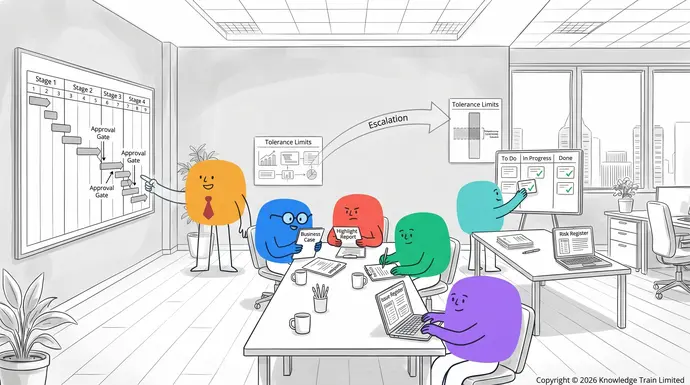
PRINCE2 meaningSupporting stakeholders in achieving strategic goals refers to a process based project management method that defines how to organise, manage and control a project from start to finish. It focuses on governance and accountability, requiring clear roles (such as the project board and project manager), continued Facilitating business justificationchange management, and management by stages with a stage plan. processes
In practice, PRINCE2 helps teams answer: why are we doing this (business case), who makes decisions (project board), what are we delivering (scope and products), how will we control risks (risk management), and how do we handle change (change control).Reducing project risk through clear requirements and solution assessment
Origin and governanceEnsuring solutions are feasible, cost-effective, and aligned with business requirements
PRINCE2 originated in the UK as a standard for managing projects, evolving from earlier PRINCE guidance and becoming widely adopted beyond information systems into general project management. The method is associated with the Portfolio, Programme, and Project best practice portfolio, and PRINCE2 examinations and certifications are delivered by PeopleCert.Business analysts enable informed decision-making, increase process efficiency, and help organisations remain competitive.
For governance and official updates, refer to the organisations that manage the framework and qualification delivery:Key responsibilities of a business analyst
- PeopleCertThe (exam institute delivering PRINCE2 certifications)business analyst
- Reference overview plays a critical role throughout project lifecycles and change initiatives. Their main responsibilities include: for history, terminology and structureRequirements elicitation:
Who should use PRINCE2? Facilitating workshops, interviews, and surveys to gather needs from stakeholders
PRINCE2 is designed for organisations that want a repeatable approach to project control and governance. It can be tailored to suit different sizes and levels of complexity, but it is especially common where transparency, auditability and decision rights matter.Requirements documentation:
- offers globally recognised certifications, such as Risk: identify, assess and control uncertainty through risk management.Business Analysis Foundation
- Change:, assess and control changes via change control (issues, requests, and off spec).International Diploma in Business Analysis
- Progress:, Practitioner certificates in track performance, manage tolerances and report by exception.Requirements Engineering
For more, read , PRINCE2 practicesModelling Business Processes., and
PRINCE2 processesBusiness Analysis Practices
The .7 processesThe describe the lifecycle of a PRINCE2 project. Each process includes activities and recommended management products to support control and decision making.International Institute of Business Analysis (IIBA)
- Starting up a project: offers globally recognised certifications, such as ECBA, CCBA, and CBAP, based on the confirm the project is viable and appoint key roles.BABOK Guide
- Directing a project:. the project board authorises initiation, stages, exceptions and closure.Certifications
- Initiating a project: demonstrate expertise in requirements elicitation, stakeholder management, and business analysis best practices. Aspiring business analysts may also pursue
- certifications
- Project manager: include BCS’s Business Analysis Foundation certificate, plans, delegates, monitors, controls and reports.International Diploma in Business Analysis
- Team manager:, and Practitioner certificates in Business Analysis Practices, Requirements Engineering, and Modelling Business Processes. manages specialist delivery within work packages.In addition, there are IIBA’s ECBA, CCBA, and CBAP, which validate knowledge of BABOK and proficiency in requirements elicitation, stakeholder engagement, and process improvement.
- Project Support and PMO (Project Management Office):How does business analysis differ from project management? supports administration, reporting, configuration and standards.Business analysis focuses on defining requirements and recommending solutions, while
How escalation works in practiceproject management
When time, cost, scope, quality, risk or benefit tolerances are forecast to be exceeded, the project manager escalates to the project board. This supports fast decisions while keeping routine control at the right level. is concerned with planning, executing, and
For a more in-depth description, read delivering projectsPRINCE2 roles and responsibilities within scope, time, and budget constraints..Subscribe to our exclusive offers and promotions
PRINCE2 management products
Management productsSubscribe now are the documents, registers and reports used to run and control a PRINCE2 project. They support governance, progress tracking, change control and risk management. Many organisations use templates to make these consistent across projects and the PMO.
Common management products
- Business case: documents business justification, costs, benefits, risks and value.
- Project brief: initial definition used to decide whether to initiate.
- Project initiation documentation: the baseline set of controls and plans for the project.
- Stage plan:
FAQs
What is PRINCE2 used for?What is a business analyst?
PRINCE2 is used for managing projects in a controlled way, with defined roles, decision points and documentation. It helps organisations maintain business justification through a business case, manage by stages using a stage plan, and apply consistent risk management and change control.
Is PRINCE2 still relevant?Simon Buehring
Yes. PRINCE2 remains widely used where governance, accountability and auditability are important, including public sector and regulated environments. It is also commonly tailored to work alongside Agile delivery methods, keeping PRINCE2 controls while enabling iterative delivery.19 Feb 2026
What are the 7 principles of PRINCE2?
The 7 principles are: continued business justification, learn from experience, defined roles and responsibilities, manage by stages, manage by exception, focus on products, and tailor to suit the project.Discover what a business analyst does and how they are pivotal in achieving company goals. Learn more about the role's importance here.
What are the 7 processes of PRINCE2?
The 7 processes are: starting up a project, directing a project, initiating a project, controlling a stage, managing product delivery, managing a stage boundary, and closing a project.
PRINCE2 vs PMP, what is the difference?
PRINCE2 is a prescriptive project management method with defined roles, stages and management products. PMP (Project Management Professional) is a certification based on PMI standards and the PMBOK Guide body of knowledge, focusing on a broad set of project management practices that can be applied in different ways depending on the organisation.
How long does PRINCE2 certification take?
Time varies by experience and study approach. Many learners prepare for PRINCE2 Foundation in a few days of focused study, and PRINCE2 Practitioner typically requires additional preparation to practise application and tailoring in scenario questions.
Is PRINCE2 certification hard?
Difficulty depends on familiarity with project management concepts and exam technique. Foundation tests knowledge of terms and structure, while Practitioner is more challenging because it tests applying the method in context, including tolerances, management products, change control and the business case.ISEB Business Analysis
What is the difference between Foundation and Practitioner?
PRINCE2 Foundation verifies you understand PRINCE2 concepts, principles, themes and processes. PRINCE2 Practitioner verifies you can apply and tailor PRINCE2 to a scenario, using appropriate controls, roles, management products, and stage based planning.Simon Buehring