
Key takeaways
Choose PPM tools and techniques that match how your organisation actually works and its maturity.
- Assess PPM maturity first, because expensive all-in-one tools can be wasted if adoption is low.
- Individual, collaborative, and integrated tools suit different ways of working and levels of data sharing.
- Embedded PPM tools improve efficiency, compliance, and the timeliness and quality of decision-making data.
- Common toolsets cover strategy mapping, EPM, architecture, knowledge, performance, risk, and requirements.
- Use prioritisation and dashboards to direct resources to strategically aligned work and highlight exceptions fast.
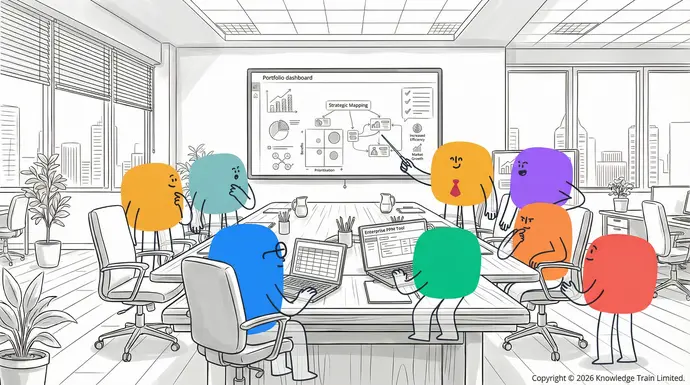
Introduction
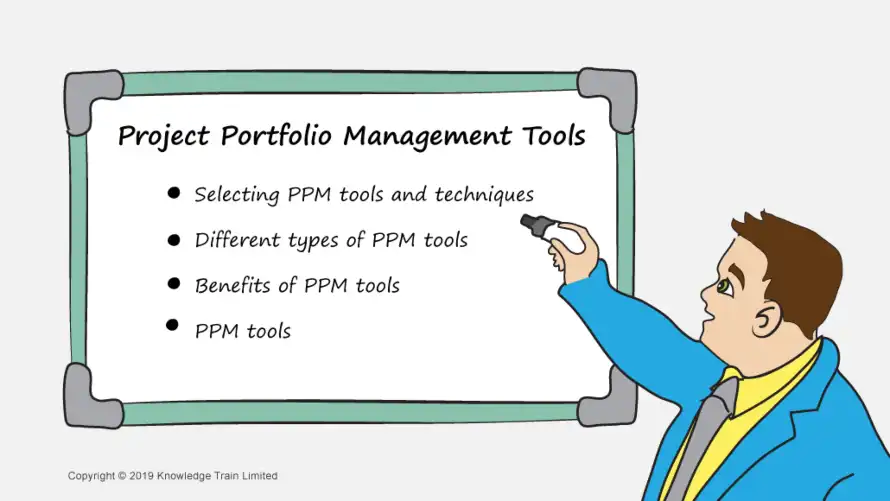
Selecting PPM tools and techniques
The PMO will normally select appropriate PPM tools and techniques. When doing so it is always best to consider the PPM maturity of the organisation. Tools can be expensive. Off-the-shelf packages doing everything can be tempting but can also be a waste of money if not used. It might be the case that a cheaper, simpler tool can be more effective than a more complex, more expensive tool.
Having said that, many PPM tools are built around best practices and unless the organisation has very specific requirements which require a custom-built solution, most package tools will be adequate for many organisations.
Different types of PPM tools
Tools can be deployed in a single office or distributed across the organisation. Tools can be used individually, collaboratively or in an integrated way. The PMO provides training on tools and can also provide specialist consultancy to projects , programmes , and portfolios for issues which arise from using PPM tools.
Individual tools
This is typically where a project manager uses a tool such as planning software or a spreadsheet on a single change initiative (programme or project). There might be several instances of the tool in use by different individuals. But each person uses it on a single change initiative.
Collaborative tools
This is where multiple people access a single set of data through a tool. There might be several instances of the tool across the organisation. Each change initiative will have multiple users collaborating through the tool.
Integrated tools
This is where many people can access multiple data sets spanning multiple change initiatives. There is usually a single instance of the tool and the ability of the tool to link data from multiple change initiatives. Enterprise project portfolio management
- Registered VAT: GB872413526.Improved compliance with business processes;
, or an project management officeagile project management course (PMO) plans, then this list of benefits could be considered as part of a to boost your career. business casePRINCE2®
PPM tools, ITIL
Tools to support portfolio, programme and ®project management, P3O are often chosen by the people responsible for managing the project management office (PMO), or enterprise PMO if it exists at the highest level within the organisation.®
The tools authorised for use by the , PRINCE2PMO® might be as common as desktop productivity software such as spreadsheets, or slide decks. They can equally be extremely sophisticated and wide-ranging tools. Agile, RESILIA
These are some of the collaborative and integrated toolsets available.®
Strategic mapping software, and the Swirl logo are registered trademarks of the PeopleCert group. Used under licence from PeopleCert. All rights reserved. AgilePM
These tools enable users to map ®programmes and AgileBA and ®projects are registered trademarks of Agile Business Consortium Limited. All rights reserved. The APMG International AgilePM and Swirl Device logo, APMG International AgileBA and Swirl Device Logo, APMG International Change Management and APMG International Better Business Cases and Swirl Device logo are trademarks of The APM Group Limited, used under permission of The APM Group Limited. All rights reserved. Better Business Cases™ is a trademark of Her Majesty’s Treasury. All rights reserved. DevOps Foundation to its resulting outputs, outcomes, benefits, and strategy.®
Enterprise PPM tools (EPM) is a registered mark of the DevOps Institute. “PMI”, “PMBOK
These are designed specifically to be used within enterprise PPM environments. They can capture plans, resources, risks, issues, and project documentation, including version control.®
Enterprise architecture tools Guide”, “PMP” and “CAPM” are registered marks of Project Management Institute, Inc. Knowledge Train Scrum Essentials™, Business Learning Library (BLL)™, Business Analysis Learning Library (BALL)™, Agile Learning Library (ALL)™, IT Learning Library (ITLL)™, and Compliance Learning Library (CLL)™ are trademarks of Knowledge Train Limited. All rights reserved.
These tools model the organisation’s business structure, processes and can map Knowledge Train Ltd is an Introducer Appointed Representative of NewDay Cards Ltd for the Newpay finance product provided by NewDay Ltd. NewDay Cards Ltd acts as a credit broker, not a lender. We will introduce you exclusively to Newpay finance products provided by NewDay Limited under this Introducer Appointed Representative arrangement. Finance available from other lenders is not covered by this arrangement. NewDay Ltd and Newday Cards Ltd are authorised and regulated by the Financial Conduct Authority (ref nos 690292 and 682417 respectively).projects from the current situation to the desired future situation (the change).
Knowledge management tools
These tools enable the sharing of information and learning from it. Some examples are wikis, FAQs, intranets.
Performance management tools
These tools align the expected project or programme performance with strategic objectives and track the actual performance.Search
Risk management tools
These enable a common, integrate and systematic approach to the identification and management of risks and issues.
Requirements management tools
These enable project scope to be defined by the capture, analysis, tracing, and prioritisation of detailed project requirements.
PPM techniques
The techniques applied within a PPM environment can be highly complex. When selecting appropriate tools and techniques to use, consideration must be given to the organisation’s maturity.Functional
Portfolio prioritisation and optimisation
This technique enables programmes and projectsFunctional to be categorised and ranked according to one or more criteria. The most common criteria are financial, strategic alignment, risk, and complexity.
This technique enables the organisation to take effective decision-making to direct resources at change initiatives which are more strategically aligned. Always active
Management dashboards
This technique highlights exception and highlight based reporting which enables senior management to quickly decide whether a change initiative is on track in terms of progress. A dashboard can be presented as part of a portfolio or programme status report, or it can be delivered electronically with the ability to drill-down into the data using a PPM software tool.
This technique is designed to quickly provide decision-makers with the clear information needed for timely and effective decision-making without getting overcome with the details.
If you work in a PMOThe technical storage or access is strictly necessary for the legitimate purpose of enabling the use of a specific service explicitly requested by the subscriber or user, or for the sole purpose of carrying out the transmission of a communication over an electronic communications network. and need to get a better understanding of the types of tools which can be useful in project, programme and portfolio environments, consider taking a P3O ® course. P3O is the best practice PMO framework for PMO professionals.
P3OPreferences® is a registered trademark of AXELOS Limited, used under permission of AXELOS Limited. All rights reserved.