
project manager to define an appropriate level of project governance and structured project management.
Responsibilities
- Provide a centre of expertise and develop consistent standards and procedures, templates and tailoring guidance. These should cover
- Project initiation;
- Risk analysis;
- Issue and change control analysis;
- Configuration management;
- Planning techniques;
- Methods and tools;
- Quality assurance;
- Project organisation structures.
- Brief project board and project assurance members on their roles and responsibilities;
- Provide a fast-track project support service;
- Design and support project reporting;
- Build and maintain a repository of good project documentation.
Project officer/coordinator/administrator
The purpose is to improve the planning and delivery process by collecting and maintaining data in a consistent form.
Responsibilities
- Implement guidelines, procedures and templates to collect and maintain consistent data;
- Facilitate the creation and update of project plans
- Manage or facilitate the quality review process;
- Provide a coordination service for the project.
Functional roles
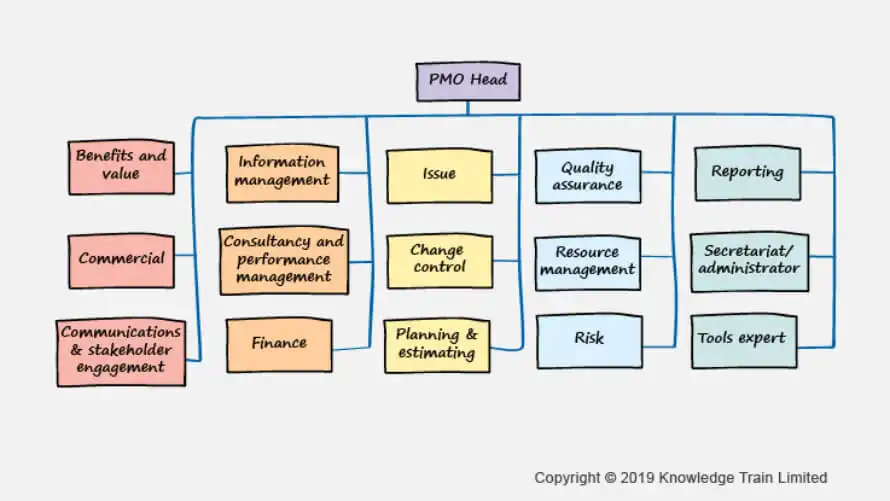
In addition to the role above, there are several functional roles which may be performed by either the project specialist or project officer roles. These are:
- Benefits and value – to ensure there is a consistent approach to benefits and value management on projects;
- Commercial – to ensure the organisation acts as an ‘informed customer’ when it comes to procurement and commercial contracts;
- Communications and stakeholder engagement – to ensure effective management of stakeholders;
- Information management – be the custodian of all master copies of project information;
- Consultancy and performance management – provide internal consultancy and expertise in project management processes ;
- Finance – establish professional financial control within projects;
- Issue – ensure effective issue control processes are in place on projects;
- Change control – ensure effective change control processes are in place on projects;
- Planning and estimating – facilitate the development and maintenance of project plans and dependencies;
- Quality assurance – ensure the projects’ products are capable of realizing the benefits expected;
- Resource management – ensure that current and future projects have the right human resources with the right skills at the right time and ensure those resources are used efficiently;
- Risk – ensure that projects have effective risk management processes in place;
- Reporting – collect data and generate reports to different stakeholders;
- Secretariat/administrator – provide project administrative support;
- Tools expert – provide expertise in software tools which can support the change environment.
References
[1] AXELOS (2013). Portfolio, Programme and Project Offices. Norwich: TSO. p8.
[2] AXELOS (2013). Portfolio, Programme and Project Offices. Norwich: TSO. pp149-150.P3O® is a registered trademark of AXELOS Limited, used under permission of AXELOS Limited. All rights reserved.