
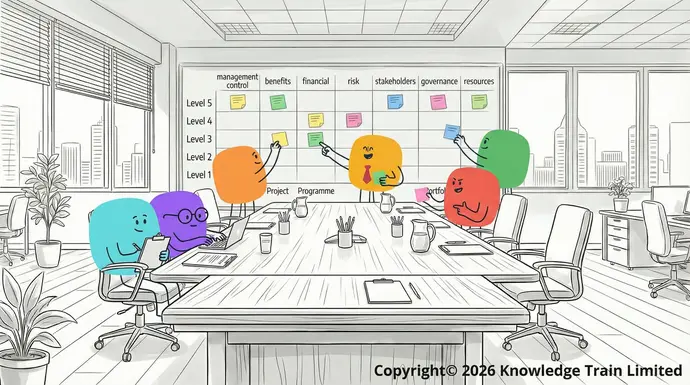
Imagine a global corporation embarking on an expansive digital transformation initiative. The firm would employ solid metrics to evaluate its projects’ performance, using tools like earned value analysis or risk trend analysis. Periodic assessment of these metrics empowers the management to base decisions on data and proactively adjust their tactics.
{title}This deals with the budget formulation, monitoring, and management of the monetary resources designated for the project, programme, or portfolio.
Risk management{title}
This focuses on identifying, evaluating, and handling risks that might hinder the successful completion of the project, programme, or portfolio.Manage consent
Stakeholder engagementManage consent
This focuses in on identifying stakeholders, understanding their requirements and expectations, and managing their engagement throughout the lifespan of the project, programme, or portfolio.
Organizational governance
This concerns the structure of rules, relationships, systems, and procedures through which authority is wielded and regulated within the project, programme, or portfolio.
Resource management
This entails planning, securing, and managing both human and material resources crucial for the successful delivery of the project, programme, or portfolio.
P3M3 assessment
A P3M3 evaluation comprises seven steps, each crafted to provide an in-depth insight into an organization’s capabilities in project, programme, and portfolio management.
Define the assessment scope
The initial step sets the stage by defining goals and objectives. It entails deciding the range of the assessment, such as the specific departments or projects to be examined and formulating clear objectives in sync with the organization’s overarching aims.
Form an assessment team
A team is constructed, typically composed of both in-house and external specialists. The makeup of this team should encapsulate a mix of technical know-how, management expertise, and P3M3-specific knowledge, ensuring a well-rounded evaluation.
Collect data
Here, the team consolidates all relevant data. Utilizing a blend of questionnaires, interviews, and document evaluations, they gather insights on the organization’s project, programme, and portfolio management protocols.
Analyse data
After collecting data, the information is examined to discern the organization’s proficiency across P3M3’s seven perspectives. This scrutiny is set against the model’s five designated maturity scales, offering a panoramic view of the organization’s capabilities.
Create assessment report
A comprehensive report is written by the assessment team, highlighting the organization’s prevailing maturity level, strengths, shortcomings, and areas of enhancement for each perspective. The current maturity standing acts as a reference for tracking ensuing improvements.
Review report
The assessment team presents and discusses the findings with the organization’s primary stakeholders. This ensures clarity regarding the insights and the suggested enhancement pathways.
Formulate a development plan
Drawing from the benchmarks in the assessment summary, a strategy is crafted to steer the organization towards advanced maturity tiers. Typically, this strategy is developed in collaboration with stakeholders, ensuring it’s in line with the organization’s strategic vision and its preparedness for evolution. Progress, regarding maturity elevation, will be gauged against this set benchmark.
It’s worth pointing out that the P3M3 assessment process is not something to be done once, and then forgotten. Instead, it should be a continuous journey of improvement, with further assessments being repeated at regular intervals.
Case Study: TechnoTech
TechnoTech, a budding technology firm, struggled with unpredictable project outcomes, inconsistent processes, and reactive solutions. Recognizing the need for structured project management, they opted for a P3M3 assessment to comprehend their current position.
Initial assessment – Level 1
The first assessment showed that TechnoTech only had a rudimentary grasp of project management. Processes were applied sporadically, often depending on individual project managers’ preferences. For instance, while their cloud integration project had some semblance of planning due to an experienced manager, their IoT integration wing functioned chaotically, reacting to issues as they cropped up.
Transition
Determined to improve, over the next 9 months, TechnoTech initiated the following actions based on the P3M3 assessment recommendations:
Standardized processes
TechnoTech hired external project management consultants to help develop standardized guidelines across all projects, ensuring uniformity regardless of the project or manager.
Training
All staff underwent training to familiarize them with these processes, ensuring a unified approach to project management.
Metrics
Key performance indicators were introduced to measure project progress, enabling data-driven decision-making.
Level 2 Achievement
After the earlier transition steps were completed, a 2nd assessment was done which evaluated the company at level 2 because it exhibited a structured approach to projects. However, while processes were standardized, their application varied, leading to discrepancies in project outcomes. Regular internal audits pinpointed these inconsistencies, marking a need for deeper analysis and metrics evaluation.
Transition
Over the following 6 months, TechnoTech performed further steps to help improved its capabilities.
Quantitative management
TechnoTech began capturing and analyzing data systematically, evaluating project health through metrics like risk trend analysis.
Feedback loops
Regular feedback sessions with project teams ensured real-time adjustments and continuous learning.
Stakeholder engagement
A concerted effort was made to involve all stakeholders, ensuring alignment with business objectives.
Level 3 Achievement
After a further 6 months, a 3rd assessment indicated that TechnoTech had reached Level 3 because it had begun to exhibit a well-defined and documented approach to project management. Every stakeholder, from managers to technicians, was well-versed with project guidelines, leading to cohesive execution. Their infrastructure projects, for instance, were not only executed in a timely manner but also adhered to cost and quality standards.
Conclusion
TechnoTech’s journey from Level 1 to Level 3 with P3M3 showcased the transformative power of structured project management. The firm, once grappling with inconsistency, became a beacon of efficiency, setting a precedent for its competitors.
P3M3 alternatives
There are several other project, programme, and portfolio management maturity level models, which are all similar to each another.
Capability Maturity Model Integration (CMMI)
CMMI is an updated version of the original Capability Maturity Model (CMM) and is applicable to a broader range of industries beyond software development.
Organizational Project Management Maturity Model (OPM3)
OPM3 from the Project Management Institute’s (PMI) features a four-tier maturity scale.
Berkeley Project Management Process Maturity Model
The Berkeley (PM)² Model uses a five-tier scale to assess the project management maturity based on the ten knowledge areas outlined in PMBOK.
PM Solutions Project Management Maturity Model (PMMMSM)
Similar to the Berkely model, PMMMSM from PM Solutions employs a five-tier scale to evaluate the maturity of the ten knowledge areas from the PMBOK.
The case for P3M3
As illustrated in this article, integrating P3M3 offers immense advantages to an organization. By bolstering project, programme, and portfolio management proficiencies, it significantly heightens the likelihood of successful change initiatives.
Beyond mere project outcomes, it enhances overall organizational capability and excellence, charting a clear pathway towards maturation. Furthermore, P3M3 instils a rich culture of perpetual learning and refinement, ensuring organizations remain agile and future-ready.